Famous Givers and Their Gifts
Sarah Knowles Bolton
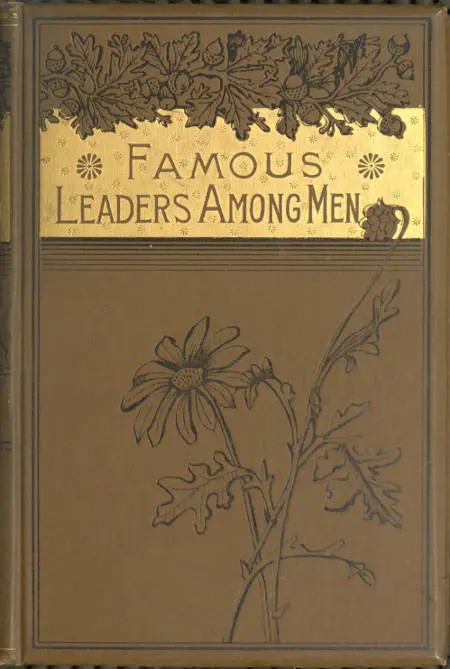
THE CLASSIC COLLECTION · 1894
"Famous Leaders Among Men" by Sarah Knowles Bolton is a historical account written in the late 19th century. The book explores the lives and accomplishments of notable figures who achieved leadership and prominence through their own determination and energy, emphasizing the factors that contributed to their greatness. The introductory sections lay a foundation for a series of biographical sketches of influential leaders from various fields. The opening of the work presents a preface that underscores the idea that remarkable individuals often rise from humble beginnings through sheer willpower and hard work. It highlights examples such as Napoleon Bonaparte, Horatio Nelson, and John Bunyan, illustrating how their initial struggles and relentless energy set the stage for their future successes. The preface hints at a detailed exploration of each figure's unique qualities, struggles, and the circumstances that allowed them to become prominent leaders, establishing the inspirational tone of the book.
Introduction adapted from the source catalogue; source summaries may be automatically generated.
Free to read · English · 117,612 words · No account needed
MAKE TIME FOR A GOOD BOOK
On by default. Untick to stop anonymous reading totals. Each page counts after 10 seconds in view. How this works.
Anonymous counting is on unless you have switched it off.
He preached his first sermon in a little hamlet called Sharon, two or three miles from the seminary, urged to go thither by a classmate. The people were mostly poor whites and negroes, who, being plain themselves, enjoyed the plain preaching. The schoolhouse was soon crowded, and more came than could be accommodated.
His classmate told, at his home in Philadelphia, of this good work. The Church of the Advent in that city needed a rector. A committee came to hear Brooks, of course without his knowledge, were delighted, and called him to their poor parish.
Fearful that he would not give satisfaction, young Brooks, now twenty-four years of age, consented to preach for three months, and at the end of that time accepted the call for a year, at a salary of one thousand dollars.
"The dissatisfaction with his work," says Dr. Arthur Brooks, "and the eagerness to press on to something better and more complete, while all the time men were praising what he had done, was always a recognized feature of his power."
Fortunately for young Brooks, Dr. Vinton had moved to Philadelphia, and had become rector of the Church of the Holy Trinity, in a wealthy part of the city.
Not forgetting his former parishioner, he invited the young preacher to occupy his pulpit Sunday afternoons. Both here and at the Advent, Phillips Brooks soon won a place in the hearts and lives of his hearers.
Dr. Vinton was called to St. Mark 's Church, in New York, and Phillips Brooks was asked to take his place at the Holy Trinity. He did not accept till invited the third time, and finally became rector Jan. 1, 1862, when he was twenty-seven.
During Phillips Brooks's ten years in Philadelphia, he took a fearless stand for the colored people, and in all that related to the Civil War.
When the three months' men were called out to defend Philadelphia from a feared attack of the Confederates, young Brooks, with a shovel on his shoulder, was in the van to help throw up earthworks.
In his Thanksgiving sermon, Nov. 26, 1863, he thanked God "that the institution of African slavery in our beloved land is one big year nearer to its inevitable death than it was last Thanksgiving Day."
When Abraham Lincoln lay dead at Independence Hall, in the journey from Washington to Springfield, Ill., Phillips Brooks preached a noble sermon, April 23, 1865. Many have recalled these words, which might be written of himself, now that he has gone from us.
Your reading position is saved on this browser. Take it to another device with a library code. Reading pages adapt to text, rather than matching a printed edition.
Sarah Knowles Bolton
Sarah Knowles Bolton
Sarah Knowles Bolton
Sarah Knowles Bolton
BEHIND THE BOOK
This eBook is for the use of anyone anywhere in the United States and most other parts of the world at no cost and with almost no restrictions whatsoever. You may copy it, give it away or re-use it under the terms of the Project Gutenberg License included with this eBook or online at www.gutenberg.org. If you are not located in the United States, you will have to check the laws of the country where you are located before using this eBook. Read the source licence.
The original source file, including credits and licence, is retained by this library. Request an original-format copy at no charge. Please include the book title and Project Gutenberg identifier #57666.
KEEP YOUR CURIOSITY GOING
Cécile Tormay

Moritz Busch
John L. Ransom
Frances Wright
Cécile Tormay

Mabel Potter Daggett