
The Snake’s Pass
Bram Stoker
THE CLASSIC COLLECTION · 1910
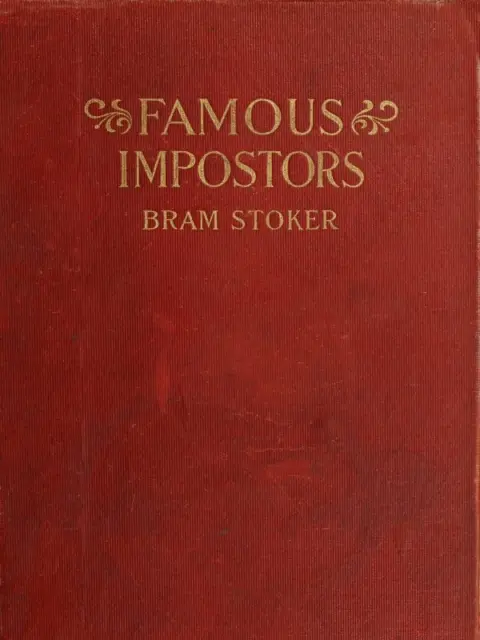
"Famous Impostors" by Bram Stoker is a non-fiction book published in 1910. The Dracula author's final work explores a fascinating gallery of historical deceptions, from royal pretenders like Perkin Warbeck to practitioners of magic such as Cagliostro. The collection examines women who disguised themselves as men, infamous hoaxes that fooled entire cities, and controversial claims including the theory that Queen Elizabeth I was secretly male. Each case reveals humanity's enduring capacity for both elaborate deception and willing belief.
Introduction adapted from the source catalogue; source summaries may be automatically generated.
Free to read · English · 78,460 words · No account needed
MAKE TIME FOR A GOOD BOOK
On by default. Untick to stop anonymous reading totals. Each page counts after 10 seconds in view. How this works.
Anonymous counting is on unless you have switched it off.
After a time La Voisin’s vogue as a sorceress brought her into certain high society where freedom of action was unhampered by moral restraints. The very rich, the leaders of society and fashion of the time, the unscrupulous whose ambitious efforts had been crowned with success of a kind, leaders of Court life, those in high military command, mistresses of royalty and high aristocracy--all became companions and clients in one or more of her mysterious arts. Amongst them were the Duchesse de Bouillon, the Comtesse de Soissons, Madame de Montespan, Olympe de Mancini, Marshal de Luxembourg, the Duc de Vendôme, Prince de Clermont-Lodeve. It was not altogether fashionable not to be in touch with Madame Voisin. Undeterred by the lessons of history, La Voisin went on her way, forced as is usual in such cases by the circumstances which grow around the criminal and prove infinitely the stronger. She was at the height of her success when the public suspicion, followed by action, revealed the terrible crimes of the Marquise de Brinvilliers; and she was caught in the tail of the tempest thus created.
This case of Madame de Brinvilliers is a typical one of how a human being, goaded by passion and lured by opportunity, may fall swiftly from any estate. It is so closely in touch with that of Madame Voisin that the two have almost to be considered together. They began with the desire for dabbling in forbidden mysteries. Three men--two Italians and one German, all men of some ability--were violent searchers for the mythical “philosopher’s stone” which was to fulfil the dream of the mediæval alchemist by turning at will all things into gold. In the search they all gravitated to Paris. There the usual thing happened. Money ran short and foolish hoping had to be supplemented by crime. In the whirling world of the time there was always a ready sale for means to an end, however nefarious either might be. The easy morality of the time allowed opportunity for all means, with the result that there was an almost open dealing in poisons. The soubriquet which stole into existence--it dared not proclaim itself--is a self-explanatory historical lesson. The poudre de succession marks an epoch which, for sheer, regardless, remorseless, profligate wickedness is almost without peer in history, and this is said without forgetting the time of the Borgias. Not even natural affection or family life or individual relationship or friendliness was afforded any consideration. This phase of crime, which was one almost confined to the upper and wealthier classes, depended on wealth and laws of heredity and entail. Those who benefited by it salved what remnants of conscience still remained to them with the thought that they were but helping the natural process of waste and recuperation. The old and feeble were removed, with as little coil as might be necessary, in order that the young and lusty might benefit. As the change was a form of plunder, which had to be paid for in a degree in some way approximate to results, prices ran high. Poisoning on a successful scale requires skilful and daring agents, whose after secrecy as well as whose present aid has to be secured. Exili and Glasser--one of the Italians and the German--did a thriving trade. As usual in such illicit traffic, the possibility of purchase under effective conditions made a market. There is every reason to believe from after results that La Voisin was one such agent. The cause of La Brinvilliers entering the market was the purely personal one of an affair of sensual passion. Death is an informative circumstance. Suspicion began to leak out that the polyglot firm of needy foreigners had dark dealings. Two of them--the Italians--were arrested and sent to the Bastille where one of them died. By unhappy chance the other was given as cell-companion Captain Sainte-Croix, who was a lover of the Marquise de Brinvilliers. Sainte-Croix as a Captain in the regiment of the Marquis had become intimate in his house. Brinvilliers was a fatuous person and of imperfect moral vision. The Captain was handsome, and Madame la Marquise amorous. Behold then all the usual personnel of a tragedy of three. After a while the intrigue became a matter of family concern. The lady’s father,--the Civil Lieutenant d’Aulroy, procured a lettre de cachet, and had the erring lover immured in the Bastille as the easiest and least public way out of the difficulty. “Evil communications corrupt good manners,” says the proverb. The proverbial philosopher understated the danger of such juxtaposition. Evil manners added corruption even to their kind. In the Bastille the exasperated lover listened to the wiles of Exili; and another stage of misdoing began. The Marquise determined on revenge, and be sure that in such a case in such a period even the massive walls of the Bastille could not prevent the secret whisper of a means of effecting it. D’Aulroy, his two sons, and another sister perished. Brinvilliers himself was spared through some bizarre freak of his wife’s conscience. Then the secret began to be whispered--first, it was said, through the confessional; and the Chambre Ardente, analogous to the British Star Chamber, instituted for such purposes, took the case in hand. The result might have been doubtful, for great social forces were at work to hush up such a scandal, but that, with a truly seventeenth century candour, the prisoner had written an elaborate confession of her guilt, which if it did not directly assure condemnation at least put justice on the right track.
Your reading position is saved on this browser. Take it to another device with a library code. Reading pages adapt to text, rather than matching a printed edition.
Bram Stoker
Bram Stoker
Bram Stoker

Bram Stoker
BEHIND THE BOOK
This eBook is for the use of anyone anywhere in the United States and most other parts of the world at no cost and with almost no restrictions whatsoever. You may copy it, give it away or re-use it under the terms of the Project Gutenberg License included with this eBook or online at www.gutenberg.org. If you are not located in the United States, you will have to check the laws of the country where you are located before using this eBook. Read the source licence.
The original source file, including credits and licence, is retained by this library. Request an original-format copy at no charge. Please include the book title and Project Gutenberg identifier #51391.
KEEP YOUR CURIOSITY GOING
Cécile Tormay

Moritz Busch
John L. Ransom
Frances Wright
Cécile Tormay

Mabel Potter Daggett