The Snake’s Pass
Bram Stoker
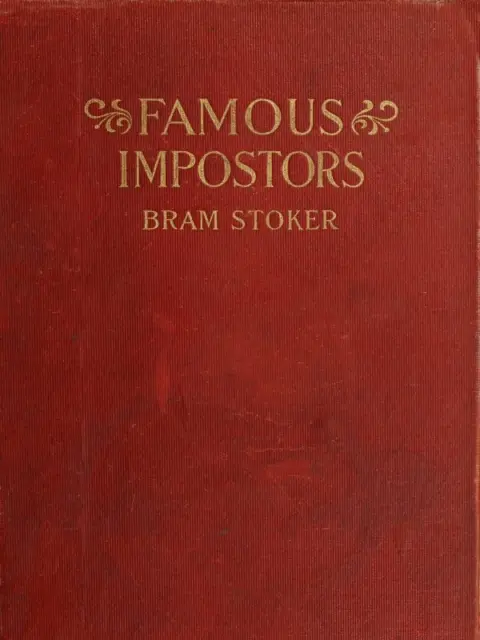
THE CLASSIC COLLECTION · 1910
"Famous Impostors" by Bram Stoker is a non-fiction book published in 1910. The Dracula author's final work explores a fascinating gallery of historical deceptions, from royal pretenders like Perkin Warbeck to practitioners of magic such as Cagliostro. The collection examines women who disguised themselves as men, infamous hoaxes that fooled entire cities, and controversial claims including the theory that Queen Elizabeth I was secretly male. Each case reveals humanity's enduring capacity for both elaborate deception and willing belief.
Introduction adapted from the source catalogue; source summaries may be automatically generated.
Free to read · English · 78,460 words · No account needed
MAKE TIME FOR A GOOD BOOK
On by default. Untick to stop anonymous reading totals. Each page counts after 10 seconds in view. How this works.
Anonymous counting is on unless you have switched it off.
John Dee was born in 1527, and came of a Welsh race. A good many years after his start in life he, after the harmless fashion of those (and other) times, made out a family tree in which it was shewn that he was descended from, among other royalties, Roderick the Great, Prince of Wales. This little effort of vanity did not, however, change anything. The world cared then about such things almost as little as it does now; or, allowing for the weakness of human beings in the way of their own self-importance, it might be better to say as it professes to do now. John Dee was sent to the University of Cambridge when he was only fifteen years old. The College chosen for him was St. John’s, and here he showed extraordinary application in his chosen subject, mathematics. He took his probationary degree of Bachelor of Arts in 1545, and was made a Fellow in 1546. In his early years of College life his work was regulated in a remarkable way. Out of the twenty-four hours, eighteen were devoted to study, four to sleep, the remaining two being set apart for meals and recreation. Lest this should seem incredible it may be remembered that three hundred years later, the French Jesuits, having made exhaustive experiments, arrived at the conclusion that for mere purposes of health, without making any allowance for the joy or happiness of life, and treating the body merely as a machine from which the utmost amount of work mental and physical could be got without injury, four hours of sleep per diem sufficed for health and sanity. And it is only natural that a healthy and ambitious young man trying to work his way to success would, or might have been, equally strenuous and self-denying. His appointment as Fellow of St. John’s was one of those made when the College was founded. That he was skilled in other branches of learning was shown by the fact that in the University he was appointed as Under Reader in Greek. He was daring in the practical application of science, and during the representation of one of the comedies of Aristophanes, created such a sensation by appearing to fly, that he began to be credited by his companions with magical powers. This was probably the beginning of the sinister reputation which seemed to follow him all his life afterwards. When once an idea of the kind has been started even the simplest facts of life and work seem to gather round it and enlarge it indefinitely. So far as we can judge after a lapse of over three hundred years, John Dee was an eager and ardent seeker after knowledge; and all through his life he travelled in the search wherever he was likely to gain his object. It is a main difficulty of following such a record that we have only facts to follow. We know little or nothing of motives except from results, and as in the development of knowledge the measure of success can only bear a small ratio to that of endeavour, it is manifest that we should show a large and tolerant understanding of the motives which animate the seeker for truth. In the course of his long life John Dee visited many lands, sojourned in many centres of learning, had relations of common interests as well as of friendship with many great scholars, and made as thinker, mathematician, and astronomer, a reputation far transcending any ephemeral and purely gaseous publicity arising from the open-mouthed wonder of the silly folk who are not capable of even trying to understand things beyond their immediate ken. Wherever he went he seems to have been in touch with the learned and progressive men of his time, and always a student. At various times he was in the Low Countries, Louvain (from whose University he obtained the degree of LL.D.), Paris, Wurtemberg, Antwerp, Presburg, Lorraine, Frankfort-on-the-Oder, Bohemia, Cracow, Prague, and Hesse-Cassel. He even went so far afield as St. Helena. He was engaged on some great works of more than national importance. For instance, when in 1582, Pope Gregory XIII instituted the reform of the Calendar which was adopted by most of the great nations of the world, Dee approved and worked out his own calculations to an almost similar conclusion, though the then opposition to him cost England a delay of over one hundred and seventy years. In 1572 he had proved his excellence as an astronomer in his valuable work in relation to a newly discovered star (Tycho Brahe’s) in Cassiopœia. In 1580 he made a complete geographical and hydrographical map of the Queen’s possessions. He tried--but unhappily in vain--to get Queen Mary to gather the vast collections of manuscripts and old books which had been made in the Monasteries (broken up by Henry VIII) of which the major part were then to be obtained both easily and cheaply. He was a Doctor of Laws (which by the way was his only claim to be called “Doctor” Dee, the title generally accorded to him). He was made a rector in Worcestershire in 1553; and in 1556, Archbishop Parker gave him ten years’ use of the livings of Upton and Long Leadenham. He was made Warden of Manchester College in 1595, and was named by Queen Elizabeth as Chancellor of St. Paul’s. In 1564, he was appointed Dean of Gloucester, though through his own neglect of his own interest it was never carried out. The Queen approved, the Archbishop sealed the deed; but Dee, unmindful, overlooked the formality of acceptance and the gift eventually went elsewhere. Queen Elizabeth, who consistently believed in and admired him, wanted to make him a bishop, but he declined the responsibility. For once the formality at consecration: “Nolo Episcopari” was spoken with truthful lips. More than once he was despatched to foreign places to make special report in the Queen’s service. That he did not--always, at all events--put private interest before public duty is shown by his refusal to accept two rectories offered to him by the Queen in 1576, urging as an excuse that he was unable to find time for the necessary duties, since he was too busily occupied in making calculations for the reformation of the Calendar. He seems to have lived a most proper life, and was twice married. After a long struggle with adversity in which--last despair of a scholar--he had to sell his books, he died very poor, just as he was preparing to migrate. At his death in 1608 he left behind him no less than seventy-nine works--nearly one for each year of his life. Just after the time of the Armada, following on some correspondence with Queen Elizabeth, he had returned to England after long and adventurous experiences in Poland and elsewhere, during which he had known what it was to receive the honours and affronts of communities. He took back with him the reputation of being a sorcerer, one which he had never courted and which so rankled in him that many years afterwards he petitioned James I to have him tried so that he might clear his character.
Your reading position is saved on this browser. Take it to another device with a library code. Reading pages adapt to text, rather than matching a printed edition.
Bram Stoker
Bram Stoker
Bram Stoker
Bram Stoker
BEHIND THE BOOK
This eBook is for the use of anyone anywhere in the United States and most other parts of the world at no cost and with almost no restrictions whatsoever. You may copy it, give it away or re-use it under the terms of the Project Gutenberg License included with this eBook or online at www.gutenberg.org. If you are not located in the United States, you will have to check the laws of the country where you are located before using this eBook. Read the source licence.
The original source file, including credits and licence, is retained by this library. Request an original-format copy at no charge. Please include the book title and Project Gutenberg identifier #51391.
KEEP YOUR CURIOSITY GOING
Cécile Tormay

Moritz Busch
John L. Ransom
Frances Wright
Cécile Tormay

Mabel Potter Daggett