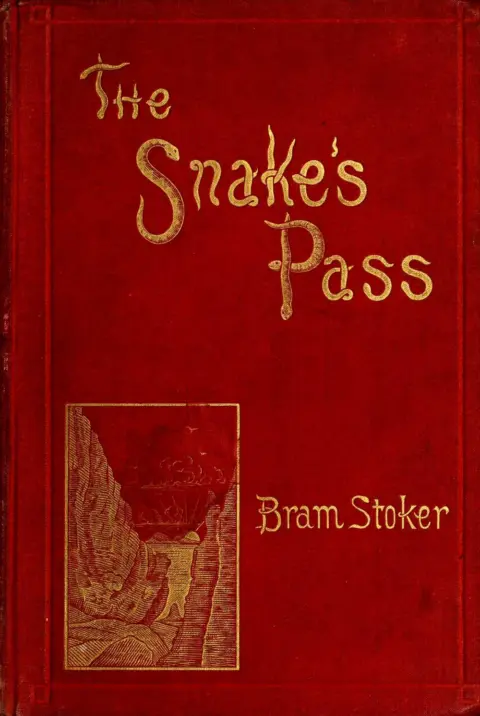
The Snake’s Pass
Bram Stoker
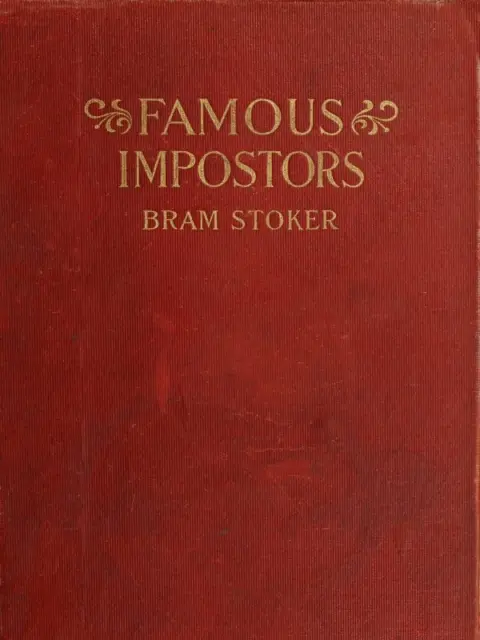
THE CLASSIC COLLECTION · 1910
"Famous Impostors" by Bram Stoker is a non-fiction book published in 1910. The Dracula author's final work explores a fascinating gallery of historical deceptions, from royal pretenders like Perkin Warbeck to practitioners of magic such as Cagliostro. The collection examines women who disguised themselves as men, infamous hoaxes that fooled entire cities, and controversial claims including the theory that Queen Elizabeth I was secretly male. Each case reveals humanity's enduring capacity for both elaborate deception and willing belief.
Introduction adapted from the source catalogue; source summaries may be automatically generated.
Free to read · English · 78,460 words · No account needed
MAKE TIME FOR A GOOD BOOK
On by default. Untick to stop anonymous reading totals. Each page counts after 10 seconds in view. How this works.
Anonymous counting is on unless you have switched it off.
It was not, however, through his alleged sorcery that Cagliostro crept into a place in history; but by the association of his name with a sordid crime which involved the names of some of the great ones of the earth. The story of the Queen’s Necklace, though he was acquitted at the trial which concluded it, will be remembered when the vapourings of the unscrupulous quack who had escaped a thousand penalties justly earned, have been long forgotten. Such is the irony of history! The story of the necklace involved Marie Antoinette, Cardinal Prince de Rohan, Comte de la Motte--an officer of the private guard of “Monsieur” (the Comte d’Artois), his wife Jeanne de Valois, descended from Henry II through Saint-Remy, his natural son and Nicole de Savigny. Louis XV had ordered from MM. Boemer et Bassange, jewellers to the Court of France, a beautiful necklace of extraordinary value for his mistress Madame du Barry, but died before it was completed. The du Barry was exiled by his successor, so the necklace remained on the hands of its makers. It was, however, of so great intrinsic value that they could not easily find a purchaser. They offered it to Marie Antoinette for one million eight hundred thousand livres; but the price was too high even for a queen, and the necklace remained on hand. So Boemer showed it to Madame de la Motte and offered to give a commission on the sale to whoever should find a buyer. She induced her husband, Comte de la Motte, to join with her in a plot to accomplish the sale. De la Motte was a friend of Cagliostro, and he too was brought in as he had influence with the Cardinal Prince de Rohan whom they looked on as a likely person to be of service. He had his own ambitions to acquire influence over the queen and use her for political purposes as Mazarin had used Anne of Austria. De Rohan was then a man of fifty--not considered much of an age in these days, but the Cardinal’s life had not made for comparative longevity. He was in fact something of that class of fool which has no peer in folly--an old fool; and Jeanne de la Motte fooled him to the top of his bent. She pretended to him that Marie Antoinette was especially friendly to her, and shewed him letters from the queen to herself all of which had been forged for the purpose. As at this time Madame de la Motte had borrowed or otherwise obtained from the Cardinal a hundred and twenty thousand livres, she felt assured he could be used for the contemplated fraud. She probably had not ever even spoken to the queen but she was not scrupulous in such a small matter as one more untruth. She finally persuaded him that Marie Antoinette wished to purchase the necklace through his agency, he acting for her and buying it in her name. To aid in the scheme she got her pet forger, Retaux de Vilette, to prepare a receipt signed “Marie Antoinette de France.” The Cardinal fell into the trap and obtained the jewel, giving to Boemer four bills due successively at intervals of six months. At Versailles de Rohan gave the casket containing the necklace to Madame de la Motte, who in his presence handed it to a valet of the royal household for conveyance to the queen. The valet was none other than the forger Retaux de Vilette. Madame de la Motte sent to the Cardinal a letter by the same forger asking him to meet her (the queen) in the shrubbery at Versailles between eleven o’clock and midnight. To complete the deception a girl was procured, one Olivia, who in figure resembled the queen sufficiently to pass for her in the dusk. The meeting between de Rohan and the alleged queen was held at the Baths of Apollo--to the deception and temporary satisfaction of the ambitious churchman. When the first instalment for the purchase of the necklace was due, Boemer tried to find out if the queen really had possession of the necklace--which had in the meanwhile been brought to London, it was said, by Comte de la Motte. As Boemer could not manage to get an audience with the queen he came to the conclusion that he had been robbed, and made the matter public. This was reported to M. de Breteuil, Master of the King’s household, and an enemy of de Rohan. De Breteuil saw the queen secretly and they agreed to act in concert in the matter. Louis XVI asked for details of the purchase from Boemer, who told the truth so far as he knew it, producing as a proof the alleged receipt of the queen. Louis pointed out to him that he should have known that the queen did not sign after the manner of the document. He then asked de Rohan, who was Grand Almoner of France, for his written justification. This being supplied, he had him arrested and sent to the Bastille. Madame de la Motte accused Cagliostro of the crime, alleging that he had persuaded de Rohan to buy the necklace. She was also arrested as were Retaux de Vilette, and, later on at Brussels, Olivia, who threw some light on the fraud. The King brought the whole matter before Parliament, which ordered a prosecution. As the result of the trial which followed, Comte de la Motte and Retaux de Vilette were banished for life; Jeanne de la Motte was condemned to make amende honourable, to be whipped and branded with V on both shoulders, and to be imprisoned for life. Olivia and Cagliostro were acquitted. The Cardinal was cleared of all charges. Nothing seems to have been done for the poor jewellers, who, after all, had received more substantial injury than any of the others, having lost nearly two million livres.
Your reading position is saved on this browser. Take it to another device with a library code. Reading pages adapt to text, rather than matching a printed edition.
Bram Stoker
Bram Stoker
Bram Stoker
Bram Stoker
BEHIND THE BOOK
This eBook is for the use of anyone anywhere in the United States and most other parts of the world at no cost and with almost no restrictions whatsoever. You may copy it, give it away or re-use it under the terms of the Project Gutenberg License included with this eBook or online at www.gutenberg.org. If you are not located in the United States, you will have to check the laws of the country where you are located before using this eBook. Read the source licence.
The original source file, including credits and licence, is retained by this library. Request an original-format copy at no charge. Please include the book title and Project Gutenberg identifier #51391.
KEEP YOUR CURIOSITY GOING
Cécile Tormay

Moritz Busch
John L. Ransom
Frances Wright
Cécile Tormay

Mabel Potter Daggett