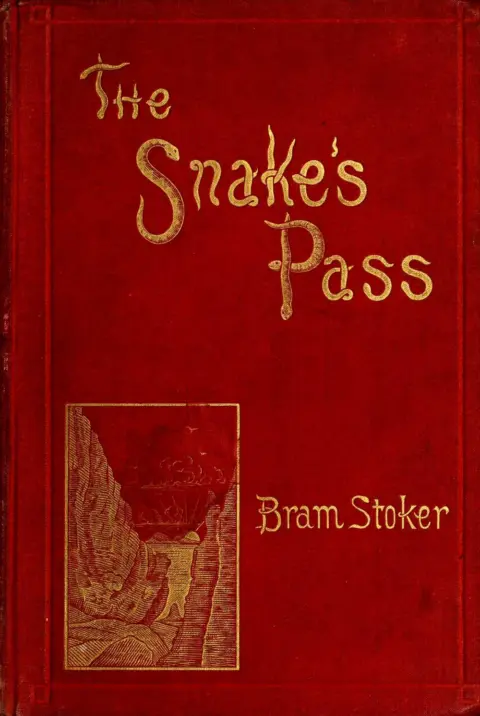
The Snake’s Pass
Bram Stoker
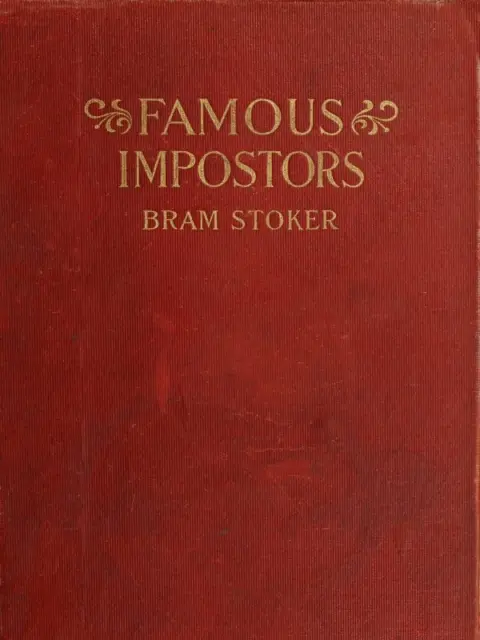
THE CLASSIC COLLECTION · 1910
"Famous Impostors" by Bram Stoker is a non-fiction book published in 1910. The Dracula author's final work explores a fascinating gallery of historical deceptions, from royal pretenders like Perkin Warbeck to practitioners of magic such as Cagliostro. The collection examines women who disguised themselves as men, infamous hoaxes that fooled entire cities, and controversial claims including the theory that Queen Elizabeth I was secretly male. Each case reveals humanity's enduring capacity for both elaborate deception and willing belief.
Introduction adapted from the source catalogue; source summaries may be automatically generated.
Free to read · English · 78,460 words · No account needed
MAKE TIME FOR A GOOD BOOK
On by default. Untick to stop anonymous reading totals. Each page counts after 10 seconds in view. How this works.
Anonymous counting is on unless you have switched it off.
From Malta he went to Rome where he employed himself in forging engravings. Like other criminals, great and small, Comte Alessandro Cagliostro--as he had now become by his own creation of nobility--had a faculty of working hard and intelligently so long as the end he aimed at was to be accomplished by crooked means. Work in the ordinary ways of honesty he loathed and shunned; but work as a help to his nefarious schemes seemed to be a joy to him. Then he set himself up as a wonder-worker, improving as he went on all the customs and tricks of that calling. He sold an elixir which he said had all the potency usually attributed to such compounds but with an added efficacy all its own. He pretended to be able to transmute metals and to make himself invisible; indeed to perform all the wonders of the alchemist, the “cheap jack,” and the charlatan. At Rome he became acquainted with and married a very beautiful woman, Lorenza de Feliciani, daughter of a lacemaker, round whom later biographers weave romances. According to contemporary accounts she seems to have been dowered with just such qualities as were useful in such a life as she had entered on. In addition to great and unusual beauty she was graceful, passionate, seductive, clever, plausible, soothing, and attractive in all ways dear and convincing to men. She must have had some winning charm which has lasted beyond her time, for a hundred years afterwards we find so level-headed a writer as Dr. Charles Mackay crediting her, quite unwarrantably with, amongst other good qualities, being a faithful wife. Her life certainly after her marriage was such that faithfulness in any form was one of the last things to expect in her. Her husband was nothing less than a swindler of a protean kind. He had had a great number of aliases before he finally fixed on Comte de Cagliostro as a nomme de guerre. He called himself successively Chevalier de Fischio, Marquis de Melina (or Melissa), Marquis de Pellegrini, Comte de Saint-German, Baron de Belmonte; together with such names as Fenix, Anna, Harat. He wrote a work somewhat of the nature of a novel called Le Grand Cophte--which he found useful later when he was pushing his scheme of a sort of new Freemasonry. After his marriage he visited several countries, Egypt, Arabia, Persia, Poland, Russia, Greece, Germany; as well as such towns as Naples, Palermo, Rhodes, Strasbourg, Paris, London, Lisbon, Vienna, Venice, Madrid, Brussels--in fact any place where many fools were crowded into a small space. In many of these he found use for the introductory letters of the Grand Master of the Knights of Malta, as well as those of other dupes from whom it was his habit to secure such letters before the inevitable crash came. Wherever he travelled he was accustomed to learn all he could of the manners, customs and facts of each place he was in, thus accumulating a vast stock of a certain form of knowledge which he found most useful in his chosen occupation--deceit. With regard to the last he utilised every form of human credulity which came under his notice. The latter half of the eighteenth century was the very chosen time of strange beliefs. Occultism became a fashion, especially amongst the richer classes, with the result that every form of swindle came to the fore. At this time Cagliostro, then nearing his fortieth year, began to have a widespread reputation for marvellous cures. As mysticism in all sorts of forms had a vogue, he used all the tricks of the cult, gathering them from various countries, especially France and Germany, where the fashion was pronounced. For this trickery he used all his knowledge of the East and all the picturesque aids to credulity which he had picked up during his years of wandering; and for his “patter,” such medical terminology as he had learned--he either became a doctor or invented a title for himself. This he interlarded with scraps of various forms of fraudulent occultism and all sorts of suggestive images of eastern quasi-religious profligacy. He took much of the imagery which he used in his rituals of fraud from records of ancient Egypt. This was a pretty safe ground for his purpose, for in his time the Egypt of the past was a sealed book. It was only in 1799 that the Rosetta stone was discovered, and more than ten years from then before Dr. Young was able to translate its three inscriptions--Hieroglyphic Demotic and Greek--whence Hieroglyphic knowledge had its source. Omne ignotum pro magnifico might well serve as a motto for all occultism, true or false. Cagliostro, whose business it was to deceive and mislead, understood this and took care that in his cabalistic forms Egyptian signs were largely mixed with the pentagon, the signs of the Zodiac, and other mysterious symbols in common use. His object was primarily to catch the eye and so arrest the intelligence of any whom he wished to impress. For this purpose he went about gorgeously dressed and with impressive appointments. In Germany for instance he always drove in a carriage with four horses with courier and equerries in striking liveries. Happily there is extant a pen picture of him by Comte de Beugnot who met him in Paris at the house of the Comtesse de la Motte:
Your reading position is saved on this browser. Take it to another device with a library code. Reading pages adapt to text, rather than matching a printed edition.
Bram Stoker
Bram Stoker
Bram Stoker
Bram Stoker
BEHIND THE BOOK
This eBook is for the use of anyone anywhere in the United States and most other parts of the world at no cost and with almost no restrictions whatsoever. You may copy it, give it away or re-use it under the terms of the Project Gutenberg License included with this eBook or online at www.gutenberg.org. If you are not located in the United States, you will have to check the laws of the country where you are located before using this eBook. Read the source licence.
The original source file, including credits and licence, is retained by this library. Request an original-format copy at no charge. Please include the book title and Project Gutenberg identifier #51391.
KEEP YOUR CURIOSITY GOING
Cécile Tormay

Moritz Busch
John L. Ransom
Frances Wright
Cécile Tormay

Mabel Potter Daggett