The Snake’s Pass
Bram Stoker
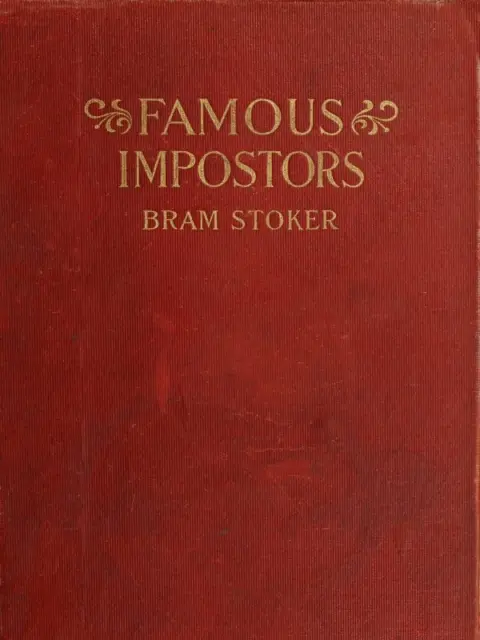
THE CLASSIC COLLECTION · 1910
"Famous Impostors" by Bram Stoker is a non-fiction book published in 1910. The Dracula author's final work explores a fascinating gallery of historical deceptions, from royal pretenders like Perkin Warbeck to practitioners of magic such as Cagliostro. The collection examines women who disguised themselves as men, infamous hoaxes that fooled entire cities, and controversial claims including the theory that Queen Elizabeth I was secretly male. Each case reveals humanity's enduring capacity for both elaborate deception and willing belief.
Introduction adapted from the source catalogue; source summaries may be automatically generated.
Free to read · English · 78,460 words · No account needed
MAKE TIME FOR A GOOD BOOK
On by default. Untick to stop anonymous reading totals. Each page counts after 10 seconds in view. How this works.
Anonymous counting is on unless you have switched it off.
Compare with this the letter of 16th March, 1554 to the Queen (Mary) written just as she was told to go to the Tower. In this letter which is beautifully written and with not a trace of agitation she protests her innocence of any plot. Her mental attitude was thoroughly borne out by a calm dignity of demeanour which is more in accord with male than female nature. In very fact Elizabeth appears all her life since 1544 to have been playing with great thoughtfulness and yet dexterity a diplomatic game--acting with histrionic subtlety a part which she had chosen advisedly.
A good idea of the personality of Elizabeth during the period beginning with 1544 may be had from a brief consideration of the risks which a person taking up such an imposture would run, first at the time of beginning the venture and then of sustaining the undertaken rôle. At the outset a boy of ten or eleven would not think of taking it seriously. At first he would look on it as a “lark” and carry out the idea with a serious energy only known in play-time. Later thought would give it a new charm in the shape of danger. This, while adding to his great zest, would sober him; thence on it would be a game--just such a game as a boy loves, perpetual struggle to get the best of someone else. To some natures wit against wit is a better strife than strength against strength, and if one were well equipped for such a fray the game would satisfy the ambition of his years. In any case when once such a game was entered on, the stake would be his own head--a consideration which must undoubtedly make for strenuous effort--even in boyhood.
The task which would have followed--which did follow if the Bisley story is true--would have been vastly greater. If the imposture escaped immediate detection--which is easily conceivable--a new kind of endeavour would have been necessary; one demanding the utmost care and perpetual vigilance in addition to the personal qualities necessary for the carrying out of the scheme. Little help could be given to the young boy on whom rested the weight of what must have appeared to all concerned in it a stupendous undertaking. From the nature of the task, which was one which even the faintest breath of suspicion would have ruined, the little band, originally involved, could gain no assistance. Safety was only possible by the maintenance of the most rigid secrecy. All around them were enemies served by a host of zealous spies. If then the story be true, those who carried such an enterprising situation to lasting success, must have been no common persons. Let us suppose for a moment that the story was true. In such case the Boy of Bisley who acted the part of the Princess Elizabeth could have had only two assistants--assistants even if they were only passive. Whatever may have happened we know from history that both Mrs. Ashley and Thomas Parry were ingrainedly loyal to Elizabeth, as she was to them. For convenience we shall speak of the substitute of the Princess as though he were the Princess herself whom he appeared to be, and for whom he was accepted thenceforth. That the imposture--if there was one--succeeded is a self-evident fact; for almost sixty years there was no question raised by any person of either sex and of any political opinion. The statecraft of England, France, the Papacy, and the German Empire were either unsuspicious or in error--or both. It is reasonable to imagine that a person of strong character and active intelligence might have steered deftly between these variously opposing forces. It is conceivable that in the case of a few individuals there might have been stray fragmentary clouds of suspicion; though if there were any they must have come to those who were held to a consequent inactivity by other dominating causes. We shall have occasion presently to touch on this subject but in the meantime we must accept it that there was no opinion expressed by any one in such a way as necessarily to provoke action. Of course after a time even suspicion became an impossibility. Here was a young girl growing into womanhood whom all around her had known all her life--or what was equivalent--believed they had. It is only now after three centuries that we can consider who it was that formed the tally of those who knew the personality of Elizabeth during both periods of her youth, that up to 1543-4 and that which followed. Henry VIII manifestly not only had no doubt on the subject but no thought. If he had had he was just the man to have settled it at once. Anne Boleyn was dead, so was her predecessor in title. Anne of Cleves had accepted the annulment of her marriage--and a pension. Jane Seymour and Catherine Howard were both dead. Nearly all those who as nurses, governesses, or teachers, Lady Bryan, Richard Croke, William Grindal, Roger Ascham, who knew the first period were dead or had retired into other spheres. Those who remained knowing well the individuality of the Princess and representing both periods were Mrs. Ashley, Thomas Parry and the Queen (later dowager) Catherine Parr.
Your reading position is saved on this browser. Take it to another device with a library code. Reading pages adapt to text, rather than matching a printed edition.
Bram Stoker
Bram Stoker
Bram Stoker
Bram Stoker
BEHIND THE BOOK
This eBook is for the use of anyone anywhere in the United States and most other parts of the world at no cost and with almost no restrictions whatsoever. You may copy it, give it away or re-use it under the terms of the Project Gutenberg License included with this eBook or online at www.gutenberg.org. If you are not located in the United States, you will have to check the laws of the country where you are located before using this eBook. Read the source licence.
The original source file, including credits and licence, is retained by this library. Request an original-format copy at no charge. Please include the book title and Project Gutenberg identifier #51391.
KEEP YOUR CURIOSITY GOING
Cécile Tormay

Moritz Busch
John L. Ransom
Frances Wright
Cécile Tormay

Mabel Potter Daggett