THE CLASSIC COLLECTION✦From a London gardenCLASSIC FREE BOOKS
From a London garden
Arthur St. John Adcock
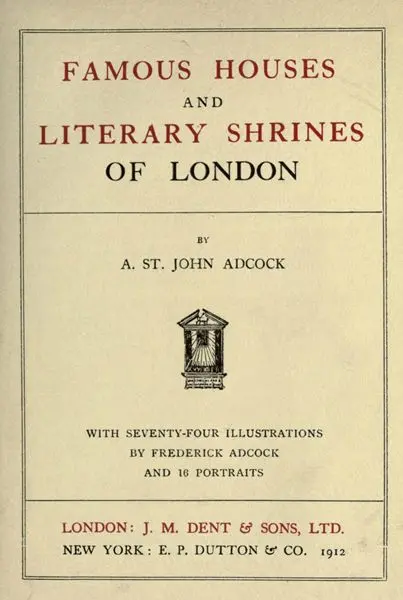
THE CLASSIC COLLECTION · 1912
"Famous Houses and Literary Shrines of London" by Arthur St. John Adcock is a historical account written in the early 20th century. The work explores notable residences and literary sites in London, highlighting the lives and works of famous authors and artists who have influenced English literature and culture. With a focus on connecting these locations to their historical significance, the book serves as both a guide and a tribute to literary heritage. The opening of the work sets the stage for an engaging exploration of the literary landscape of London, emphasizing the intrinsic connection between place and memory. Adcock reflects on how the stories and personalities of famous figures like Chaucer, Shakespeare, and Johnson infuse life into the city’s buildings and streets. He introduces the concept that understanding the past occupants allows modern inhabitants to appreciate the significance of these locations beyond their physical existence, suggesting that London itself is steeped in stories waiting to be unearthed. As he begins to detail specific locations and their historical importance, he evokes a sense of nostalgia for a literary world that is both vibrant and richly textured, creating anticipation for the journeys ahead through the city's storied past.
Introduction adapted from the source catalogue; source summaries may be automatically generated.
Free to read · English · 69,119 words · No account needed
MAKE TIME FOR A GOOD BOOK
On by default. Untick to stop anonymous reading totals. Each page counts after 10 seconds in view. How this works.
Anonymous counting is on unless you have switched it off.
Rogers had a fine head, a distinguished manner, a bland, silky way of saying the most cutting and cynical things. He was not so much a poet as a banker of a poetical temperament. His poetry will presently be forgotten, but his breakfasts and his dinners will be remembered because he lived to be well over ninety, was a very wealthy man of taste, and had the will and the means to play the generous host to some three generations of the wisest, wittiest, greatest men of his era, and several of them said brighter and better things in his dining and drawing-rooms than he ever wrote in his books. He covered such a long span of time that he could entertain Sheridan, who was born in 1751, and Dickens, who died in 1870. Many of the same glorious company had a meeting-place also until a more recent day at Bath House, Mayfair, where Lady Ashburton, the great friend of the Carlyles, held famous receptions, of which Carlyle himself and the Brookfields have left us reminiscences. And the invaluable Allingham has one or two notes about her in his Diary; one dated 5th November 1875, in which he says Carlyle passed his house "about four to-day. I overtook him in the Fulham Road, and walked with him to Lady Ashburton's door at Knightsbridge. He said, 'Browning in his young days wore a turn-down shirt collar with a ribbon for a necktie, and a green coat. I first met him one evening at Leigh Hunt's, a modest youth, with a good strong face and a head of dark hair. He said little, but what he said was good.'" Possibly the talk fell upon him because Browning was among the guests he was to meet that day at Lady Ashburton's.
William Morris and Burne Jones lived and worked together at 17 Red Lion Square; Steele used to live in Bloomsbury Square, where later Disraeli and his father lived, at No. 5. George Borrow lived at 23 Hereford Square, South Kensington. Berkeley Square has a peculiar attraction for me, less because Horace Walpole had his home at 42, than because Colley Cibber dwelt as a very old man at No. 20. In the same way I am not so much drawn to Gower Street by the fact that in a greatly altered house there Darwin used to live, as I am to that shabby Percy Street, Tottenham Court Road, where Albert Smith had a house at which Sala once visited him. Walpole and Darwin are, of course, incomparably greater men than Cibber and Albert Smith, but these last two have a curious fascination for me. I read Smith's Christopher Tadpole and The Scattergood Family when I was a boy, and his figure flits elusively in the background of Dickens's reputation, wrapped in a very characteristic mid-Victorian bohemianism, and, without precisely knowing why, I have taken a sort of liking to him. Sala says he was a kind, cheery little man, who when he was at work at home wore a blue blouse. "I recall him," he says, "as a sturdy-looking, broad-shouldered, short-necked man, with grey eyes and flowing locks of light brown, and large side-whiskers; later in life he wore a beard. His voice was a high treble." His study in Percy Street was littered always with French novels, dolls, pipes, cheap jewellery, cakes of soap made in the image of fruit, minature Swiss châlets, fancy costumes, and such a miscellany of odds and ends that it had the appearance of an old curiosity shop. As for Cibber, I began by feeling contempt for him, because of the scorn Pope pours on him in The Dunciad, and the character for dulness that was imposed upon him by that savage satirist and his host of imitators. But when I read some of Cibber's comedies (such as The Careless Husband, and Love Makes a Man) I found them amusing and clever in their fashion, certainly not dull, and when I dropped one day into the National Portrait Gallery and saw that coloured bust of him under a glass case and leering through the glass eyes that have been fitted into his head--I succumbed, and acquired a sneaking regard for the gay old coxcomb that is not yet beginning to cool. You cannot read his plays and his delightful Apology for his Life without getting interested in him; and then if you go and look at that bust you will feel that you know the sly, witty, shrewd, ruddy-visaged, not over clean, furtive, leery old rascal as intimately as if you had been acquainted with him in the flesh.
Your reading position is saved on this browser. Take it to another device with a library code. Reading pages adapt to text, rather than matching a printed edition.
Arthur St. John Adcock
Arthur St. John Adcock
BEHIND THE BOOK
This eBook is for the use of anyone anywhere in the United States and most other parts of the world at no cost and with almost no restrictions whatsoever. You may copy it, give it away or re-use it under the terms of the Project Gutenberg License included with this eBook or online at www.gutenberg.org. If you are not located in the United States, you will have to check the laws of the country where you are located before using this eBook. Read the source licence.
The original source file, including credits and licence, is retained by this library. Request an original-format copy at no charge. Please include the book title and Project Gutenberg identifier #44269.
KEEP YOUR CURIOSITY GOING
Wilfrid Scawen Blunt
Wilfrid Scawen Blunt

E. W. (Edgar Watson) Howe
Cécile Tormay

Moritz Busch
John L. Ransom