THE CLASSIC COLLECTION✦From a London gardenCLASSIC FREE BOOKS
From a London garden
Arthur St. John Adcock
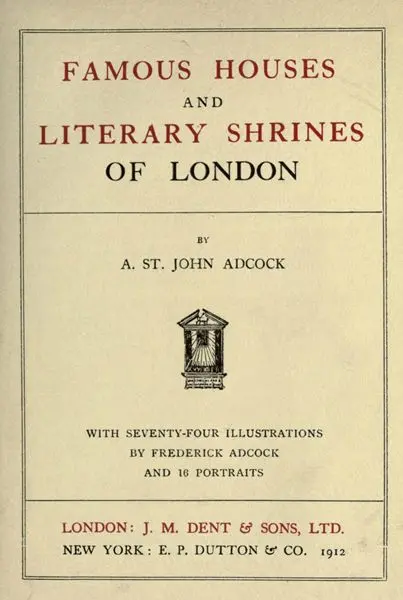
THE CLASSIC COLLECTION · 1912
"Famous Houses and Literary Shrines of London" by Arthur St. John Adcock is a historical account written in the early 20th century. The work explores notable residences and literary sites in London, highlighting the lives and works of famous authors and artists who have influenced English literature and culture. With a focus on connecting these locations to their historical significance, the book serves as both a guide and a tribute to literary heritage. The opening of the work sets the stage for an engaging exploration of the literary landscape of London, emphasizing the intrinsic connection between place and memory. Adcock reflects on how the stories and personalities of famous figures like Chaucer, Shakespeare, and Johnson infuse life into the city’s buildings and streets. He introduces the concept that understanding the past occupants allows modern inhabitants to appreciate the significance of these locations beyond their physical existence, suggesting that London itself is steeped in stories waiting to be unearthed. As he begins to detail specific locations and their historical importance, he evokes a sense of nostalgia for a literary world that is both vibrant and richly textured, creating anticipation for the journeys ahead through the city's storied past.
Introduction adapted from the source catalogue; source summaries may be automatically generated.
Free to read · English · 69,119 words · No account needed
MAKE TIME FOR A GOOD BOOK
On by default. Untick to stop anonymous reading totals. Each page counts after 10 seconds in view. How this works.
Anonymous counting is on unless you have switched it off.
Browning, who was born at Hanover Cottage, Southampton Street, Camberwell, in 1812, lived at De Vere Gardens, and at 19 Warwick Crescent. Removing from 74 Gloucester Place in 1842, Elizabeth Barrett and her autocratic father went to 50 Wimpole Street, and calling there with a friend in 1845, Robert Browning was introduced to her. It was from and to this house that so many of those wonderful love-letters of theirs were written, and little more than a year after their first meeting, her father stubbornly refusing his consent to their union, she stole out by this sedate and sombre door one autumn morning to join her waiting lover, and they were quietly and clandestinely married at the old church round the corner in Marylebone Road--the same church in which, in the same year, Dickens, then living at Devonshire House and within sight of it, married Mr. Dombey, with Captain Cuttle looking on at the ceremony from the gallery.
At 82 Wimpole Street Wilkie Collins died; and at 67, lived Henry Hallam, the historian, and his son Arthur, the friend of Tennyson, who often visited him there, and has enshrined his memory for ever in his In Memoriam; where, too, he pictures this house and this street:
"Dark house, by which once more I stand
Here in the long unlovely street,
Doors, where my heart was used to beat
So quickly, waiting for a hand.
A hand that can be clasped no more--
Behold me, for I cannot sleep,
And like a guilty thing I creep
At earliest morning to the door.
He is not here; but far away
The noise of life begins again,
And ghastly thro' the drizzling rain
On the bald street breaks the blank day."
Theodore Hook, another Cockney, was born in Charlotte Street, Bedford Square; Captain Marryat, another, in Great George Street, Westminster, and whilst he was writing the most famous of his books he lived at 8 Duke Street, St. James's, and at Sussex Lodge, in the Fulham Road. Ruskin, who, like Browning, is included in my earlier list of Cockneys, was born at 54 Hunter Street, and made his home for many years at 163 Denmark Hill, both of which houses still survive him.
Benjamin Franklin lived at 7 Craven Street, Strand; before he rented a house in London after Johnson's death, Boswell had lodgings, on his annual visits to town, in Half Moon Street, Piccadilly, in Conduit Street, Regent Street, and in Old Bond Street; where Sterne dwelt before him and Gibbon after him, and at 27A, Harrison Ainsworth, later than them all; but Ainsworth's more notable residence, where he lived when he was in the full glory of his enormous popularity, is Kensal House, out in the no-longer-rural district of Kensal Green.
Your reading position is saved on this browser. Take it to another device with a library code. Reading pages adapt to text, rather than matching a printed edition.
Arthur St. John Adcock
Arthur St. John Adcock
BEHIND THE BOOK
This eBook is for the use of anyone anywhere in the United States and most other parts of the world at no cost and with almost no restrictions whatsoever. You may copy it, give it away or re-use it under the terms of the Project Gutenberg License included with this eBook or online at www.gutenberg.org. If you are not located in the United States, you will have to check the laws of the country where you are located before using this eBook. Read the source licence.
The original source file, including credits and licence, is retained by this library. Request an original-format copy at no charge. Please include the book title and Project Gutenberg identifier #44269.
KEEP YOUR CURIOSITY GOING
Wilfrid Scawen Blunt
Wilfrid Scawen Blunt

E. W. (Edgar Watson) Howe
Cécile Tormay

Moritz Busch
John L. Ransom