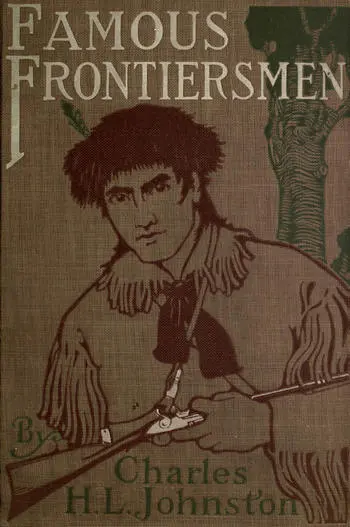
Famous Frontiersmen and Heroes of the Border Their Adventurous Lives and Stirring Experiences in Pioneer Days
Charles H. L. (Charles Haven Ladd) Johnston
THE CLASSIC COLLECTION · 1917
"Famous Discoverers and Explorers of America" by Charles H. L. Johnston is a historical account likely written in the early 20th century. The text chronicles the significant figures involved in the exploration and discovery of the Americas, emphasizing their journeys, struggles, and achievements. The book aims to paint a vivid picture of these daring adventurers, celebrating their contributions to the world. The opening of the book introduces Leif Ericson, portraying him as a young boy deeply fascinated by the sea and adventures to the west. It delves into his ambitions sparked by legends of unexplored lands, followed by Ericson's eventual maturity into a strong Viking. The narrative then outlines Ericson's historic voyage to the New World, where he and his crew became the first Europeans to settle in America, establishing a settlement in a land rich with resources, later referred to as Vinland. This initial chapter not only sets the stage for exploring Ericson's discoveries but also emphasizes the theme of adventure and the relentless human spirit of exploration.
Introduction adapted from the source catalogue; source summaries may be automatically generated.
Free to read · English · 106,073 words · No account needed
MAKE TIME FOR A GOOD BOOK
On by default. Untick to stop anonymous reading totals. Each page counts after 10 seconds in view. How this works.
Anonymous counting is on unless you have switched it off.
Radisson’s face grew pale beneath his war paint. He hesitated to answer, and, as he looked about him, the suspicious Iroquois cried out:
“Why so much whispering?”
“We are telling hunting stories,” answered the Algonquin, smiling.
This seemed to satisfy the Iroquois, for, wearied by the day’s hunt, they soon dozed off in sleep and were snoring heavily: their feet to the glowing embers. Their guns were stacked carelessly against a tree. It was the time for action.
The French boy was terrified lest the Algonquin should carry out his threat, and so pretended to be asleep. Rising noiselessly, the captive redskin crept up to the fire and eyed the three sleeping Mohawks with no kindly glance. The redmen slept heavily on, while the cry of a whip-poor-will sounded ominously from the black and gloomy forest.
The crafty Algonquin stepped, like a cat, over the sleeping forms of the braves, took possession of their firearms, and then walked to where Radisson was lying. The French boy rose uneasily. As he did so, the Indian thrust a tomahawk into one of his hands, pointing, with a menacing gesture, to the three Iroquois. Radisson’s hand shook like a leaf.
But the captive red man’s hand did not shake, and, lifting his own hatchet, he had brained one of the sleeping redskins without more ado. Pierre endeavored to imitate the warrior, but, unnerved with the horror of it all, he lost hold of his tomahawk, just as it struck the head of the sleeping Iroquois. The redskin leaped to his feet, uttering a wild yell, which awakened the third sleeper. But he had no chance to rise, as the Algonquin felled him with one, swift blow, while Radisson, recovering his hatchet, hit the second red man with such force, that he fell back, lifeless.
Hurray! Radisson was free!
The Algonquin did not waste precious moments; but, hastily scalping the dead, he threw their bodies into the river, then, packing up all their possessions, they placed them in the canoe, took to the water, and slipped away towards Lake Champlain.
“I was sorry to have been in such an encounter,” writes Radisson. “But it was too late to repent.”
The fugitives were a long way from Three Rivers, on the St. Lawrence, and they knew that many roving Iroquois were hunting in the country between them and the French settlement. They must go carefully, be perpetually on their guard, and then,—they would be among their own people again! Only, caution! caution! And never a sound at any time!
Your reading position is saved on this browser. Take it to another device with a library code. Reading pages adapt to text, rather than matching a printed edition.
Charles H. L. (Charles Haven Ladd) Johnston
Charles H. L. (Charles Haven Ladd) Johnston
BEHIND THE BOOK
This eBook is for the use of anyone anywhere in the United States and most other parts of the world at no cost and with almost no restrictions whatsoever. You may copy it, give it away or re-use it under the terms of the Project Gutenberg License included with this eBook or online at www.gutenberg.org. If you are not located in the United States, you will have to check the laws of the country where you are located before using this eBook. Read the source licence.
The original source file, including credits and licence, is retained by this library. Request an original-format copy at no charge. Please include the book title and Project Gutenberg identifier #50415.
KEEP YOUR CURIOSITY GOING
Wilfrid Scawen Blunt
Wilfrid Scawen Blunt

E. W. (Edgar Watson) Howe
Cécile Tormay

Moritz Busch
John L. Ransom