THE CLASSIC COLLECTION✦An outlaw’s diary: the CommuneCLASSIC FREE BOOKS
An outlaw’s diary: the Commune
Cécile Tormay
THE CLASSIC COLLECTION · 1903
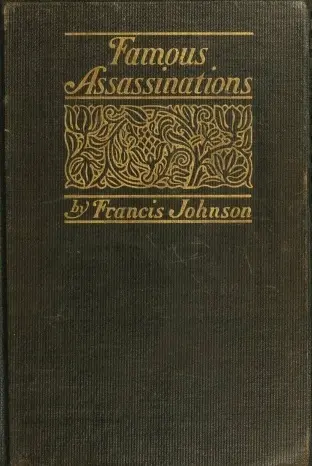
"Famous Assassinations of History from Philip of Macedon, 336 B.C., to Alexander of Servia, A.D. 1903" by Francis Johnson is a historical account written in the early 20th century. The book chronicles a selection of notable political assassinations throughout history, spanning nearly 2,500 years, beginning with the assassination of Philip of Macedon and concluding with the murder of King Alexander and Queen Draga of Servia. The opening of the book provides context through a preface where Johnson explains his intention to gather accounts of thirty-one significant historical assassinations into one volume, highlighting their political impact and psychological aspects. He sets the stage by detailing the first assassination of Philip of Macedon, emphasizing its crucial role in paving the way for his son, Alexander the Great. The narrative intertwines the personal conflicts and tensions within Philip's court, particularly involving his wife, Olympias, and their son, creating a dramatic backdrop that culminates in the king's shocking murder during a public festival.
Introduction adapted from the source catalogue; source summaries may be automatically generated.
Free to read · English · 102,382 words · No account needed
MAKE TIME FOR A GOOD BOOK
On by default. Untick to stop anonymous reading totals. Each page counts after 10 seconds in view. How this works.
Anonymous counting is on unless you have switched it off.
Nicholas the First was a man of superior intelligence, of indomitable will, and of great vigor of mind, which enabled him to pay strict attention to the different departments of the public service. His most effective instrument was the third section of the Czar’s personal bureau,--a secret political police by which he overawed the empire and whose very name caused terror in the heart and home of every Russian family. Whosoever was unfortunate enough to fall under the suspicion of this terrible Hermandad--more cruel and more vindictive than the Spanish Inquisition--might just as well resign himself at once to his fate,--life-long exile to Siberia or a secret execution, most probably by strangulation, in one of the prisons of Russia. It was the office of this secret police, which reported directly to the Emperor, not only to ferret out crime and bring criminals to justice, but to protect the subjects of the Czar from contact with hurtful foreign influences, to confiscate books and newspapers from abroad, to open and read letters, and to learn family secrets which might be used against the correspondents or their friends. Everything, in fact, which the imperial government could think of to cut off Russia from the current of European ideas, to prevent its subjects from receiving a liberal education at the universities, to expand their minds by travelling abroad, to become familiar with the great political and philosophical questions of the day by a study of literature and newspapers, was done with rigorous care by the police and approved by the Czar.
Occasionally the Emperor became indignant at the venality and corruption of high public officials; but he did not see that this venality and corruption were but the logical consequence of the system of despotism and Byzantinism which his will imposed even on the highest members of the aristocracy. His smile, his praise, was the highest distinction, the highest aim of the ambition of the aristocracy, and for this servile subjection to the imperial will they compensated themselves by unbridled licentiousness and beastly excesses, and by robbing the public treasury. Because it was well known that the Emperor looked with suspicion on the universities as nurseries of liberal or revolutionary ideas, the nobility did not send their sons thither, for fear that the young men might become infected with these ideas, and that transportation to Siberia might suddenly interrupt their studies. The nobility, therefore, deemed it more prudent to send the lads to court or to the military schools, where they were safe at least from the contagion of European liberalism. It is really a wonder that, with such an organization of society and with a system of police surveillance perhaps never equalled in the world, with a Damocles’ sword always suspended over their heads, there still remained a number of liberal-minded men, who never abandoned the hope of better days, never renounced their dream that the time would come for Russia, as it had come for western Europe, to enter socially and politically the family of enlightened nations, blessed with liberal institutions and freed from the despotism of semi-Oriental rulers. These liberal-minded men and true patriots--professors of the universities, literary men, and a very small number of young noblemen--lived mostly at Moscow, where the distance from the observing eye of the ruler and his court saved them from detection, although their secret influence pervaded the whole empire, and kept the flame of liberalism burning in the hearts of the intellectual élite. While Nicholas had thus succeeded in building up an Eastern despotism on the banks of the Neva, he endeavored at the same time to impress Europe with the idea of his unrivalled power. His army was considered one of the best in Europe, and the immense population of his empire--larger than that of any two of the other great powers--gave him almost unlimited material for recruits. The generals commanding these armies were also renowned throughout Europe. They had won their laurels in the battles against the revolutionary armies of Poland and Hungary, in conquering the warlike population of the Caucasus, and subjecting large territories in western Asia to the white eagle of the Czar. The Russian diplomats had the reputation of being the shrewdest in Europe, and had either by secret treaties or by matrimonial alliances succeeded in making Russian influence preponderant on the continent of Europe. The Emperor Nicholas stood, therefore, on a commanding height when he provoked the great western powers of Europe, together with Turkey, to mortal combat. It was a challenge born in arrogance and political short-sightedness, and it found its deserved rebuke in a total defeat of the Russian armies and a thorough humiliation of the Russian Emperor. Nicholas ought to have known that, in engaging in war with the western powers, he not only endangered his military prestige, but put to the test also his system of domestic administration, based entirely on his autocratic will, and silently, although reluctantly, submitted to by his subjects, as a tribute to his dominant position in Europe. When by the disasters of the Crimean War that position was lost, when it became clear to the Russian people that the Emperor was not absolutely the universal dictator of Europe, not only his military prestige was destroyed, but his system of domestic government lost immensely in public estimation. Nicholas felt this double humiliation so keenly that it was just as much personal chagrin as physical disease which caused his death even before the war was over.
Your reading position is saved on this browser. Take it to another device with a library code. Reading pages adapt to text, rather than matching a printed edition.
BEHIND THE BOOK
This eBook is for the use of anyone anywhere in the United States and most other parts of the world at no cost and with almost no restrictions whatsoever. You may copy it, give it away or re-use it under the terms of the Project Gutenberg License included with this eBook or online at www.gutenberg.org. If you are not located in the United States, you will have to check the laws of the country where you are located before using this eBook. Read the source licence.
The original source file, including credits and licence, is retained by this library. Request an original-format copy at no charge. Please include the book title and Project Gutenberg identifier #53273.
KEEP YOUR CURIOSITY GOING
Cécile Tormay

Moritz Busch
John L. Ransom
Frances Wright
Cécile Tormay

Mabel Potter Daggett