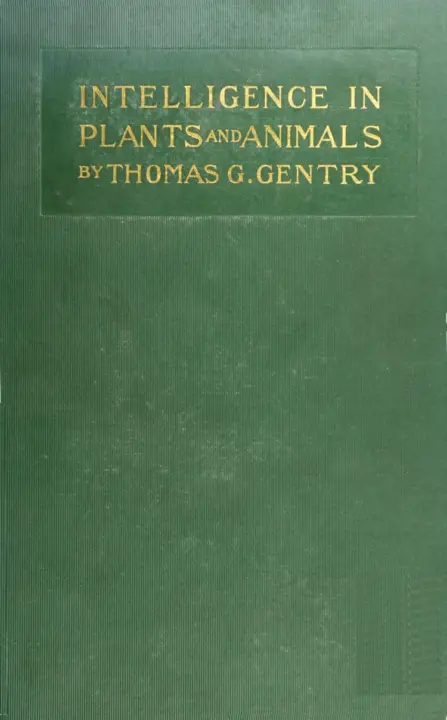
Intelligence in Plants and Animals Being a New Edition of the Author’s Privately Issued “Soul and Immortality.”
Thomas G. (Thomas George) Gentry
THE CLASSIC COLLECTION · 1892
"Family names from the Irish, Anglo-Saxon, Anglo-Norman and Scotch" by Thomas G. Gentry is an etymological and onomastic reference work written in the late 19th century. It explores the origins and meanings of surnames from these traditions, pairing brief historical sketches and language lessons with alphabetized glossaries of names. The focus is on how history, phonetics, and grammar shape surname forms and senses, making it useful to readers interested in ancestry and the linguistic roots of family names.
The opening of the work lays out a preface that explains why names matter, surveys earlier scholarship (strong on Hebrew and Greek, weaker on Latin and English lists), notes the particular difficulty of Celtic names, and states the author’s aim to provide reliable, primary-sourced derivations while acknowledging limits. A contents page signals a structure that repeats for each tradition: history, language notes, and derivations. The Irish section begins with a concise history of the Celts within the Indo-European family, the spread into western Europe and Britain, Roman contact, and the persistence of Celtic elements in place‑names and common words; it notes modern survivals in Welsh, Gaelic, Irish, and Manx. This is followed by “Lessons in Irish,” a practical primer on the alphabet, vowel and consonant sounds, aspiration, diphthongs/triphthongs, word endings, and regional pronunciations, and then by an extensive A–Y list of Irish-derived surnames with compact etymologies. The excerpt closes as the Anglo-Saxon part begins, emphasizing the centrality of Anglo-Saxon to English vocabulary and introducing the historical arrival of the Jutes, Saxons, and Angles.
Introduction adapted from the source catalogue; source summaries may be automatically generated.
Free to read · English · 53,434 words · No account needed
MAKE TIME FOR A GOOD BOOK
On by default. Untick to stop anonymous reading totals. Each page counts after 10 seconds in view. How this works.
Anonymous counting is on unless you have switched it off.
Snader. Snæd, a shaft, a pole, the handle of a scythe; ere, an agent. One who uses a snead, or sneed. Sneeder, a cognate term.
Snare. Sneáre, a snare, a loop, a noose.
Sneade. Snæd, a pole, a shaft, the handle of a scythe. Sneed, of like
derivation.
Sneath. Snæd, a pole, a shaft, the handle of a scythe.
Sneden. Snǽd-en, to cut, to cut off, to amputate. Snethen, from the
same radix.
Snediker. Snǽd, cut, shorn; æcer, a field. A mown field.
Sneer. Snear, active, quick, nimble.
Snelbaker. Snel-bæc-ere, from snel, active, cheerful; bæcere, a baker. An active, cheerful baker. Snellbaker, from the same roots.
Snell. Snel, or snell, quick, active, cheerful, bold, brave.
Snelling. Snell, Snell; ing, offspring. Descendant of Snell.
Sneyd. Snid, I cut, I amputate, I slay.
Snider. Snid-ere, a cutter, hewer, pruner. Snyder, from the same
derivation.
Snodgrass. Snod, a fillet, a cap, a hood; græs, grass. A straw
fillet; a straw cap.
Snow. Snáw, snow.
Snowdon. Snáw-dan, to snow.
Snowdon. Snáw-dún, from snáw, snow; dún, a mountain, a hill. A
snow mountain.
Soden. Soden, perfect participle of seódham, to boil, to agitate, to cook. Boiled; agitated; cooked.
Soder. Seod, a little sack, a bag, scrip; ere, an agent. A sack-maker. Soeder, of like significance.
Soding. Seod, a bag, a sack; ing, expressive of action. Sack-making.
Sodman. Seod, a bag, a sack; man, a man. A sack-maker; a bag-dealer.
Soeffing. Seofung, sighing, sobbing, lamentation.
Somer. Sumer, summer. Sommer, Summer, from the same radix.
Somers. Somer, Somer; s for sun, son. Son of Somer. Sommers,
Summers, equivalents.
Somerset. Somer-setl, from sumer, summer, and setl, a seat. A summer seat. Sommerset, a kindred term.
Sorg. Sorg, sorrow, care, anxiety.
Sorig. Sorhg, sorrow.
Souder. Sódh, truth; ere, an agent. One who speaks the truth.
Souders. Souder, Souder; s for sun, son. Son of Souder.
South. Súdh, south.
Southcott. Súdh, south; cóte, a cottage. A south-cottage.
Southern. Súdh-erna, southern.
Southwark. Súdh-geweorc, from súdh, south, and geweorc, a fortress, a work. A south-work; a south-fortress.
Southwell. Súdh, south; wel, a well. A south-well.
Southwick. Súdh, south; wic, a camp. A south-camp.
Southwood. Súdh, south; wud, wood. A south-wood.
Southworth. Súdh, south; weordh, worth, price, value. South-worth;
southern value.
Sower. Sawere, a sower.
Sowerby. Sower, Sower; bý, a dwelling, a habitation. Sower’s
dwelling.
Sowers. Sower, Sower; s for sun, son. Son of Sower.
Sox. Socks, from socces, genitive of socc, a sock, a woolen wrapper for the feet. Belonging to a sock.
Spackman. Spǽc, speech; man, a man. A speaker; an orator.
Your reading position is saved on this browser. Take it to another device with a library code. Reading pages adapt to text, rather than matching a printed edition.
Thomas G. (Thomas George) Gentry
BEHIND THE BOOK
This eBook is for the use of anyone anywhere in the United States and most other parts of the world at no cost and with almost no restrictions whatsoever. You may copy it, give it away or re-use it under the terms of the Project Gutenberg License included with this eBook or online at www.gutenberg.org. If you are not located in the United States, you will have to check the laws of the country where you are located before using this eBook. Read the source licence.
The original source file, including credits and licence, is retained by this library. Request an original-format copy at no charge. Please include the book title and Project Gutenberg identifier #77230.
KEEP YOUR CURIOSITY GOING

Charles G. (Charles Griffith) Ross
Hannah Webster Foster

Emily Lawless
Edwin Hamlin Carr

Charles De Lano Hine
Andrew Ure