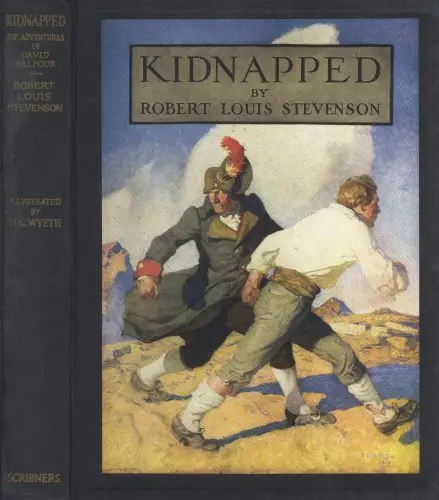
Vailima Letters Being Correspondence Addressed by Robert Louis Stevenson to Sidney Colvin, November 1890-October 1894
Robert Louis Stevenson
THE CLASSIC COLLECTION · 1882
"Familiar Studies of Men and Books" by Robert Louis Stevenson is a collection of literary essays written in the late 19th century. The book reflects Stevenson's observations and commentary on various notable figures in literature and history, exploring their influences and contributions through a critical yet affectionate lens. The opening of the collection introduces the author’s intent, describing the blending of critical analysis and personal insight in his studies of authors like Hugo, Burns, Whitman, and Thoreau. Stevenson articulates the challenges and nuances of writing about such diverse figures, indicating that these reflections are driven by both admiration and a sense of responsibility to present their subjects with care. He acknowledges his own limitations and the complexities of capturing the essence of these literary giants while maintaining a genuine interest in their lives and works. Through this approach, Stevenson sets the stage for a rich exploration of the intersecting lives of these influential men and their writings.
Introduction adapted from the source catalogue; source summaries may be automatically generated.
Free to read · English · 96,786 words · No account needed
MAKE TIME FOR A GOOD BOOK
On by default. Untick to stop anonymous reading totals. Each page counts after 10 seconds in view. How this works.
Anonymous counting is on unless you have switched it off.
{192} Etude Biographique sur François Villon. Paris: H. Menu.
{195} Bougeois de Paris, ed. Panthéon, pp. 688, 689.
{196} Bourgeois, pp. 627, 636, and 725.
{204} Chronìque Scandaleuse, ed. Panthéon, p. 237.
{210} Monstrelet: Panthéon Littéraire, p. 26.
{220a} Chron. Scand. ut supra.
{220b} Here and there, principally in the order of events, this article differs from M. Longnon’s own reading of his material. The ground on which he defers the execution of Montigny and De Cayeux beyond the date of their trials seems insufficient. There is a law of parsimony for the construction of historical documents; simplicity is the first duty of narration; and hanged they were.
{224} Chron. Scand., p. 338.
{238} Champollion-Figeac’s Louis et Charles d’Orléans, p. 348.
{240a} D’Héricault’s admirable Memoir, prefixed to his edition of Charles’s works, vol. i. p. xi.
{240b} Vallet de Viriville, Charles VII. et son Epoque, ii. 428, note
2.
{241a} See Lecoy de la Marche, Le Roi René, i. 167.
{241b} Vallet, Charles VII, ii. 85, 86, note 2.
{241c} Champollion-Figeac, 193–198.
{242a} Champollion-Figeac, 209.
{242b} The student will see that there are facts cited, and expressions borrowed, in this paragraph, from a period extending over almost the whole of Charles’s life, instead of being confined entirely to his boyhood. As I do not believe there was any change, so I do not believe there is any anachronism involved.
{243} The Debate between the Heralds of France and England, translated and admirably edited by Mr. Henry Pyne. For the attribution of this tract to Charles, the reader is referred to Mr. Pyne’s conclusive argument.
{244} Des Ursins.
{248} Michelet, iv. App. 179, p. 337.
{249} Champollion-Figeac, pp. 279–82.
{250} Michelet, iv. pp. 123–4.
{253} Debate between the Heralds.
{254} Sir H. Nicholas, Agincourt.
{257a} Debate between the Heralds.
{257b} Works (ed. d’Héricault), i. 43.
{257c} Ibid. 143.
{258a} Works (ed. d’Héricault), i. 190.
{258b} Ibid. 144.
{258c} Ibid. 158.
{259a} M. Champollion-Figeac gives many in his editions of Charles’s works, most (as I should think) of very doubtful authenticity, or worse.
{259b} Rymer, x. 564. D’Héricault’s Memoir, p. xli. Gairdner’s Paston Letters, i. 27, 99.
{260} Champollion-Figeac, 377.
{262a} Dom Plancher, iv. 178–9.
{262b} Works, i. 157–63.
{265a} Vallet’s Charles VII., i. 251.
{265b} Procès de Jeanne d’Arc, i. 133–55.
{267a} Monstrelet.
{267b} Vallet’s Charles VII., iii. chap. i. But see the chronicle that bears Jaquet’s name: a lean and dreary book.
{268} Monstrelet.
{269} D’Héricault’s Memoir, xl. xli. Vallet, Charles VI., ii. 435.
{271a} Champollion-Figeac, 368.
{271b} Works, i. 115.
{271c} D’Héricault’s Memoir, xlv.
{272} ChampoIlion-Figeac, 381, 361, 381.
{273} Champollion-Figeac, 359,361.
{276a} Lecoy de la Marche, Roi René, ii. 155, 177.
{276b} Champollion-Figeac, chaps. v. and vi.
{276c} Ibid. 364; Works, i. 172.
Your reading position is saved on this browser. Take it to another device with a library code. Reading pages adapt to text, rather than matching a printed edition.
Robert Louis Stevenson

Robert Louis Stevenson

Robert Louis Stevenson
BEHIND THE BOOK
This eBook is for the use of anyone anywhere in the United States and most other parts of the world at no cost and with almost no restrictions whatsoever. You may copy it, give it away or re-use it under the terms of the Project Gutenberg License included with this eBook or online at www.gutenberg.org. If you are not located in the United States, you will have to check the laws of the country where you are located before using this eBook. Read the source licence.
The original source file, including credits and licence, is retained by this library. Request an original-format copy at no charge. Please include the book title and Project Gutenberg identifier #425.
KEEP YOUR CURIOSITY GOING

David Patterson (Spirit) Hatch

David Patterson (Spirit) Hatch

David Patterson (Spirit) Hatch
Cécile Tormay

Moritz Busch
John L. Ransom