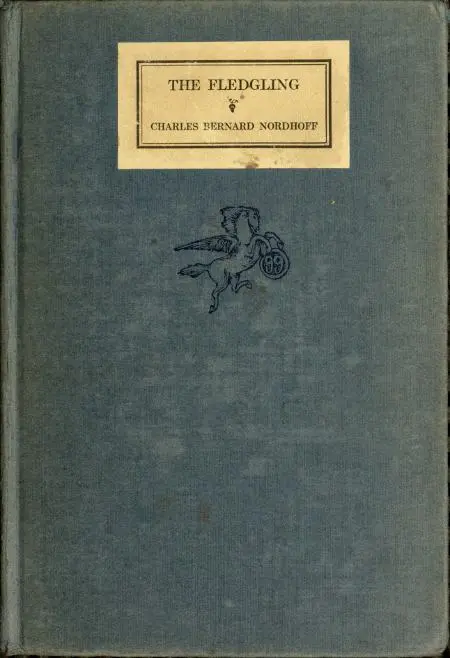
The Fledgling
Charles Nordhoff
THE CLASSIC COLLECTION · 1921
"Faery Lands of the South Seas" by James Norman Hall and Charles Nordhoff is a travel narrative written in the early 20th century. The book chronicles the authors' expedition to the remote islands of the South Pacific, primarily focusing on the exploration of Polynesian culture, landscapes, and their own reflections on life during this journey. Central to the narrative is the juxtaposition of the authors' experiences with the enchanting yet simple lives of the islanders they encounter. The opening of "Faery Lands of the South Seas" sets the stage for the adventure that James Norman Hall and Charles Nordhoff embark upon following the end of World War I. It begins with a nostalgic reflection on their life in Paris, where they discuss their longing for new adventures, ultimately leading them to the South Pacific islands. As they approach Tahiti, they describe the breathtaking beauty of the islands, emphasizing the charm and simplicity of the local inhabitants' way of life. The authors recognize the allure of the unspoiled nature and the rich culture of the islands, setting a tone of reverence and curiosity that will characterize their explorations throughout the text.
Introduction adapted from the source catalogue; source summaries may be automatically generated.
Free to read · English · 101,048 words · No account needed
MAKE TIME FOR A GOOD BOOK
On by default. Untick to stop anonymous reading totals. Each page counts after 10 seconds in view. How this works.
Anonymous counting is on unless you have switched it off.
"A friend of mine--an educated and skeptical Englishman, in whose word I have the utmost confidence--was the witness of one of these blood-splashing affairs. He lived on Moorea, just across from Tahiti; Haapiti was the village, I think. One afternoon he whistled to his fox terrier and strolled to a near-by house, where the body of a native (an old fellow he had liked) lay in state, surrounded by mourning relatives. As he stood on the veranda the dog began to growl furiously, and at the same moment the oldest man present--a sort of doctor and authority on spiritual matters--shouted out suddenly that everyone must leave the house. The native explained afterward that he had caught a glimpse of something like a small comet--a shapeless and luminous body, trailing a fiery tail--rushing horizontally toward the rear of the building. The people gathered outside in a bit of a panic; the fox terrier seemed to have gone mad on the porch--alternately cowing and leaping forward with frenzied growls toward some invisible thing. All at once there was a great racket of overturned furniture inside the house, and next moment the Englishman saw gouts of what looked like blood splashing over the outer wall and the floor of the veranda. The dog was covered--it was a week before his coat was clean. The net result of the affair was that the veranda needed a cleaning, a couple of tables were overturned, and the body of the old man considerably disturbed; but its most curious feature is the fact that my friend--suspecting native trickery and the desire to impress a white man--took a specimen of the blood across to Papeete, where he got the hospital people to examine it. It was human blood beyond a doubt. What do you make of that?
"The other evening, when I was having a yarn with Apakura, she told me about another kind of varua ino, who figures as the villain in the tale of a Polynesian Cinderella. It may interest you. A great many years ago, on Ahu Ahu, there was a man named Tautu--one of Apakura's family--a renowned fighting man, who dabbled in sorcery when there were no wars to be fought. Tall, handsome, and famous, it was no wonder that Tautu was pursued by all the island girls--scheming sisters, in particular, who went so far as to build a hut near where he lived. Hoping to catch the eye of the hero, they took their finest ornaments and robes of tapa and went to live in the hut, accompanied by their little sister, Titiara, who was to act as a drudge about the house. Young Titiara had no designs on Tautu, and she possessed no finery to make herself beautiful in his eyes, but one day, when she was gathering wood in the bush, he chanced to pass. Stopping to speak with her, he was struck with her goodness and beauty, and from that time the two met every day in the forest. The older sisters, meanwhile, were the victims of a mischievous earth spirit which haunted the vicinity and visited them in the guise of Tautu. They were triumphant--when it was known that they had won the warrior's favors all their friends would be wild with jealousy; they could not resist preening themselves before their little sister. 'Tautu loves us,' they told her; 'he comes every day when you are off gathering wood.' 'But that is impossible,' said Titiara, 'for Tautu is my lover; he meets me each day in the forest.' The older girls laughed scornfully at this, but Titiara said no more until she met her lover in the evening. When she told him what her sisters had said, he laughed. 'It is a varua ino,' he informed her, 'a mischievous spirit whose true appearance is that of a hideous old man. To-morrow I will prove to your sisters that it is not I who visit them.' That night Tautu sat up late, weaving a magic net of hibiscus bark--a net which had the property of causing a spirit to assume its true shape. Next afternoon Tautu and Titiara stole up to the house where the spirit, in the form of a splendid warrior, was talking and laughing with the two sisters. Tautu cast the net; next moment the spirit was howling and struggling in the magic meshes, unable to escape, moaning as it shriveled and changed to the appearance of an old man, gray-bearded, trembling, and hideous. The two sisters shrank back in loathing and mortification, while Tautu told them that he had chosen Titiara to be his wife."
Your reading position is saved on this browser. Take it to another device with a library code. Reading pages adapt to text, rather than matching a printed edition.
Charles Nordhoff
James Norman Hall
James Norman Hall
Charles Nordhoff
BEHIND THE BOOK
This eBook is for the use of anyone anywhere in the United States and most other parts of the world at no cost and with almost no restrictions whatsoever. You may copy it, give it away or re-use it under the terms of the Project Gutenberg License included with this eBook or online at www.gutenberg.org. If you are not located in the United States, you will have to check the laws of the country where you are located before using this eBook. Read the source licence.
The original source file, including credits and licence, is retained by this library. Request an original-format copy at no charge. Please include the book title and Project Gutenberg identifier #54479.
KEEP YOUR CURIOSITY GOING
Wilfrid Scawen Blunt
Wilfrid Scawen Blunt

E. W. (Edgar Watson) Howe
Francis Greenleaf Allinson & Anne C. E. (Anne Crosby Emery) Allinson
Cyrenus Cole

John Martineau