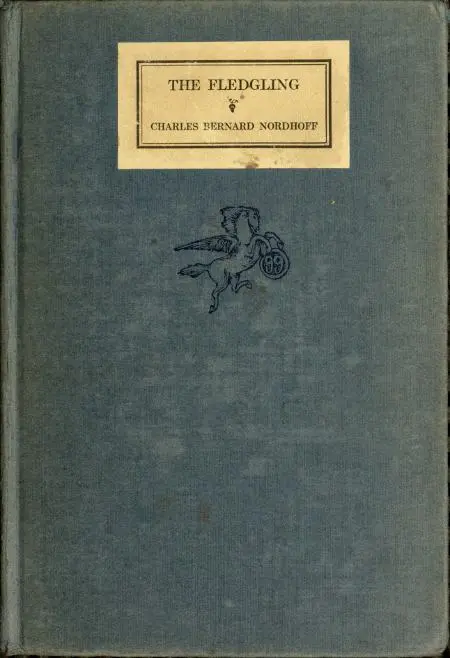
The Fledgling
Charles Nordhoff
THE CLASSIC COLLECTION · 1921
"Faery Lands of the South Seas" by James Norman Hall and Charles Nordhoff is a travel narrative written in the early 20th century. The book chronicles the authors' expedition to the remote islands of the South Pacific, primarily focusing on the exploration of Polynesian culture, landscapes, and their own reflections on life during this journey. Central to the narrative is the juxtaposition of the authors' experiences with the enchanting yet simple lives of the islanders they encounter. The opening of "Faery Lands of the South Seas" sets the stage for the adventure that James Norman Hall and Charles Nordhoff embark upon following the end of World War I. It begins with a nostalgic reflection on their life in Paris, where they discuss their longing for new adventures, ultimately leading them to the South Pacific islands. As they approach Tahiti, they describe the breathtaking beauty of the islands, emphasizing the charm and simplicity of the local inhabitants' way of life. The authors recognize the allure of the unspoiled nature and the rich culture of the islands, setting a tone of reverence and curiosity that will characterize their explorations throughout the text.
Introduction adapted from the source catalogue; source summaries may be automatically generated.
Free to read · English · 101,048 words · No account needed
MAKE TIME FOR A GOOD BOOK
On by default. Untick to stop anonymous reading totals. Each page counts after 10 seconds in view. How this works.
Anonymous counting is on unless you have switched it off.
We returned in an hour's time with the canoe half filled with fish--square-nosed tinga-tingas, silvery tamures, brown spotted kitos, gnareas; we had more than made good the loss of the chickens. The preparations for the feast had been completed. The table was set or, better, the cloth of green fronds was laid on the ground near the beach. At each place there was a tin of my corned beef or salmon; the half of a coconut shell filled with raw fish, cut into small pieces in a sauce of miti haari--salted coconut milk--and a green coconut for drinking. Along the center of the table were great piles of fish, baked and raw; roast pork and chicken; mounds of bread stacked up like cannon balls. The bread was not of Moy Ling's baking, but made in native fashion--lumps of boiled dough of the size and weight of large grape fruit. One would think that the most optimistic stomach would ache at the prospect of receiving it, but the Paumotuan stomach is of ostrichlike hardihood and, as I have said, after long fasting it demands quantity rather than quality in food.
It was then about half past six, a seasonable hour for the feast, for the air was still cool and fresh. The food was steaming on the table, but we were not yet ready to sit down to it. Fete days, like Sundays, required costumes appropriate to the occasion, and everyone retired into the bush to change clothing. I thought then that I was to be the only disreputable banqueter of the lot, and regretted that I had been so eager to see my new house. Not expecting visitors, I had come away from the village with only my supply of food. Fortunately, Puarei had been thoughtful for me. I found not only my white clothing, but my other possessions--bolts of ribbon, perfume, the cheap jewelry, etc., which I had bought, on credit, of Moy Ling. And the house itself had been furnished and decorated during the hour when I was out with the fish spearers. There was a table and a chair, made of bits of old packing cases, in one corner; and on the sleeping mat a crazy quilt and a pillow with my name worked in red silk within a border of flowers. Hanging from the ceiling was a faded papier-mache bell, the kind one sees in grocers' windows at home at Christmas time. This was originally the gift of some trader; and the pictures, too, which decorated the walls. They had been cut from the advertising pages of some American magazine. One of them represented a man, dressed in a much-advertised brand of underwear, who was smiling with cool solicitude at two others who were perspiring heavily and wishing--if the legend printed beneath was true--that their underwear bore the same stamp as that of their fortunate comrade. There was another, in color, of a woman smiling across a table at her husband, who smiled back while they ate a particular brand of beans. The four walls of my house were hung with pictures of this sort, strung on cords of coconut fiber--Huirai's work, I was sure, done out of the kindness of his heart. He was merely an unconscious agent of the gods, administering this further reproof for my temerity in seeking consciously an adventure in solitude. As I changed my clothing I pondered the problem as to how I could get rid of the gallery without giving Huirai offense, and from this I fell to thinking of the people smiling down at me. Is our race made up, in large part, of such out-and-out materialists, whose chief joy in life lies in discovering some hitherto untried brand of soup or talcum powder? Do they live, these people? They looked real enough in the picture. I seemed to know many of them, and I remembered their innumerable prototypes I had met in the world I had left only the year before. "Well, if they are real," I thought, "what has become of the old doomsday men and women who used to stand at street corners with bundles of tracts in their hands, saying to passers-by, 'My friend, is your soul saved?'?" No answer came from the smiling materialists on all sides of me. They smiled still, as though in mockery of my attempt to elude them in whatsoever unfrequented corner of the world; as though life were merely the endless enjoyment of creature comforts, the endless, effortless use of labor-saving devices. One man, in his late fifties, who really ought to have been thinking about his soul, had in his eyes only the light of sensual gratification. He was in pajamas and half shaven, announcing to me, to the world at large: "At last! A razor!"
Your reading position is saved on this browser. Take it to another device with a library code. Reading pages adapt to text, rather than matching a printed edition.
Charles Nordhoff
James Norman Hall
James Norman Hall
Charles Nordhoff
BEHIND THE BOOK
This eBook is for the use of anyone anywhere in the United States and most other parts of the world at no cost and with almost no restrictions whatsoever. You may copy it, give it away or re-use it under the terms of the Project Gutenberg License included with this eBook or online at www.gutenberg.org. If you are not located in the United States, you will have to check the laws of the country where you are located before using this eBook. Read the source licence.
The original source file, including credits and licence, is retained by this library. Request an original-format copy at no charge. Please include the book title and Project Gutenberg identifier #54479.
KEEP YOUR CURIOSITY GOING
Wilfrid Scawen Blunt
Wilfrid Scawen Blunt

E. W. (Edgar Watson) Howe
Francis Greenleaf Allinson & Anne C. E. (Anne Crosby Emery) Allinson
Cyrenus Cole

John Martineau