
Last letters from the living dead man
David Patterson (Spirit) Hatch
THE CLASSIC COLLECTION · 1900
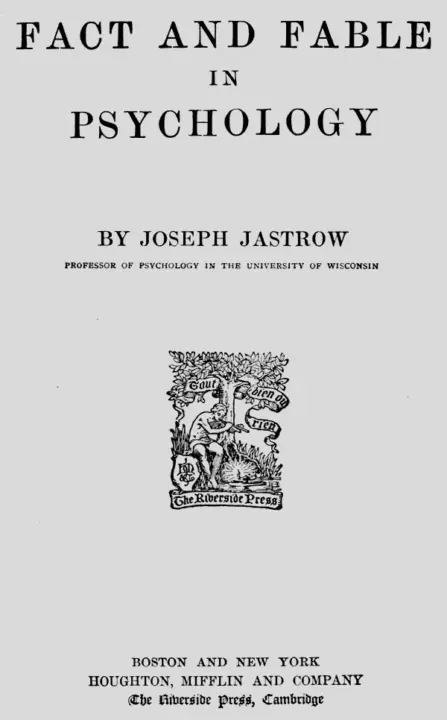
"Fact and Fable in Psychology" by Joseph Jastrow is a collection of essays written in the late 19th century. The work explores various psychological phenomena and the misconceptions that surround them, particularly those related to the occult and pseudoscience. Jastrow aims to highlight the importance of critical thinking and scientific rigor in understanding human mental processes, emphasizing the need to distinguish between fact and belief. The opening of the book sets the stage for Jastrow's examination of the public's fascination with unusual and often erroneous concepts in psychology, including occult beliefs and spiritualism. He discusses the challenges faced by psychologists in combating widespread misconceptions fueled by sensationalism and superstition. Jastrow argues for a grounded view of psychology that prioritizes normal mental functions over more obscure psychic phenomena, proposing that a deeper understanding of common psychological processes can illuminate the irregularities that captivate popular interest.
Introduction adapted from the source catalogue; source summaries may be automatically generated.
Free to read · English · 100,833 words · No account needed
MAKE TIME FOR A GOOD BOOK
On by default. Untick to stop anonymous reading totals. Each page counts after 10 seconds in view. How this works.
Anonymous counting is on unless you have switched it off.
We may therefore profitably confine our attention to the psychological lessons to be drawn from the record of fraud and deception which the exploitation of Spiritualism has produced.[9] When the day comes when the manifestations above considered shall be definitely conceded to have a natural explanation along the general lines here presented, and the spiritualists shall have taken refuge in other and distinctively different manifestations, then it may become advisable to prepare a revised account of the psychology of Spiritualism.
There remains an important series of considerations that form an essential factor in the psychological comprehension of the phenomena of Spiritualism; this is the effect of bias and prepossession. When by one means or another a strong faith in the reality of spiritualistic manifestations has been induced; when the critical attitude gives place to a state of extreme emotional tension; when, perhaps, special griefs and trials give undue fervor to the desire for a material proof of life after death, of communion with the dear departed; when the convert becomes a defendant of the faith, anxious to strengthen the proofs of his own conviction,--then we have no longer mere unintentional lapses of observation and memory to deal with, but actual mental blindness to obvious fraud and natural explanations; then caution is thrown to the winds and marvels are reported that are the result of expectant attention and imagination, or of real illusion and hallucination. The blamelessness that may be conceded for one's mystification by conjuring performances cannot be extended to the present class of experiences; here it is not unusualness of external arrangements that forms the main factor in the deception, but the abnormal condition of the observer's mind. The materialization séances offer a sufficient example of this form of manifestation. To recognize a departed friend in the thinly disguised form of the medium is most naturally interpreted as a mark of weak insight or of strong prejudice. "Again and again," writes Dr. Furness, "men have led round the circles the materialized spirits of their wives and introduced them to each visitor in turn; fathers have taken round their daughters, and I have seen widows sob in the arms of their dead husbands. Testimony such as this staggers me. Have I been smitten with color-blindness? Before me, as far as I can detect, stands the very medium herself, in shape, size, form, and feature true to a line, and yet, one after another, honest men and women at my side, within ten minutes of each other, assert that she is the absolute counterpart of their nearest and dearest friend; nay, that she is that friend. It is as incomprehensible to me as the assertion that the heavens are green, and the leaves of the trees deep blue. Can it be that the faculty of observation and comparison is rare, and that our features are really vague and misty to our best friends? Is it that the medium exercises some mesmeric influence on her visitors, who are thus made to accept the faces which she wills them to see? Or is it, after all, only the dim light and a fresh illustration of la nuit tous les chats sont gris?" In the confessions of an exposed medium we read: "The first séance I held, after it became known to the Rochester people that I was a medium, a gentleman from Chicago recognized his daughter Lizzie in me after I had covered my small mustache with a piece of flesh-colored cloth, and reduced the size of my face with a shawl I had purposely hung up in the back of the cabinet." With such powerful magicians as an expectant interest and a strong prepossession, the realm of the marvelous is easily entered; but the evidence thus accumulated may be said to have about the same scientific value as the far more interesting entertainments of the "Thousand and One Nights." "Sergeant Cox," Mr. Podmore tells us, "adduced the hallucinatory feeling of a missing limb in proof of a spiritual body; and a writer in the 'Spiritualist,' 'not yet convinced of the spiritualistic theory,' could even pronounce the after-images produced by gazing at a straw hat to be 'independent of any known human agency.' From all of which it may be gathered that the conscientious spiritualist, when on marvels bent, did not display a frugal mind." Such opinions certainly justify Mr. Podmore's remark that there are spiritualists, "not a few, who would be capable of testifying, if their prepossessions happened to point that way, that they had seen the cow jump over the moon; and would refer for corroborative evidence to the archives of the nursery."
Your reading position is saved on this browser. Take it to another device with a library code. Reading pages adapt to text, rather than matching a printed edition.
BEHIND THE BOOK
This eBook is for the use of anyone anywhere in the United States and most other parts of the world at no cost and with almost no restrictions whatsoever. You may copy it, give it away or re-use it under the terms of the Project Gutenberg License included with this eBook or online at www.gutenberg.org. If you are not located in the United States, you will have to check the laws of the country where you are located before using this eBook. Read the source licence.
The original source file, including credits and licence, is retained by this library. Request an original-format copy at no charge. Please include the book title and Project Gutenberg identifier #48869.
KEEP YOUR CURIOSITY GOING
David Patterson (Spirit) Hatch

David Patterson (Spirit) Hatch

David Patterson (Spirit) Hatch

Ralph Waldo Emerson

Maurice Baring

Oscar Wilde & James McNeill Whistler