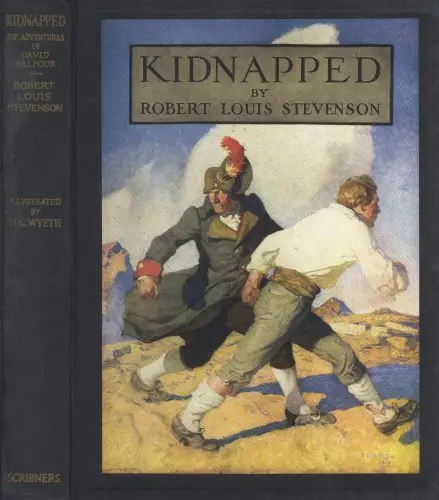
Vailima Letters Being Correspondence Addressed by Robert Louis Stevenson to Sidney Colvin, November 1890-October 1894
Robert Louis Stevenson
THE CLASSIC COLLECTION · 1900
"Fables" by Robert Louis Stevenson is a collection of allegorical tales written in the late 19th century. The book explores moral lessons and human experiences through a series of whimsical narratives, each featuring unique characters and situations that reflect on virtues and vices. Its likely topic centers around the complexities of morality and the human condition, utilizing imaginative scenarios to communicate profound truths. In this collection, each fable presents a distinct story, often framed within dialogues or interactions between anthropomorphic characters. For instance, tales like "The Sick Man and the Fireman" and "The Devil and the Innkeeper" explore themes of selfishness, duty, and the nature of evil. The characters engage in witty banter and paradoxical situations that highlight their traits, ultimately leading to humorous and thoughtful conclusions. Stevenson’s use of irony and satire invites readers to reflect on social conventions and personal choices, making the fables both entertaining and enlightening. Each story culminates in a moral, adeptly reflecting the intricacies of human behavior and ethics, making it a timeless work of literature.
Introduction adapted from the source catalogue; source summaries may be automatically generated.
Free to read · English · 14,518 words · No account needed
MAKE TIME FOR A GOOD BOOK
On by default. Untick to stop anonymous reading totals. Each page counts after 10 seconds in view. How this works.
Anonymous counting is on unless you have switched it off.
"I never heard the like of this!" cried the daughter of Miru. "Pray, what do you expect to gain?"
"That is not the point," said the missionary. "I took this pledge for others, I am not going to break it for myself."
The daughter of Miru was puzzled; she came and told her mother, and Miru was vexed; and they went and told Akaanga. "I don't know what to do about this," said Akaanga; and he came and reasoned with the missionary.
"But there is such a thing as right and wrong," said the missionary; "and your ovens cannot alter that."
"Give the kava to the rest," said Akaanga to the daughters of Miru. "I must get rid of this sea-lawyer instantly, or worse will come of it."
The next moment the missionary came up in the midst of the sea, and there before him were the palm trees of the island. He swam to the shore gladly, and landed. Much matter of thought was in that missionary's mind.
"I seem to have been misinformed upon some points," said he. "Perhaps there is not much in it, as I supposed; but there is something in it after all. Let me be glad of that."
And he rang the bell for service.
The sticks break, the stones crumble,
The eternal altars tilt and tumble,
Sanctions and tales dislimn like mist
About the amazed evangelist.
He stands unshook from age to youth
Upon one pin-point of the truth.
In the ancient days there went three men upon pilgrimage; one was a priest, and one was a virtuous person, and the third was an old rover with his axe.
As they went, the priest spoke about the grounds of faith.
"We find the proofs of our religion in the works of nature," said he, and
beat his breast.
"That is true," said the virtuous person.
"The peacock has a scrannel voice," said the priest, "as has been laid down always in our books. How cheering!" he cried, in a voice like one that wept. "How comforting!"
"I require no such proofs," said the virtuous person.
"Then you have no reasonable faith," said the priest.
"Great is the right, and shall prevail!" cried the virtuous person. "There is loyalty in my soul; be sure, there is loyalty in the mind of Odin."
"These are but playings upon words," returned the priest. "A sackful of such trash is nothing to the peacock."
Just then they passed a country farm, where there was a peacock seated on a rail; and the bird opened its mouth and sang with the voice of a nightingale.
Your reading position is saved on this browser. Take it to another device with a library code. Reading pages adapt to text, rather than matching a printed edition.
Robert Louis Stevenson

Robert Louis Stevenson

Robert Louis Stevenson
BEHIND THE BOOK
This eBook is for the use of anyone anywhere in the United States and most other parts of the world at no cost and with almost no restrictions whatsoever. You may copy it, give it away or re-use it under the terms of the Project Gutenberg License included with this eBook or online at www.gutenberg.org. If you are not located in the United States, you will have to check the laws of the country where you are located before using this eBook. Read the source licence.
The original source file, including credits and licence, is retained by this library. Request an original-format copy at no charge. Please include the book title and Project Gutenberg identifier #343.
KEEP YOUR CURIOSITY GOING
Coulson Kernahan

Maurice Baring
Frances Wright
Cécile Tormay

Frederic Jesup Stimson

W. H. P. (William Henry Pope) Jarvis