The First regiment Massachusetts heavy artillery, United States volunteers, in the Spanish-American war of 1898
James A. (James Albert) Frye
THE CLASSIC COLLECTION · 1893
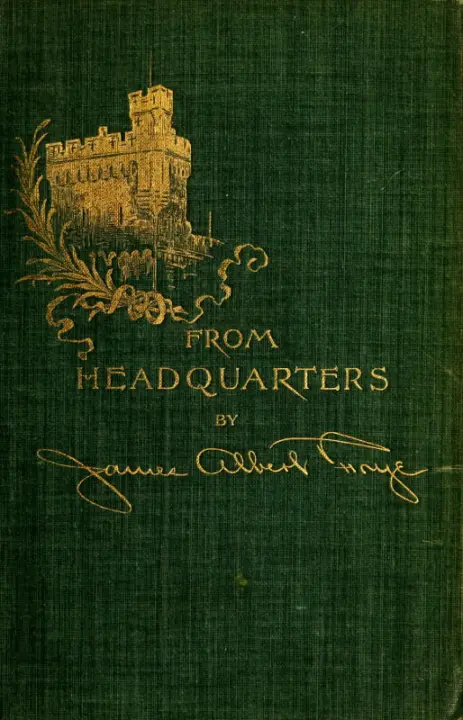
"Fables of Field and Staff" by James A. Frye is a collection of whimsical fables likely written in the late 19th century. The book details the amusing and sometimes outrageous experiences of a volunteer infantry regiment during peacetime, bringing to life the camaraderie and peculiarities of military life. Through its narratives, it explores a series of events surrounding the characters within the regiment, including various officers and a veteran named Sam, who often serves as a storyteller. At the start of the book, the tone is set with a preface that hints at the jests and camaraderie intrinsic to military culture. As the narrative unfolds, we are introduced to the mundane yet humorous atmosphere of the regiment, where a solitary and sleepy room serves as the backdrop for conversations among officers. One officer, Bones, recounts an amusing tale involving a previous captain named Merrowbank, whose misguided belief in the divine protection of his regiment led to a comical inspection debacle, ultimately resulting in the company being mockingly referred to as "The Forty Thieves." This blend of humor, military life anecdotes, and unique characters invites readers to indulge in the light-hearted exploration of life within the ranks.
Introduction adapted from the source catalogue; source summaries may be automatically generated.
Free to read · English · 37,232 words · No account needed
MAKE TIME FOR A GOOD BOOK
On by default. Untick to stop anonymous reading totals. Each page counts after 10 seconds in view. How this works.
Anonymous counting is on unless you have switched it off.
It was nearing nine o’clock. Colonel Elliott glanced at his watch, and then leaned back in his chair with the comfortable consciousness that his evening’s work was over. One by one he had gone through the pile of papers that he had found upon his desk. He had written, “Respectfully forwarded, approved,” upon each in its turn, and now they were ready to go to the adjutant, to be entered up and sent along upon their sluggish travels “through channels.”
The colonel gathered the scattered documents into a bunch, snapped a rubber band about them, and then called, “Orderly!”
“Take these papers to the adjutant,” said the chief, as a soldier stepped promptly into the room, with his hand at his cap. “Then find Major Pollard, and say to him, with my compliments, that I’d like him to report to me here.”
The orderly saluted, and disappeared. The colonel bit the tip from a cigar, lighted it, and then drew from his pocket a half dozen letters. Rapidly running through them, he picked out one, tossed it upon his desk, and then, letting his head fall back, he fixed his eyes upon the ceiling, and smoked away in thoughtful silence.
Along the broad corridors of the armory echoed the steady tramp of feet, the rattle of arms, and the sharp commands of the line officers, for it was a regular drill-night of The Third, and four of the regiment’s twelve companies were at work in the great hall lying beyond the administrative rooms. Presently, above the hum of the other sounds, the colonel heard quick, firm footsteps approaching his door, and in a moment Major Pollard and Van Sickles, of the staff, came into the room.
“You sent for me, Colonel?” said the major, inquiringly.
“Yes,” said the chief, adding, as Van Sickles made a motion as if to withdraw, “I’d like to have you stay, Van. I’ve something to tell that’ll answer a question you once asked me.”
Both drew up chairs. The colonel passed over his cigar case, and then said, “A year ago you fellows got me to talking, one night up in The Battery, about something that happened while I was out with the ‘Old Regiment.’ As I recall it, I told you a yarn about the resurrection of Bob Sheldon, and you, Van, asked me, when I’d finished, what had become of Bob since the war. Do you remember?”
“Sheldon?” said Van Sickles. “Oh, yes. He was the man that was brained by a splinter of shell, and afterwards came to time all right. Your old captain, wasn’t he? Yes, I remember.”
Your reading position is saved on this browser. Take it to another device with a library code. Reading pages adapt to text, rather than matching a printed edition.
James A. (James Albert) Frye

James A. (James Albert) Frye
BEHIND THE BOOK
This eBook is for the use of anyone anywhere in the United States and most other parts of the world at no cost and with almost no restrictions whatsoever. You may copy it, give it away or re-use it under the terms of the Project Gutenberg License included with this eBook or online at www.gutenberg.org. If you are not located in the United States, you will have to check the laws of the country where you are located before using this eBook. Read the source licence.
The original source file, including credits and licence, is retained by this library. Request an original-format copy at no charge. Please include the book title and Project Gutenberg identifier #48545.
KEEP YOUR CURIOSITY GOING
Coulson Kernahan

Maurice Baring
Frances Wright
Cécile Tormay

Frederic Jesup Stimson

W. H. P. (William Henry Pope) Jarvis


