
Letters to a Friend, Written to Mrs. Ezra S. Carr, 1866-1879
John Muir
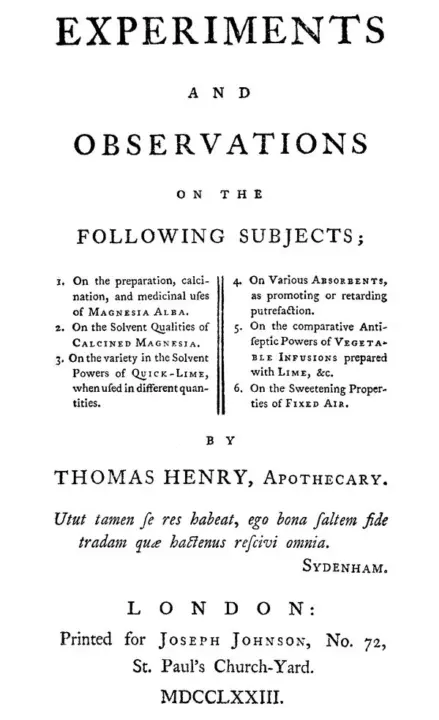
THE CLASSIC COLLECTION · 1773
"Experiments and Observations on the Following Subjects" by Thomas Henry is a scientific publication written in the late 18th century. The work focuses on pharmacological inquiries and the preparation of medicinal substances, particularly magnesia alba. It presents a series of experiments and observations that aim to improve understanding and methodology in chemical pharmacy. At the start of the treatise, the author dedicates his work to Thomas Percival, expressing gratitude for his influence on his experimental pursuits. The preface highlights the importance of precise composition in medicine and suggests that apothecaries should take an active role in furthering chemical knowledge. The opening chapters detail an improved method for preparing magnesia alba, discussing its medicinal properties, and methods of preparation while criticizing the existing practices in the field. Henry emphasizes the need for purity in medicinal substances and outlines how various factors influence the effectiveness of drugs prepared from magnesia.
Introduction adapted from the source catalogue; source summaries may be automatically generated.
Free to read · English · 18,307 words · No account needed
MAKE TIME FOR A GOOD BOOK
On by default. Untick to stop anonymous reading totals. Each page counts after 10 seconds in view. How this works.
Anonymous counting is on unless you have switched it off.
Two drachms of snake root were rubbed for fifteen minutes with the above-mentioned different proportions of distilled water, quick-lime and lime water, and lime water alone.
Number 1 was a dark brown tincture, tasting strongly of the serpentaria.
Number 2, straw coloured, taste of the lime disagreeable, that of the
root not distinguishable.
Number 3, amber coloured, tastes of the root.
Two drachms of Columbo being triturated in the same manner,
Number 1, dark brown tincture; tastes much of the Columbo.
Number 2, yellow; faint taste of the Columbo, but that of the lime very
disagreeably prevalent.
Number 3, colour as number 1; but tastes more highly of the Columbo.
Two drachms of contrayerva root with the same treatment yielded in the
following proportions:
Number 1 gave a pale brown tincture, tasting of the contrayerva.
Number 2, bright amber colour; taste of the lime so strong as to admit
of no other.
Number 3 exceeded number 1 both in colour and taste.
Jalap being triturated in the same proportions,
Number 1 dark brown; taste of the jalap strong.
Number 2 pale yellow; taste of the lime predominant, though that of the
jalap perceptible.
Number 3, colour not quite so high as number 1, but equal in taste.
The result of the same trial with ipecacuanha was, that number 1 was of a light brown colour, tasting highly of the ipecacuanha.
Number 2 was of a deep yellow, having the same disagreeable taste of the lime complained of in the other tinctures, but that of the ipecacuanha scarcely perceptible.
Number 3 produced a tincture of the colour of red port wine, strongly flavoured with the ipecacuanha, though it had not so much of the distinguishing sharpness of that root as number 1.
The different tinctures of rhubarb, prepared in the same manner as above, had the following appearances:
Number 1 brown, with a yellowish tinge, strongly impregnated with the
taste of the rhubarb.
Number 2 deep yellow, taste of the lime as in the other tinctures
prepared with it.
Number 3 crimson; taste of the rhubarb strong, but unequal to number 1.
None of the tinctures prepared with lime water grew turbid from a stream of fixed air being conveyed into them.
Hence it appears that the triture of quick-lime with all the above roots did not in the least degree promote, but rather impede their solution in water; that lime water extracts the soluble parts of many, and especially their colouring principles, more powerfully than distilled water; but that this is by no means always the case, as in three instances out of six, the tinctures prepared with distilled water exceeded those with lime water in taste, and in two instances were superiour, and in one equal in colour.
Your reading position is saved on this browser. Take it to another device with a library code. Reading pages adapt to text, rather than matching a printed edition.
BEHIND THE BOOK
This eBook is for the use of anyone anywhere in the United States and most other parts of the world at no cost and with almost no restrictions whatsoever. You may copy it, give it away or re-use it under the terms of the Project Gutenberg License included with this eBook or online at www.gutenberg.org. If you are not located in the United States, you will have to check the laws of the country where you are located before using this eBook. Read the source licence.
The original source file, including credits and licence, is retained by this library. Request an original-format copy at no charge. Please include the book title and Project Gutenberg identifier #46143.
KEEP YOUR CURIOSITY GOING
John Muir

Asa Gray
Asa Gray

Florence Nightingale
Elizabeth Robins Pennell
Denison Olmsted