THE CLASSIC COLLECTION✦The whistleCLASSIC FREE BOOKS
The whistle
Benjamin Franklin
THE CLASSIC COLLECTION · 1751
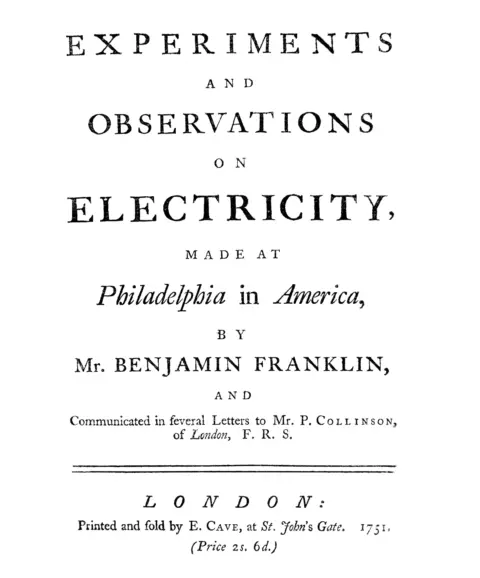
"Experiments and Observations on Electricity Made at Philadelphia in America" by Benjamin Franklin is a scientific publication written in the mid-18th century. This work comprises a series of letters detailing Franklin's experiments and observations regarding electricity, offering insights into the nature and behavior of electrical phenomena. It serves as a pivotal contribution to the understanding of electricity during the Enlightenment period. The opening of the book introduces the author’s initial forays into electrical experiments, revealing that his findings were initially intended for private amusement rather than publication. Franklin discusses specific experiments, such as the behavior of charged glass bottles and the effects of electricity on various objects, while outlining both conclusions and conjectures regarding the nature of electrical charges and discharges. He emphasizes the empirical foundation of his work, demonstrating a thoughtful approach to understanding the complexities of electricity and its potential applications, hinting at broader implications such as safety measures associated with lightning.
Introduction adapted from the source catalogue; source summaries may be automatically generated.
Free to read · English · 23,304 words · No account needed
MAKE TIME FOR A GOOD BOOK
On by default. Untick to stop anonymous reading totals. Each page counts after 10 seconds in view. How this works.
Anonymous counting is on unless you have switched it off.
Take a wire bent in the form of a C, with a stick of wax fixed to the outside of the curve, to hold it by; and apply one end of this wire to the coating, and the other at the same time to the prime conductor, the phial will be discharged; and if the balls are not electrified before the discharge, neither will they appear to be so after the discharge, for they will not repel each other.
Now if the fire discharged from the inside surface of the bottle through its wire, remained on the prime conductor, the balls would be electrified and recede from each other.
If the phial really exploded at both ends, and discharged fire from both coating and wire, the balls would be more electrified and recede farther: for none of the fire can escape, the wax handle preventing.
But if the fire, with which the inside surface is surcharged, be so much precisely as is wanted by the outside surface, it will pass round through the wire fixed to the wax handle, restore the equilibrium in the glass, and make no alteration in the state of the prime conductor.
Accordingly we find, that if the prime conductor be electrified, and the cork balls in a state of repellency before the bottle is charged, they continue so afterwards. If not, they are not electrified by that discharge.
CORRECTIONS and ADDITIONS
to the PRECEDING PAPERS.
Page 2, Sect. 1. We since find, that the fire in the bottle is not contained in the non-electric, but in the glass. All that is after said of the top and bottom of the bottle, is true of the inside and outside surfaces, and should have been so expressed. See Sect. 16, p. 16.
Page 6, Line 13. The equilibrium will soon be restored but silently, etc. This must have been a mistake. When the bottle is full charged, the crooked wire cannot well be brought to touch the top and bottom so quick, but that there will be a loud spark; unless the points be sharp, without loops.
Ibid. line ult. Outside: add, such moisture continuing up to the cork or
wire.
Page 12, line 14. By candle-light etc. From some observations since made, I am inclined to think, that it is not the light, but the smoke or non-electric effluvia from the candle, coal, and red-hot iron, that carry off the electrical fire, being first attracted and then repelled.
Page 13, line 15. Windmil wheels, &c. We afterwards discovered, that the afflux or efflux of the electrical fire, was not the cause of the motions of those wheels, but various circumstances of attraction and repulsion.
Your reading position is saved on this browser. Take it to another device with a library code. Reading pages adapt to text, rather than matching a printed edition.
BEHIND THE BOOK
This eBook is for the use of anyone anywhere in the United States and most other parts of the world at no cost and with almost no restrictions whatsoever. You may copy it, give it away or re-use it under the terms of the Project Gutenberg License included with this eBook or online at www.gutenberg.org. If you are not located in the United States, you will have to check the laws of the country where you are located before using this eBook. Read the source licence.
The original source file, including credits and licence, is retained by this library. Request an original-format copy at no charge. Please include the book title and Project Gutenberg identifier #45515.
KEEP YOUR CURIOSITY GOING

David Patterson (Spirit) Hatch

David Patterson (Spirit) Hatch

David Patterson (Spirit) Hatch
Cécile Tormay

Moritz Busch
John L. Ransom