THE CLASSIC COLLECTION✦The whistleCLASSIC FREE BOOKS
The whistle
Benjamin Franklin
THE CLASSIC COLLECTION · 1751
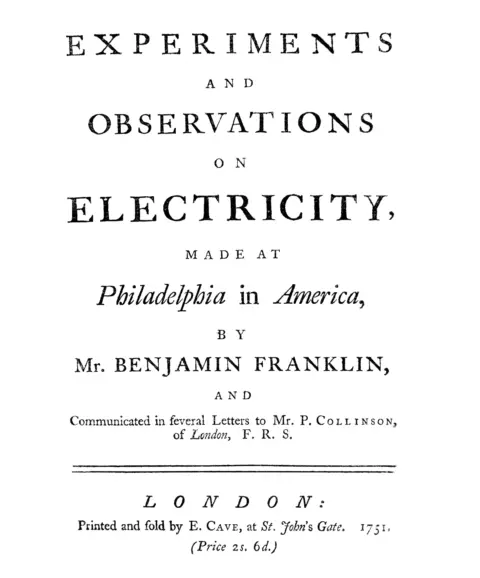
"Experiments and Observations on Electricity Made at Philadelphia in America" by Benjamin Franklin is a scientific publication written in the mid-18th century. This work comprises a series of letters detailing Franklin's experiments and observations regarding electricity, offering insights into the nature and behavior of electrical phenomena. It serves as a pivotal contribution to the understanding of electricity during the Enlightenment period. The opening of the book introduces the author’s initial forays into electrical experiments, revealing that his findings were initially intended for private amusement rather than publication. Franklin discusses specific experiments, such as the behavior of charged glass bottles and the effects of electricity on various objects, while outlining both conclusions and conjectures regarding the nature of electrical charges and discharges. He emphasizes the empirical foundation of his work, demonstrating a thoughtful approach to understanding the complexities of electricity and its potential applications, hinting at broader implications such as safety measures associated with lightning.
Introduction adapted from the source catalogue; source summaries may be automatically generated.
Free to read · English · 23,304 words · No account needed
MAKE TIME FOR A GOOD BOOK
On by default. Untick to stop anonymous reading totals. Each page counts after 10 seconds in view. How this works.
Anonymous counting is on unless you have switched it off.
35. Thus I take the difference between non electrics and glass, an electric per se, to consist in these two particulars. 1st, That a non-electric easily suffers a change in the quantity of the electrical fluid it contains. You may lessen its whole quantity by drawing out a part, which the whole body will again resume; but of glass you can only lessen the quantity contain'd in one of its surfaces; and not that, but by supplying an equal quantity at the same time to the other surface; so that the whole glass may always have the same quantity in the two surfaces, their two different quantities being added together. And this can only be done in glass that is thin; beyond a certain thickness we have yet no power that can make this change. And, 2dly, that the electrical fire freely removes from place to place, in and through the substance of a non-electric, but not so through the substance of glass. If you offer a quantity to one end of a long rod of metal, it receives it, and when it enters, every particle that was before in the rod, pushes its neighbour quite to the further end, where the overplus is discharg'd; and this instantaneously where the rod is part of the circle in the experiment of the shock. But glass, from the smallness of its pores, or stronger attraction of what it contains, refuses to admit so free a motion; a glass rod will not conduct a shock, nor will the thinnest glass suffer any particle entring one of its surfaces to pass thro' to the other.
36. Hence we see the impossibility of success, in the experiments propos'd, to draw out the effluvial virtues of a non-electric, as cinnamon for instance, and mixing them with the electrical fluid, to convey them with that into the body, by including it in the globe, and then applying friction, etc. For though the effluvia of cinnamon, and the electrical fluid should mix within the globe, they would never come out together through the pores of the glass, and so go to the prime conductor; for the electrical fluid itself cannot come through; and the prime conductor is always supply'd from the cushion, and that from the floor. And besides, when the globe is filled with cinnamon, or other non-electric, no electrical fluid can be obtain'd from its outer surface, for the reason before-mentioned. I have try'd another way, which I thought more likely to obtain a mixture of the electrical and other effluvia together, if such a mixture had been possible. I placed a glass plate under my cushion, to cut off the communication between the cushion and floor; then brought a small chain from the cushion into a glass of oil of turpentine, and carried another chain from the oil of turpentine to the floor, taking care that the chain from the cushion to the glass touch'd no part of the frame of the machine. Another chain was fix'd to the prime conductor, and held in the hand of a person to be electrised. The ends of the two chains in the glass were near an inch distant from each other, the oil of turpentine between. Now the globe being turn'd, could draw no fire from the floor through the machine, the communication that way being cut off by the thick glass plate under the cushion: it must then draw it through the chains whose ends were dipt in the oil of turpentine. And as the oil of turpentine being an electric per se, would not conduct what came up from the floor, was obliged to jump from the end of one chain, to the end of the other, through the substance of that oil, which we could see in large sparks; and so it had a fair opportunity of seizing some of the finest particles of the oil in its passage, and carrying them off with it: but no such effect followed, nor could I perceive the least difference in the smell of the electrical effluvia thus collected, from what it has when collected otherwise; nor does it otherwise affect the body of a person electrised. I likewise put into a phial, instead of water, a strong purgative liquid, and then charged the phial, and took repeated shocks from it, in which case every particle of the electrical fluid must, before it went through my body, have first gone through the liquid when the phial is charging, and returned through it when discharging, yet no other effect followed than if it had been charged with water. I have also smelt the electrical fire when drawn through gold, silver, copper, lead, iron, wood, and the human body, and could perceive no difference; the odour is always the same where the spark does not burn what it strikes; and therefore I imagine it does not take that smell from any quality of the bodies it passes through. And indeed, as that smell so readily leaves the electrical matter, and adheres to the knuckle receiving the sparks, and to other things; I suspect that it never was connected with it, but arises instantaneously from something in the air acted upon by it. For if it was fine enough to come with the electrical fluid through the body of one person, why should it stop on the skin of another?
Your reading position is saved on this browser. Take it to another device with a library code. Reading pages adapt to text, rather than matching a printed edition.
BEHIND THE BOOK
This eBook is for the use of anyone anywhere in the United States and most other parts of the world at no cost and with almost no restrictions whatsoever. You may copy it, give it away or re-use it under the terms of the Project Gutenberg License included with this eBook or online at www.gutenberg.org. If you are not located in the United States, you will have to check the laws of the country where you are located before using this eBook. Read the source licence.
The original source file, including credits and licence, is retained by this library. Request an original-format copy at no charge. Please include the book title and Project Gutenberg identifier #45515.
KEEP YOUR CURIOSITY GOING

David Patterson (Spirit) Hatch

David Patterson (Spirit) Hatch

David Patterson (Spirit) Hatch
Cécile Tormay

Moritz Busch
John L. Ransom