THE CLASSIC COLLECTION✦The whistleCLASSIC FREE BOOKS
The whistle
Benjamin Franklin
THE CLASSIC COLLECTION · 1751
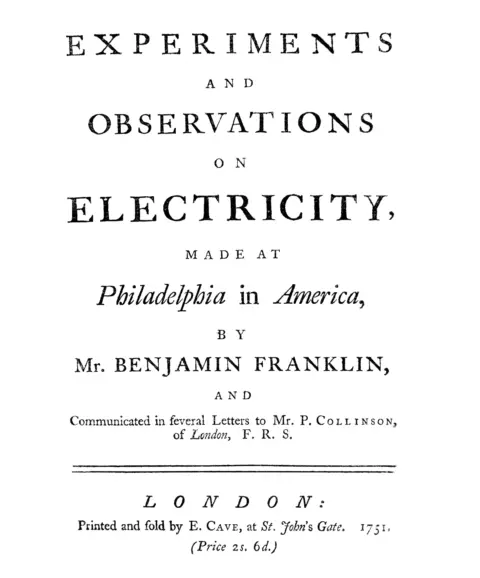
"Experiments and Observations on Electricity Made at Philadelphia in America" by Benjamin Franklin is a scientific publication written in the mid-18th century. This work comprises a series of letters detailing Franklin's experiments and observations regarding electricity, offering insights into the nature and behavior of electrical phenomena. It serves as a pivotal contribution to the understanding of electricity during the Enlightenment period. The opening of the book introduces the author’s initial forays into electrical experiments, revealing that his findings were initially intended for private amusement rather than publication. Franklin discusses specific experiments, such as the behavior of charged glass bottles and the effects of electricity on various objects, while outlining both conclusions and conjectures regarding the nature of electrical charges and discharges. He emphasizes the empirical foundation of his work, demonstrating a thoughtful approach to understanding the complexities of electricity and its potential applications, hinting at broader implications such as safety measures associated with lightning.
Introduction adapted from the source catalogue; source summaries may be automatically generated.
Free to read · English · 23,304 words · No account needed
MAKE TIME FOR A GOOD BOOK
On by default. Untick to stop anonymous reading totals. Each page counts after 10 seconds in view. How this works.
Anonymous counting is on unless you have switched it off.
25. In one of my former papers, I mention'd, that gilding on a book, though at first it communicated the shock perfectly well, yet fail'd after a few experiments, which we could not account for. We have since found, that one strong shock breaks the continuity of the gold in the filleting, and makes it look rather like dust of gold, abundance of its parts being broken and driven off; and it will seldom conduct above one strong shock. Perhaps this may be the reason; when there is not a perfect continuity in the circle, the fire must leap over the vacancies; there is a certain distance which it is able to leap over according to its strength; if a number of small vacancies, though each be very minute, taken together exceed that distance, it cannot leap over them, and so the shock is prevented.
26. From the before mentioned law of electricity, that points, as they are more or less acute, draw on and throw off the electrical fluid with more or less power, and at greater or less distances, and in larger or smaller quantities in the same time, we may see how to account for the situation of the leaf of gold suspended between two plates, the upper one continually electrified, the under one in a person's hand standing on the floor. When the upper plate is electrified, the leaf is attracted and raised towards it, and would fly to that plate were it not for its own points. The corner that happens to be uppermost when the leaf is rising, being a sharp point, from the extream thinness of the gold, draws and receives at a distance a sufficient quantity of the electrical fluid to give itself an electrical atmosphere, by which its progress to the upper plate is stopt, and it begins to be repelled from that plate, and would be driven back to the under plate, but that its lowest corner is likewise a point, and throws off or discharges the overplus of the leaf's atmosphere, as fast as the upper corner draws it on. Were these two points perfectly equal in acuteness, the leaf would take place exactly in the middle space, for its Weight is a trifle, compared to the power acting on it: But it is generally nearest the unelectrified plate, because, when the leaf is offered to the electrified plate at a distance, the sharpest point is commonly first affected and raised towards it; so that point, from its greater acuteness, receiving the fluid faster than its opposite can discharge it at equal distances, it retires from the electrified plate, and draws nearer to the unelectrified plate, till it comes to a distance where the discharge can be exactly equal to the receipt, the latter being lessened, and the former encreased; and there it remains as long as the globe continues to supply fresh electrical matter. This will appear plain, when the difference of acuteness in the corners is made very great. Cut a piece of Dutch gold (which is fittest for these experiments on account of its greater strength) into the form of FIG. 10 the upper corner a right angle, the two next obtuse angles, and the lowest a very acute one; and bring this on your plate under the electrified plate, in such a manner as that the right-angled part may be first raised (which is done by covering the acute part with the hollow of your hand) and you will see this leaf take place much nearer to the upper than to the under plate; because, without being nearer, it cannot receive so fast at its right-angled point, as it can discharge at its acute one. Turn this leaf with the acute part uppermost, and then it takes place nearest the unelectrified plate, because otherwise it receives faster at its acute point than it can discharge at its right-angled one. Thus the difference of distance is always proportioned to the difference of acuteness. Take care in cutting your leaf to leave no little ragged particles on the edges, which sometimes form points where you would not have them. You may make this figure so acute below and blunt above, as to need no under plate, it discharging fast enough into the air. When it is made narrower, as the figure between the pricked lines, we call it the Golden Fish, from its manner of acting. For if you take it by the tail, and hold it at a foot or greater horizontal distance from the prime conductor, it will, when let go, fly to it with a brisk but wavering motion, like that of an eel through the water; it will then take place under the prime conductor, at perhaps a quarter or half an inch distance, and keep a continual shaking of its tail like a fish, so that it seems animated. Turn its tail towards the prime conductor, and then it flies to your finger, and seems to nibble it. And if you hold a plate under it at six or eight inches distance, and cease turning the Globe, when the electrical atmosphere of the conductor grows small, it will descend to the plate and swim back again several times with the same fish-like motion, greatly to the entertainment of spectators. By a little practice in blunting or sharpening the heads or tails of these figures, you may make them take place as desired, nearer, or farther from the electrified plate.
Your reading position is saved on this browser. Take it to another device with a library code. Reading pages adapt to text, rather than matching a printed edition.
BEHIND THE BOOK
This eBook is for the use of anyone anywhere in the United States and most other parts of the world at no cost and with almost no restrictions whatsoever. You may copy it, give it away or re-use it under the terms of the Project Gutenberg License included with this eBook or online at www.gutenberg.org. If you are not located in the United States, you will have to check the laws of the country where you are located before using this eBook. Read the source licence.
The original source file, including credits and licence, is retained by this library. Request an original-format copy at no charge. Please include the book title and Project Gutenberg identifier #45515.
KEEP YOUR CURIOSITY GOING

David Patterson (Spirit) Hatch

David Patterson (Spirit) Hatch

David Patterson (Spirit) Hatch
Cécile Tormay

Moritz Busch
John L. Ransom