THE CLASSIC COLLECTION✦Familiar Letters The Writings of Henry David Thoreau, Volume 06 (of 20)CLASSIC FREE BOOKS
Familiar Letters The Writings of Henry David Thoreau, Volume 06 (of 20)
Henry David Thoreau
THE CLASSIC COLLECTION · 1840
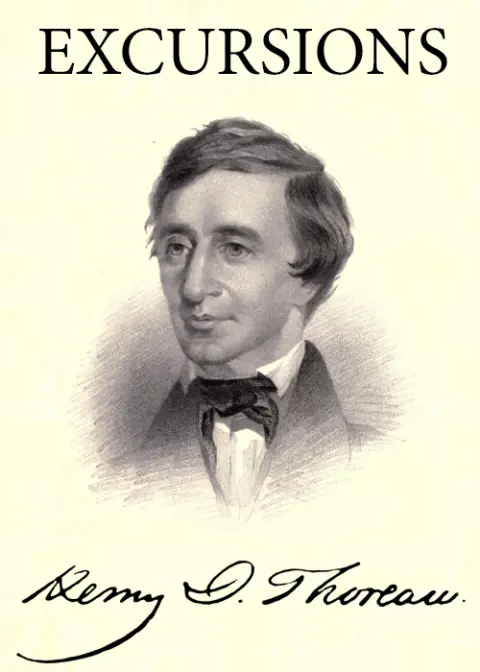
"Excursions" by Henry David Thoreau is a collection of essays and nature writings reflective of the mid-19th century. The work explores Thoreau's contemplative relationship with nature, his philosophies on life, and his experiences during his walks in the natural landscapes of Massachusetts. Each essay serves as a window into his thoughts on natural history, society, and personal freedom, showcasing his profound appreciation for the environment. The opening of "Excursions" includes a biographical sketch by Ralph Waldo Emerson that introduces Thoreau's character, emphasizing his independence, intellectual pursuits, and connection to nature. Thoreau is depicted as a nonconformist, choosing a life of solitude and study rather than conventional employment, and living simply while immersed in the natural world around him. Emerson outlines Thoreau's encounters and experiments with nature, including his work as a land surveyor, and hints at his various explorations of philosophical and moral questions throughout his life and writings. This foundational sketch sets the tone for the essays that follow, highlighting Thoreau's unique perspective and commitment to understanding the deeper truths of existence as expressed through the beauty of the natural world.
Introduction adapted from the source catalogue; source summaries may be automatically generated.
Free to read · English · 71,955 words · No account needed
MAKE TIME FOR A GOOD BOOK
On by default. Untick to stop anonymous reading totals. Each page counts after 10 seconds in view. How this works.
Anonymous counting is on unless you have switched it off.
Here at length we have free range, as not in palaces, nor cottages, nor temples, and intrude nowhere. All the secrets of housekeeping are exhibited to the eyes of men, above and below, before and behind. This is the necessary way to live, men have confessed, in these days, and shall he skulk and hide? And why should we have any serious disgust at kitchens? Perhaps they are the holiest recess of the house. There is the hearth, after all,—and the settle, and the fagots, and the kettle, and the crickets. We have pleasant reminiscences of these. They are the heart, the left ventricle, the very vital part of the house. Here the real and sincere life which we meet in the streets was actually fed and sheltered. Here burns the taper that cheers the lonely traveller by night, and from this hearth ascend the smokes that populate the valley to his eyes by day. On the whole, a man may not be so little ashamed of any other part of his house, for here is his sincerity and earnest, at least. It may not be here that the besoms are plied most,—it is not here that they need to be, for dust will not settle on the kitchen floor more than in nature.
Hence it will not do for the Landlord to possess too fine a nature. He must have health above the common accidents of life, subject to no modern fashionable diseases; but no taste, rather a vast relish or appetite. His sentiments on all subjects will be delivered as freely as the wind blows; there is nothing private or individual in them, though still original, but they are public, and of the hue of the heavens over his house,—a certain out-of-door obviousness and transparency not to be disputed. What he does, his manners are not to be complained of, though abstractly offensive, for it is what man does, and in him the race is exhibited. When he eats, he is liver and bowels, and the whole digestive apparatus to the company, and so all admit the thing is done. He must have no idiosyncrasies, no particular bents or tendencies to this or that, but a general, uniform, and healthy development, such as his portly person indicates, offering himself equally on all sides to men. He is not one of your peaked and inhospitable men of genius, with particular tastes, but, as we said before, has one uniform relish, and taste which never aspires higher than a tavern-sign, or the cut of a weather-cock. The man of genius, like a dog with a bone, or the slave who has swallowed a diamond, or a patient with the gravel, sits afar and retired, off the road, hangs out no sign of refreshment for man and beast, but says, by all possible hints and signs, I wish to be alone—good-by—farewell. But the landlord can afford to live without privacy. He entertains no private thought, he cherishes no solitary hour, no Sabbath day, but thinks,—enough to assert the dignity of reason,—and talks, and reads the newspaper. What he does not tell to one traveller, he tells to another. He never wants to be alone, but sleeps, wakes, eats, drinks, sociably, still remembering his race. He walks abroad through the thoughts of men, and the Iliad and Shakspeare are tame to him, who hears the rude but homely incidents of the road from every traveller. The mail might drive through his brain in the midst of his most lonely soliloquy, without disturbing his equanimity, provided it brought plenty of news and passengers. There can be no pro-fanity where there is no fane behind, and the whole world may see quite round him. Perchance his lines have fallen to him in dustier places, and he has heroically sat down where two roads meet, or at the Four Corners, or the Five Points, and his life is sublimely trivial for the good of men. The dust of travel blows ever in his eyes, and they preserve their clear, complacent look. The hourlies and half-hourlies, the dailies and weeklies, whirl on well-worn tracks, round and round his house, as if it were the goal in the stadium, and still he sits within in unruffled serenity, with no show of retreat. His neighbor dwells timidly behind a screen of poplars and willows, and a fence with sheaves of spears at regular intervals, or defended against the tender palms of visitors by sharp spikes,—but the traveller’s wheels rattle over the door-step of the tavern, and he cracks his whip in the entry. He is truly glad to see you, and sincere as the bull’s-eye over his door. The traveller seeks to find, wherever he goes, some one who will stand in this broad and catholic relation to him, who will be an inhabitant of the land to him a stranger, and represent its human nature, as the rock stands for its inanimate nature; and this is he. As his crib furnishes provender for the traveller’s horse, and his larder provisions for his appetite, so his conversation furnishes the necessary aliment to his spirits. He knows very well what a man wants, for he is a man himself, and as it were the farthest travelled, though he has never stirred from his door. He understands his needs and destiny. He would be well fed and lodged, there can be no doubt, and have the transient sympathy of a cheerful companion, and of a heart which always prophesies fair weather. And after all the greatest men, even, want much more the sympathy which every honest fellow can give, than that which the great only can impart. If he is not the most upright, let us allow him this praise, that he is the most downright of men. He has a hand to shake and to be shaken, and takes a sturdy and unquestionable interest in you, as if he had assumed the care of you, but if you will break your neck, he will even give you the best advice as to the method.
Your reading position is saved on this browser. Take it to another device with a library code. Reading pages adapt to text, rather than matching a printed edition.
Henry David Thoreau

Henry David Thoreau

Henry David Thoreau
Henry David Thoreau
BEHIND THE BOOK
This eBook is for the use of anyone anywhere in the United States and most other parts of the world at no cost and with almost no restrictions whatsoever. You may copy it, give it away or re-use it under the terms of the Project Gutenberg License included with this eBook or online at www.gutenberg.org. If you are not located in the United States, you will have to check the laws of the country where you are located before using this eBook. Read the source licence.
The original source file, including credits and licence, is retained by this library. Request an original-format copy at no charge. Please include the book title and Project Gutenberg identifier #9846.
KEEP YOUR CURIOSITY GOING

David Patterson (Spirit) Hatch

David Patterson (Spirit) Hatch

David Patterson (Spirit) Hatch

Ralph Waldo Emerson

Maurice Baring

Oscar Wilde & James McNeill Whistler