THE CLASSIC COLLECTION✦Familiar Letters The Writings of Henry David Thoreau, Volume 06 (of 20)CLASSIC FREE BOOKS
Familiar Letters The Writings of Henry David Thoreau, Volume 06 (of 20)
Henry David Thoreau
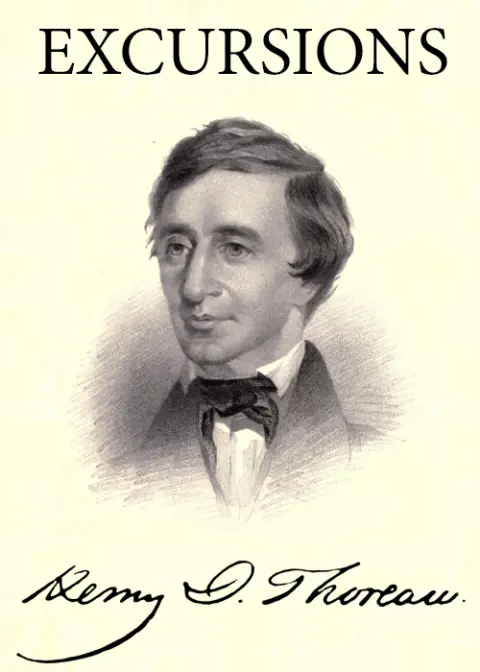
THE CLASSIC COLLECTION · 1840
"Excursions" by Henry David Thoreau is a collection of essays and nature writings reflective of the mid-19th century. The work explores Thoreau's contemplative relationship with nature, his philosophies on life, and his experiences during his walks in the natural landscapes of Massachusetts. Each essay serves as a window into his thoughts on natural history, society, and personal freedom, showcasing his profound appreciation for the environment. The opening of "Excursions" includes a biographical sketch by Ralph Waldo Emerson that introduces Thoreau's character, emphasizing his independence, intellectual pursuits, and connection to nature. Thoreau is depicted as a nonconformist, choosing a life of solitude and study rather than conventional employment, and living simply while immersed in the natural world around him. Emerson outlines Thoreau's encounters and experiments with nature, including his work as a land surveyor, and hints at his various explorations of philosophical and moral questions throughout his life and writings. This foundational sketch sets the tone for the essays that follow, highlighting Thoreau's unique perspective and commitment to understanding the deeper truths of existence as expressed through the beauty of the natural world.
Introduction adapted from the source catalogue; source summaries may be automatically generated.
Free to read · English · 71,955 words · No account needed
MAKE TIME FOR A GOOD BOOK
On by default. Untick to stop anonymous reading totals. Each page counts after 10 seconds in view. How this works.
Anonymous counting is on unless you have switched it off.
No ripple shows Musketaquid,
Her very current e’en is hid,
As deepest souls do calmest rest,
When thoughts are swelling in the breast,
And she that in the summer’s drought
Doth make a rippling and a rout,
Sleeps from Nabshawtuck to the Cliff,
Unruffled by a single skiff.
But by a thousand distant hills
The louder roar a thousand rills,
And many a spring which now is dumb,
And many a stream with smothered hum,
Doth swifter well and faster glide,
Though buried deep beneath the tide.
Our village shows a rural Venice,
Its broad lagoons where yonder fen is;
As lovely as the Bay of Naples
Yon placid cove amid the maples;
And in my neighbor’s field of corn
I recognize the Golden Horn.
Here Nature taught from year to year,
When only red men came to hear,
Methinks ’twas in this school of art
Venice and Naples learned their part;
But still their mistress, to my mind,
Her young disciples leaves behind.
The fisherman now repairs and launches his boat. The best time for spearing is at this season, before the weeds have begun to grow, and while the fishes lie in the shallow water, for in summer they prefer the cool depths, and in the autumn they are still more or less concealed by the grass. The first requisite is fuel for your crate; and for this purpose the roots of the pitchpine are commonly used, found under decayed stumps, where the trees have been felled eight or ten years.
With a crate, or jack, made of iron hoops, to contain your fire, and attached to the bow of your boat about three feet from the water, a fish-spear with seven tines, and fourteen feet long, a large basket, or barrow, to carry your fuel and bring back your fish, and a thick outer garment, you are equipped for a cruise. It should be a warm and still evening; and then with a fire crackling merrily at the prow, you may launch forth like a cucullo into the night. The dullest soul cannot go upon such an expedition without some of the spirit of adventure; as if he had stolen the boat of Charon and gone down the Styx on a midnight expedition into the realms of Pluto. And much speculation does this wandering star afford to the musing nightwalker, leading him on and on, jack-o’lantern-like, over the meadows; or, if he is wiser, he amuses himself with imagining what of human life, far in the silent night, is flitting mothlike round its candle. The silent navigator shoves his craft gently over the water, with a smothered pride and sense of benefaction, as if he were the phosphor, or light-bringer, to these dusky realms, or some sister moon, blessing the spaces with her light. The waters, for a rod or two on either hand and several feet in depth, are lit up with more than noonday distinctness, and he enjoys the opportunity which so many have desired, for the roofs of a city are indeed raised, and he surveys the midnight economy of the fishes. There they lie in every variety of posture; some on their backs, with their white bellies uppermost, some suspended in midwater, some sculling gently along with a dreamy motion of the fins, and others quite active and wide awake,—a scene not unlike what the human city would present. Occasionally he will encounter a turtle selecting the choicest morsels, or a musk-rat resting on a tussuck. He may exercise his dexterity, if he sees fit, on the more distant and active fish, or fork the nearer into his boat, as potatoes out of a pot, or even take the sound sleepers with his hands. But these last accomplishments he will soon learn to dispense with, distinguishing the real object of his pursuit, and find compensation in the beauty and never-ending novelty of his position. The pines growing down to the water’s edge will show newly as in the glare of a conflagration; and as he floats under the willows with his light, the song-sparrow will often wake on her perch, and sing that strain at midnight, which she had meditated for the morning. And when he has done, he may have to steer his way home through the dark by the north star, and he will feel himself some degrees nearer to it for having lost his way on the earth.
Your reading position is saved on this browser. Take it to another device with a library code. Reading pages adapt to text, rather than matching a printed edition.
Henry David Thoreau

Henry David Thoreau

Henry David Thoreau
Henry David Thoreau
BEHIND THE BOOK
This eBook is for the use of anyone anywhere in the United States and most other parts of the world at no cost and with almost no restrictions whatsoever. You may copy it, give it away or re-use it under the terms of the Project Gutenberg License included with this eBook or online at www.gutenberg.org. If you are not located in the United States, you will have to check the laws of the country where you are located before using this eBook. Read the source licence.
The original source file, including credits and licence, is retained by this library. Request an original-format copy at no charge. Please include the book title and Project Gutenberg identifier #9846.
KEEP YOUR CURIOSITY GOING

David Patterson (Spirit) Hatch

David Patterson (Spirit) Hatch

David Patterson (Spirit) Hatch

Ralph Waldo Emerson

Maurice Baring

Oscar Wilde & James McNeill Whistler