THE CLASSIC COLLECTION✦Familiar Letters The Writings of Henry David Thoreau, Volume 06 (of 20)CLASSIC FREE BOOKS
Familiar Letters The Writings of Henry David Thoreau, Volume 06 (of 20)
Henry David Thoreau
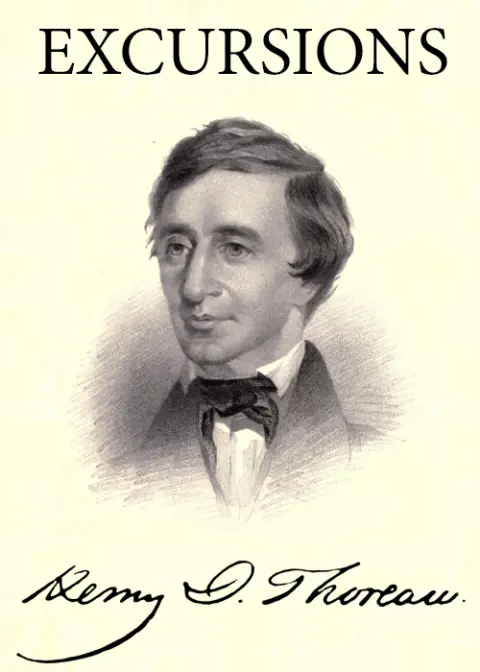
THE CLASSIC COLLECTION · 1840
"Excursions" by Henry David Thoreau is a collection of essays and nature writings reflective of the mid-19th century. The work explores Thoreau's contemplative relationship with nature, his philosophies on life, and his experiences during his walks in the natural landscapes of Massachusetts. Each essay serves as a window into his thoughts on natural history, society, and personal freedom, showcasing his profound appreciation for the environment. The opening of "Excursions" includes a biographical sketch by Ralph Waldo Emerson that introduces Thoreau's character, emphasizing his independence, intellectual pursuits, and connection to nature. Thoreau is depicted as a nonconformist, choosing a life of solitude and study rather than conventional employment, and living simply while immersed in the natural world around him. Emerson outlines Thoreau's encounters and experiments with nature, including his work as a land surveyor, and hints at his various explorations of philosophical and moral questions throughout his life and writings. This foundational sketch sets the tone for the essays that follow, highlighting Thoreau's unique perspective and commitment to understanding the deeper truths of existence as expressed through the beauty of the natural world.
Introduction adapted from the source catalogue; source summaries may be automatically generated.
Free to read · English · 71,955 words · No account needed
MAKE TIME FOR A GOOD BOOK
On by default. Untick to stop anonymous reading totals. Each page counts after 10 seconds in view. How this works.
Anonymous counting is on unless you have switched it off.
A small Red Maple has grown, perchance, far away at the head of some retired valley, a mile from any road, unobserved. It has faithfully discharged the duties of a Maple there, all winter and summer, neglected none of its economies, but added to its stature in the virtue which belongs to a Maple, by a steady growth for so many months, never having gone gadding abroad, and is nearer heaven than it was in the spring. It has faithfully husbanded its sap, and afforded a shelter to the wandering bird, has long since ripened its seeds and committed them to the winds, and has the satisfaction of knowing, perhaps, that a thousand little well-behaved Maples are already settled in life somewhere. It deserves well of Mapledom. Its leaves have been asking it from time to time, in a whisper, “When shall we redden?” And now, in this month of September, this month of travelling, when men are hastening to the sea-side, or the mountains, or the lakes, this modest Maple, still without budging an inch, travels in its reputation,—runs up its scarlet flag on that hillside, which shows that it has finished its summer’s work before all other trees, and withdraws from the contest. At the eleventh hour of the year, the tree which no scrutiny could have detected here when it was most industrious is thus, by the tint of its maturity, by its very blushes, revealed at last to the careless and distant traveller, and leads his thoughts away from the dusty road into those brave solitudes which it inhabits. It flashes out conspicuous with all the virtue and beauty of a Maple,—Acer rubrum. We may now read its title, or rubric, clear. Its virtues, not its sins, are as scarlet.
Notwithstanding the Red Maple is the most intense scarlet of any of our trees, the Sugar-Maple has been the most celebrated, and Michaux in his “Sylva” does not speak of the autumnal color of the former. About the second of October, these trees, both large and small, are most brilliant, though many are still green. In “sprout-lands” they seem to vie with one another, and ever some particular one in the midst of the crowd will be of a peculiarly pure scarlet, and by its more intense color attract our eye even at a distance, and carry off the palm. A large Red-Maple swamp, when at the height of its change, is the most obviously brilliant of all tangible things, where I dwell, so abundant is this tree with us. It varies much both in form and color. A great many are merely yellow, more scarlet, others scarlet deepening into crimson, more red than common. Look at yonder swamp of Maples mixed with Pines, at the base of a Pine-clad hill, a quarter of a mile off, so that you get the full effect of the bright colors, without detecting the imperfections of the leaves, and see their yellow, scarlet, and crimson fires, of all tints, mingled and contrasted with the green. Some Maples are yet green, only yellow or crimson-tipped on the edges of their flakes, like the edges of a Hazel-Nut burr; some are wholly brilliant scarlet, raying out regularly and finely every way, bilaterally, like the veins of a leaf; others, of more irregular form, when I turn my head slightly, emptying out some of its earthiness and concealing the trunk of the tree, seem to rest heavily flake on flake, like yellow and scarlet clouds, wreath upon wreath, or like snowdrifts driving through the air, stratified by the wind. It adds greatly to the beauty of such a swamp at this season, that, even though there may be no other trees interspersed, it is not seen as a simple mass of color, but, different trees being of different colors and hues, the outline of each crescent tree-top is distinct, and where one laps on to another. Yet a painter would hardly venture to make them thus distinct a quarter of a mile off.
Your reading position is saved on this browser. Take it to another device with a library code. Reading pages adapt to text, rather than matching a printed edition.
Henry David Thoreau

Henry David Thoreau

Henry David Thoreau
Henry David Thoreau
BEHIND THE BOOK
This eBook is for the use of anyone anywhere in the United States and most other parts of the world at no cost and with almost no restrictions whatsoever. You may copy it, give it away or re-use it under the terms of the Project Gutenberg License included with this eBook or online at www.gutenberg.org. If you are not located in the United States, you will have to check the laws of the country where you are located before using this eBook. Read the source licence.
The original source file, including credits and licence, is retained by this library. Request an original-format copy at no charge. Please include the book title and Project Gutenberg identifier #9846.
KEEP YOUR CURIOSITY GOING

David Patterson (Spirit) Hatch

David Patterson (Spirit) Hatch

David Patterson (Spirit) Hatch

Ralph Waldo Emerson

Maurice Baring

Oscar Wilde & James McNeill Whistler