
Last letters from the living dead man
David Patterson (Spirit) Hatch
THE CLASSIC COLLECTION · 1888
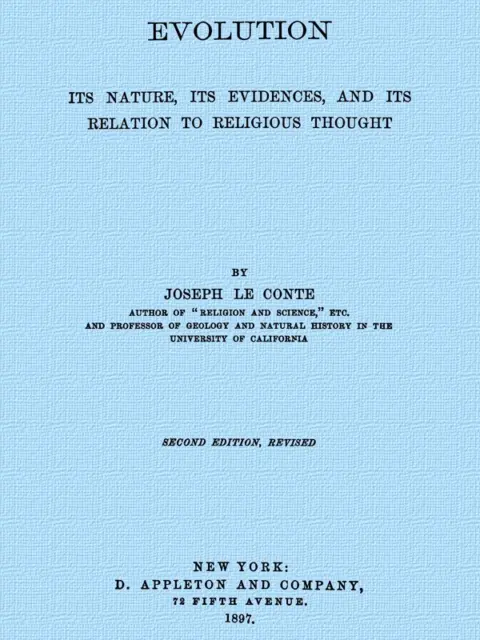
"Evolution: Its Nature, Its Evidences, and Its Relation to Religious Thought" by Joseph Le Conte is a scientific publication written in the late 19th century. The work explores the concept of evolution, its underlying principles, supporting evidence from various scientific fields, and its implications for religious beliefs. Le Conte aims to present a comprehensive yet accessible overview of evolution, making it relevant to both scientific and theological discussions. The opening of the book establishes its purpose, which is to clarify the definition of evolution and its universality across nature. Le Conte states that the concept of evolution is not solely applicable to biology, but extends to all areas of thought and scientific inquiry, including geology, sociology, and astronomy. He introduces the idea of continuous progressive change governed by specific laws and natural forces, arguing that evolution affects every aspect of existence and is fundamentally linked to the evolution of human thought and society. This framing sets the stage for a deeper exploration of evolutionary theory and its interactions with religious doctrines in the following chapters.
Introduction adapted from the source catalogue; source summaries may be automatically generated.
Free to read · English · 92,463 words · No account needed
MAKE TIME FOR A GOOD BOOK
On by default. Untick to stop anonymous reading totals. Each page counts after 10 seconds in view. How this works.
Anonymous counting is on unless you have switched it off.
[1] The term Chorology, used by Haeckel, nearly covers the ground.
[2] Ontos-gennao (individual-making, or genesis of the individual).
[3] Taxis, nomos (relating to science of arrangement).
[4] This statement is general; it will be modified hereafter.
[5] Phule-gennao (kind-making); genesis of the race.
[6] This formulation of the laws of organic succession was given by me in 1860, before I knew anything of either Darwin’s or Spencer’s evolution. They were my own mode of formulating Agassiz’s views.
[7] Genesis without previous life--spontaneous generation.
[8] Fishes were first introduced in the later Silurian; but became
dominant in the Devonian.
[9] Amphibians were introduced in the Carboniferous, but true reptile
not until the Permian.
[10] Of course I mean downward in social function. Individually the scavenger may be nobler than the statesman.
[11] Cope, “Science,” vol. ii, p. 274, 1883.
[12] Boston Society of Natural History--anniversary memoir, 1880. Also, “American Naturalist,” June, 1882.
[13] “Archives des Sciences,” vol. liv, 1875.
[14] “Nature,” vol. xxxi, p. 4, 1884.
[15] See abstract of Dr. Romanes’s views, “Nature,” vol. xxxiv, pp. 314, 336, 362. Also, discussions of the same by Meldola, Galton, Wallace, etc., in immediately subsequent numbers.
[16] This subject is more fully treated in chapter IX, p. 240 et seq.
[17] See an article entitled “Genesis of Sex,” “Popular Science Monthly,” 1879, vol. xvi, p. 167.
[18] Mr. Wallace has recently, in his work on “Darwinism,” taken strong ground against this Darwinian factor. He thinks, for example, that sexual vigor is the cause of both the splendor of color and the pertinacity which secures the female. We see little difference in this way of putting it. Our object, however, is not to argue the question of what are true factors, but simply to give the most accepted, and, as it seems to us, also the most probable view.
[19] By reason I mean the faculty of dealing with the phenomena of the inner world of consciousness and ideas. Animals live in one world--the outer world of sense; man in two--the outer world of sense, like animals, but also in an inner and higher world of ideas. All that is characteristic of man comes of this capacity of dealing with the inner world. In default of a better word I call it reason. If any one can suggest a better word, I will gladly adopt it.
[20] While all comparative anatomists agree that the lung is a diverticulum from the œsophagus, like the air-bladder of the gar-fish, some think that it is a different diverticulum, which is seen first in the dipnoi.
Your reading position is saved on this browser. Take it to another device with a library code. Reading pages adapt to text, rather than matching a printed edition.
BEHIND THE BOOK
This eBook is for the use of anyone anywhere in the United States and most other parts of the world at no cost and with almost no restrictions whatsoever. You may copy it, give it away or re-use it under the terms of the Project Gutenberg License included with this eBook or online at www.gutenberg.org. If you are not located in the United States, you will have to check the laws of the country where you are located before using this eBook. Read the source licence.
The original source file, including credits and licence, is retained by this library. Request an original-format copy at no charge. Please include the book title and Project Gutenberg identifier #46834.
KEEP YOUR CURIOSITY GOING
David Patterson (Spirit) Hatch

David Patterson (Spirit) Hatch

David Patterson (Spirit) Hatch
Coulson Kernahan

Ralph Waldo Emerson
Frances Wright