
Billy Topsail, M.D.: A Tale of Adventure With Doctor Luke of the Labrador
Norman Duncan
THE CLASSIC COLLECTION · 1906
"Every Man for Himself" by Norman Duncan is a novel written in the early 20th century. The story is set against the rugged backdrop of Newfoundland and follows the life of Tumm, a fisherman who shares tales of his experiences and the eccentric characters around him, particularly focusing on Abraham Botch, a contemplative man from Jug Cove. The narrative explores themes of existence, identity, and the relentless struggle for survival in a harsh, indifferent world. At the start of the novel, we are introduced to Tumm and the crew aboard the trader "Good Samaritan" as they anchor in Poor Man's Harbor during a snowstorm. Tumm engages the crew with a philosophical tale about souls and purpose, leading to an encounter with Abraham Botch, who ponders the nature of existence. Through Tumm's storytelling, we learn of Botch's deep questioning about life, the soul, and the universe, which sets the stage for the exploration of profound themes intertwining with the everyday struggles of the fishermen. Tumm's observations and interactions with Botch highlight the tension between whimsical thoughts and harsh realities, framing the novel's exploration of humanity's quest for understanding in an unforgiving environment.
Introduction adapted from the source catalogue; source summaries may be automatically generated.
Free to read · English · 62,156 words · No account needed
MAKE TIME FOR A GOOD BOOK
On by default. Untick to stop anonymous reading totals. Each page counts after 10 seconds in view. How this works.
Anonymous counting is on unless you have switched it off.
What was a shadow upon the gentle spirit of "By-an'-by" Brown was the sunlight of certain expectation irradiating "By-an'-by's" baby. But the maid fell ill. Nobody knew why. Suspicion dwelled like a skeleton with "By-an'-by" Brown; but this he did not divulge to Blunder Cove. Nothin' much the matter along o' she, said the Cove; jus' a little spell o' somethin' or other. It was a childish indisposition, perhaps--but come with fever and pallor and a poignant restlessness. "By-an'-by" Brown had never before known how like to a black cloud the future of a man might be. At any rate, she must be put to bed: whereupon, of course, "By-an'-by" Brown indefinitely put off going to bed, having rather stand watch, he said. It was presently a question at Blunder Cove: who was the more wan and pitiable, "By-an'-by's" baby, being sick, or "By-an'-by," being anxious? And there was no cure anywhere to be had--no cure for either. "By-an'-by" Brown conceived that the appearance of Long Bill Tweak would instantly work a miracle upon the maid. But where was Bill Tweak? There was no magic at hand to accomplish the feat of summoning a scamp from Nowhere!
One windy night "By-an'-by" Brown sat with the child to comfort her. "I 'low," he drawled, "that you wisht a wonderful sight that your father was here."
"Uh-huh!" the maid exclaimed.
Brown sighed. "I s'pose," he muttered.
"Is he comin'?" she demanded.
"Oh--by-an'-by!"
"I wisht 'twas now," said she. "That I does!"
Brown listened to the wind. It was blowing high and bitterly: a winter wind, with snow from the northeast. "By-an'-by" was troubled.
"I 'low," said he, hopelessly, "that you'll love un a sight, won't
ye?--when he comes?"
"Ye bet ye!" the maid answered.
"More'n ye love--some folks?"
"A lot," said she.
Brown was troubled. He heard the kitchen stove snore in its familiar way, the kettle bubble, the old wind assault the cottage he had builded for the baby; and he remembered recent years--and was troubled.
"Will ye love un more?" he asked, anxiously, turning his face from the child, "than ye loves me?" He hesitated. "Ye won't, will ye?" he implored.
"'Twill be different," said she.
"Will it?" he asked, rather vacantly.
"Ye see," she explained, "he'll be my father."
"Then," suggested "By-an'-by," "ye'll be goin' away along o' he?--when he
comes?"
"Oh, my, no!"
"Ye'll not? Ye'll stay along o' me?"
"Why, ye see," she began, bewildered, "I'll--why, o' course, I'll--oh," she complained, "what ye ask me that for?"
"Jus' couldn't help it," said "By-an'-by," humbly.
The maid began to cry.
Your reading position is saved on this browser. Take it to another device with a library code. Reading pages adapt to text, rather than matching a printed edition.
Norman Duncan
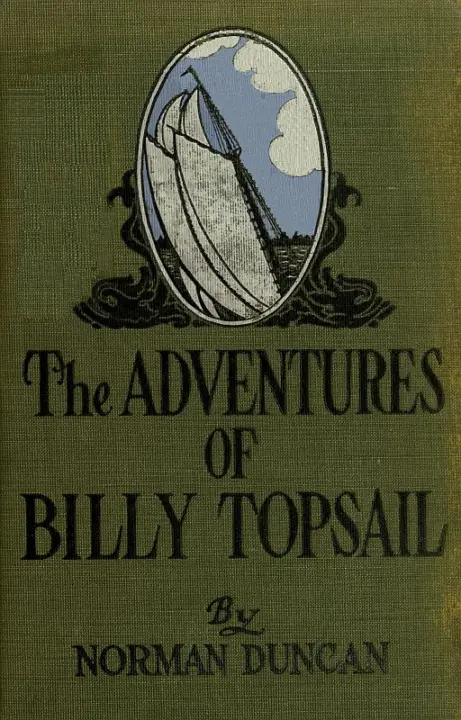
Norman Duncan
Norman Duncan
Norman Duncan
BEHIND THE BOOK
This eBook is for the use of anyone anywhere in the United States and most other parts of the world at no cost and with almost no restrictions whatsoever. You may copy it, give it away or re-use it under the terms of the Project Gutenberg License included with this eBook or online at www.gutenberg.org. If you are not located in the United States, you will have to check the laws of the country where you are located before using this eBook. Read the source licence.
The original source file, including credits and licence, is retained by this library. Request an original-format copy at no charge. Please include the book title and Project Gutenberg identifier #36998.
KEEP YOUR CURIOSITY GOING
Coulson Kernahan

Maurice Baring
Frances Wright
Cécile Tormay

Frederic Jesup Stimson

W. H. P. (William Henry Pope) Jarvis