
Billy Topsail, M.D.: A Tale of Adventure With Doctor Luke of the Labrador
Norman Duncan
THE CLASSIC COLLECTION · 1906
"Every Man for Himself" by Norman Duncan is a novel written in the early 20th century. The story is set against the rugged backdrop of Newfoundland and follows the life of Tumm, a fisherman who shares tales of his experiences and the eccentric characters around him, particularly focusing on Abraham Botch, a contemplative man from Jug Cove. The narrative explores themes of existence, identity, and the relentless struggle for survival in a harsh, indifferent world. At the start of the novel, we are introduced to Tumm and the crew aboard the trader "Good Samaritan" as they anchor in Poor Man's Harbor during a snowstorm. Tumm engages the crew with a philosophical tale about souls and purpose, leading to an encounter with Abraham Botch, who ponders the nature of existence. Through Tumm's storytelling, we learn of Botch's deep questioning about life, the soul, and the universe, which sets the stage for the exploration of profound themes intertwining with the everyday struggles of the fishermen. Tumm's observations and interactions with Botch highlight the tension between whimsical thoughts and harsh realities, framing the novel's exploration of humanity's quest for understanding in an unforgiving environment.
Introduction adapted from the source catalogue; source summaries may be automatically generated.
Free to read · English · 62,156 words · No account needed
MAKE TIME FOR A GOOD BOOK
On by default. Untick to stop anonymous reading totals. Each page counts after 10 seconds in view. How this works.
Anonymous counting is on unless you have switched it off.
"Windy weather," said he, with an engaging smile.
"Never seed nothin' like it!" Jonathan declared.
The twins were by this time busy with their forks, their eyes darting little glances at the parson, at the parson's overloaded plate, at the ruin of the mountain.
"Wind in the east," the parson remarked.
Jonathan was perturbed. "You isn't very hearty the night," said he.
"Oh, dear me, yes!" the parson protested. "I was just about to begin."
The faces of the twins were by this overcast.
"Don't spare it, parson."
The parson gulped a mouthful with a wry face--an obstinately wry face; he could not manage to control it. He smiled at once--a quick, sweet comprehensive little smile. It was heroic--he was sure that it was! And it was! He could do no more. 'Twas impossible to take the brewis. A melancholy--ay, and perilous--situation for a hungry man: an old man, and a dyspeptic. Conceive it, if you can!
"That ain't hearty," Aunt Tibbie complained.
"To be frank," said the parson, in great humiliation--"to be perfectly frank, I like brewis, but--"
The happiness faded from Aunt Tibbie's eyes.
"--I don't find it inspiring," the parson concluded, in shame.
The twins promptly took advantage of the opportunity to pass their
plates for more.
"Dyspepsey?" Aunt Tibbie inquired.
"It might be called that," Parson All replied, sweeping the board with a smile, but yet with a flush of guilt and shame, "by a physician."
"Poor man!" Aunt Tibbie signed.
There was a brief silence--expectant, but not selfishly so, on the part of the parson; somewhat despairing on the part of the hosts.
"Well, parson," Skipper Jonathan said, doggedly, "all you got t' do is ask for what you wants."
"No, no!"
"That's all you got t' do," Jonathan persisted.
"Most kind of you, sir! But--no, no!"
"Please do!" Aunt Tibbie begged.
But the parson was not to be persuaded. Not Parson All of Satan's Trap--a kindly, sensitive soul! He was very hungry, to be sure, and must go hungry to bed (it seemed); but he would not ask for what he wanted. To-morrow? Well, something had to be done. He would yield--he must yield to the flesh--a little. This he did timidly: with shame for the weakness of the flesh. He resented the peculiarity of brewis in his particular case. Indeed, he came near to rebellion against the Lord--no, not rebellion: merely rebellious questionings. But he is to be forgiven, surely; for he wished most earnestly that he might eat brewis and live--just as you and I might have done.
"Now, Parson All," Jonathan demanded, "you just got t' tell."
Your reading position is saved on this browser. Take it to another device with a library code. Reading pages adapt to text, rather than matching a printed edition.
Norman Duncan
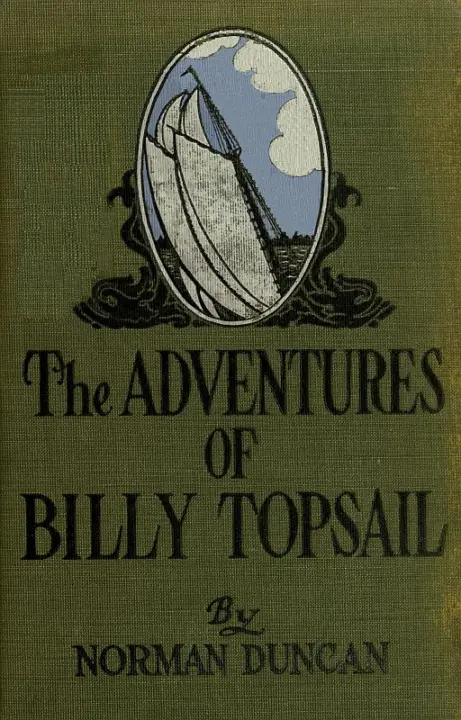
Norman Duncan
Norman Duncan
Norman Duncan
BEHIND THE BOOK
This eBook is for the use of anyone anywhere in the United States and most other parts of the world at no cost and with almost no restrictions whatsoever. You may copy it, give it away or re-use it under the terms of the Project Gutenberg License included with this eBook or online at www.gutenberg.org. If you are not located in the United States, you will have to check the laws of the country where you are located before using this eBook. Read the source licence.
The original source file, including credits and licence, is retained by this library. Request an original-format copy at no charge. Please include the book title and Project Gutenberg identifier #36998.
KEEP YOUR CURIOSITY GOING
Coulson Kernahan

Maurice Baring
Frances Wright
Cécile Tormay

Frederic Jesup Stimson

W. H. P. (William Henry Pope) Jarvis