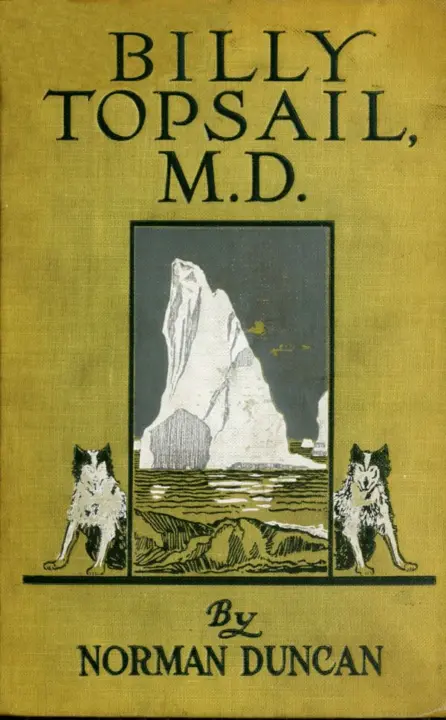
Billy Topsail, M.D.: A Tale of Adventure With Doctor Luke of the Labrador
Norman Duncan
THE CLASSIC COLLECTION · 1906
"Every Man for Himself" by Norman Duncan is a novel written in the early 20th century. The story is set against the rugged backdrop of Newfoundland and follows the life of Tumm, a fisherman who shares tales of his experiences and the eccentric characters around him, particularly focusing on Abraham Botch, a contemplative man from Jug Cove. The narrative explores themes of existence, identity, and the relentless struggle for survival in a harsh, indifferent world. At the start of the novel, we are introduced to Tumm and the crew aboard the trader "Good Samaritan" as they anchor in Poor Man's Harbor during a snowstorm. Tumm engages the crew with a philosophical tale about souls and purpose, leading to an encounter with Abraham Botch, who ponders the nature of existence. Through Tumm's storytelling, we learn of Botch's deep questioning about life, the soul, and the universe, which sets the stage for the exploration of profound themes intertwining with the everyday struggles of the fishermen. Tumm's observations and interactions with Botch highlight the tension between whimsical thoughts and harsh realities, framing the novel's exploration of humanity's quest for understanding in an unforgiving environment.
Introduction adapted from the source catalogue; source summaries may be automatically generated.
Free to read · English · 62,156 words · No account needed
MAKE TIME FOR A GOOD BOOK
On by default. Untick to stop anonymous reading totals. Each page counts after 10 seconds in view. How this works.
Anonymous counting is on unless you have switched it off.
"Well, no," Jehoshaphat admitted, frankly. "I isn't; leastways, not
alone."
"Not alone?" anxiously.
"No; not alone. I'll go with you, Mister Wull, if you're lonesome, an' wants company. You sees, sir, I can't give in. I jus' can't! I'm here, Mister Wull, in this here cranky rodney, beyond the Tombstone grounds, with a dirty gale from a point or two south o' west about t' break, because I'm the public o' Satan's Trap. I can die, sir, t' save gossip; but I sim-plee jus' isn't able t' give in. 'Twouldn't be right."
"Well, I won't give in."
"Nor I, sir. So here we is--out here beyond the Tombstone grounds, you on a pan an' me in a rodney. An' the weather isn't--well--not quite kind."
It was not. The black clouds, torn, streaming, had possessed the sky, and the night was near come. Haul-Away Head and Daddy Tool's Point had melted with the black line of coast. Return--safe passage through the narrows to the quiet water and warm lights of Satan's Trap--was almost beyond the most courageous hope. The wind broke from the shore in straight lines--a stout, agile wind, loosed for riot upon the sea. The sea was black, with a wind-lop upon the grave swell--a black-and-white sea, with spume in the gray air. The west was black, with no hint of other color--without the pity of purple or red. Roundabout the sea was breaking, troubled by the wind, indifferent to the white little rodney and the lives o' men.
"You better give in," old John Wull warned.
"No," Jehoshaphat answered; "no; oh no! I won't give in. Not in."
A gust turned the black sea white.
"You better give in," said Jehoshaphat.
John Wull shrugged his shoulders and turned his back.
"Now, Mister Wull," said Jehoshaphat, firmly, "I 'low I can't stand this much longer. I 'low we can't be fools much longer an' get back t' Satan's Trap. I got a sail, here, Mister Wull; but, ecod! the beat t' harbor isn't pleasant t' think about."
"You better go home," sneered old John Wull.
"I 'low I will," Jehoshaphat declared.
Old John Wull came to the windward edge of the ice, and there stood frowning, with his feet submerged. "What was you sayin'?" he asked. "That you'd go home?"
Jehoshaphat looked away.
"An' leave me?" demanded John Wull. "Leave me? Me?"
"I got t' think o' my kids."
"An' you'd leave me t' die?"
"Well," Jehoshaphat complained, "'tis long past supper-time. You better
give in."
"I won't!"
Your reading position is saved on this browser. Take it to another device with a library code. Reading pages adapt to text, rather than matching a printed edition.
Norman Duncan
Norman Duncan
Norman Duncan
Norman Duncan
BEHIND THE BOOK
This eBook is for the use of anyone anywhere in the United States and most other parts of the world at no cost and with almost no restrictions whatsoever. You may copy it, give it away or re-use it under the terms of the Project Gutenberg License included with this eBook or online at www.gutenberg.org. If you are not located in the United States, you will have to check the laws of the country where you are located before using this eBook. Read the source licence.
The original source file, including credits and licence, is retained by this library. Request an original-format copy at no charge. Please include the book title and Project Gutenberg identifier #36998.
KEEP YOUR CURIOSITY GOING
Coulson Kernahan

Maurice Baring
Frances Wright
Cécile Tormay

Frederic Jesup Stimson

W. H. P. (William Henry Pope) Jarvis