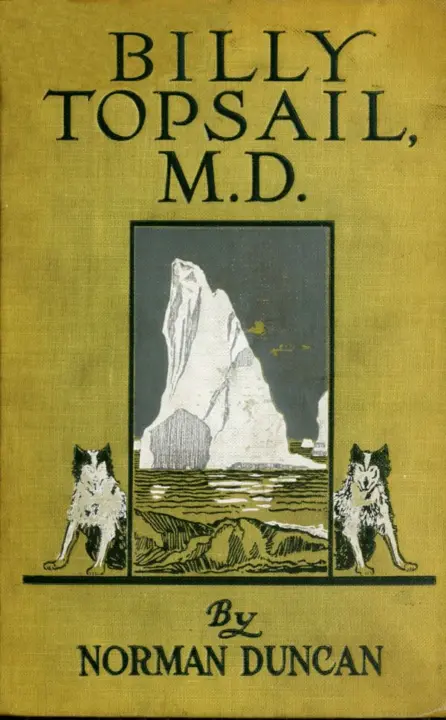
Billy Topsail, M.D.: A Tale of Adventure With Doctor Luke of the Labrador
Norman Duncan
THE CLASSIC COLLECTION · 1906
"Every Man for Himself" by Norman Duncan is a novel written in the early 20th century. The story is set against the rugged backdrop of Newfoundland and follows the life of Tumm, a fisherman who shares tales of his experiences and the eccentric characters around him, particularly focusing on Abraham Botch, a contemplative man from Jug Cove. The narrative explores themes of existence, identity, and the relentless struggle for survival in a harsh, indifferent world. At the start of the novel, we are introduced to Tumm and the crew aboard the trader "Good Samaritan" as they anchor in Poor Man's Harbor during a snowstorm. Tumm engages the crew with a philosophical tale about souls and purpose, leading to an encounter with Abraham Botch, who ponders the nature of existence. Through Tumm's storytelling, we learn of Botch's deep questioning about life, the soul, and the universe, which sets the stage for the exploration of profound themes intertwining with the everyday struggles of the fishermen. Tumm's observations and interactions with Botch highlight the tension between whimsical thoughts and harsh realities, framing the novel's exploration of humanity's quest for understanding in an unforgiving environment.
Introduction adapted from the source catalogue; source summaries may be automatically generated.
Free to read · English · 62,156 words · No account needed
MAKE TIME FOR A GOOD BOOK
On by default. Untick to stop anonymous reading totals. Each page counts after 10 seconds in view. How this works.
Anonymous counting is on unless you have switched it off.
John Wull, from the little office at the back of the shop, where it was warm and still, watched the fisherman breast the white wind.
"Mister Wull," said Jehoshaphat, when he stood in the office, "I 'low I'll be havin' another barrel o' flour."
Wull frowned.
"Ay," Jehoshaphat repeated, perplexed; "another barrel."
Wull pursed his lips.
"O' flour," said Jehoshaphat, staring.
The trader drummed on the desk and gazed out of the window. He seemed to forget that Jehoshaphat Rudd stood waiting. Jehoshaphat felt awkward and out of place; he smoothed his tawny beard, cracked his fingers, scratched his head, shifted from one foot to the other. Some wonder troubled him, then some strange alarm. He had never before realized that the lives of his young were in the keeping of this man.
"Flour," he ventured, weakly--"one barrel."
Wull turned. "It's gone up," said he.
"Have it, now!" Jehoshaphat exclaimed. "I 'lowed last fall, when I paid eight," he proceeded, "that she'd clumb as high as she could get 'ithout fallin'. But she've gone up, says you? Dear man!"
"Sky high," said the trader.
"Dear man!"
The stove was serene and of good conscience. It labored joyously in response to the clean-souled wind. For a moment, while the trader watched the snow through his bushy brows and Jehoshaphat Rudd hopelessly scratched his head, its hearty, honest roar was the only voice lifted in the little office at the back of John Wull's shop.
"An' why?" Jehoshaphat timidly asked.
"Scarcity."
"Oh," said Jehoshaphat, as though he understood. He paused. "Isn't you got as much as you had?" he inquired.
The trader nodded.
"Isn't you got enough in the storehouse t' last till the mail-boat
runs?"
"Plenty, thank God!"
"Scarcity," Jehoshaphat mused. "Mm-m-m! Oh, I sees," he added, vacantly. "Well, Mister Wull," he sighed, "I 'low I'll take one of Early Rose an' pay the rise."
Wull whistled absently.
"Early Rose," Jehoshaphat repeated, with a quick, keen glance of alarm.
The trader frowned.
"Rose," Jehoshaphat muttered. He licked his lips. "Of Early," he
reiterated, in a gasp, "Rose."
"All right, Jehoshaphat."
Down came the big key from the nail. Jehoshaphat's round face beamed. The trader slapped his ledger shut, moved toward the door, but stopped dead, and gazed out of the window, while his brows fell over his eyes, and he fingered the big key.
"Gone up t' eighteen," said he, without turning.
Jehoshaphat stared aghast.
"Wonderful high for flour," the trader continued, in apologetic explanation; "but flour's wonderful scarce."
"Tisn't right!" Jehoshaphat declared. "Eighteen dollars a barrel for Early Rose? 'Tisn't right!"
The key was restored to the nail.
Your reading position is saved on this browser. Take it to another device with a library code. Reading pages adapt to text, rather than matching a printed edition.
Norman Duncan
Norman Duncan
Norman Duncan
Norman Duncan
BEHIND THE BOOK
This eBook is for the use of anyone anywhere in the United States and most other parts of the world at no cost and with almost no restrictions whatsoever. You may copy it, give it away or re-use it under the terms of the Project Gutenberg License included with this eBook or online at www.gutenberg.org. If you are not located in the United States, you will have to check the laws of the country where you are located before using this eBook. Read the source licence.
The original source file, including credits and licence, is retained by this library. Request an original-format copy at no charge. Please include the book title and Project Gutenberg identifier #36998.
KEEP YOUR CURIOSITY GOING
Coulson Kernahan

Maurice Baring
Frances Wright
Cécile Tormay

Frederic Jesup Stimson

W. H. P. (William Henry Pope) Jarvis