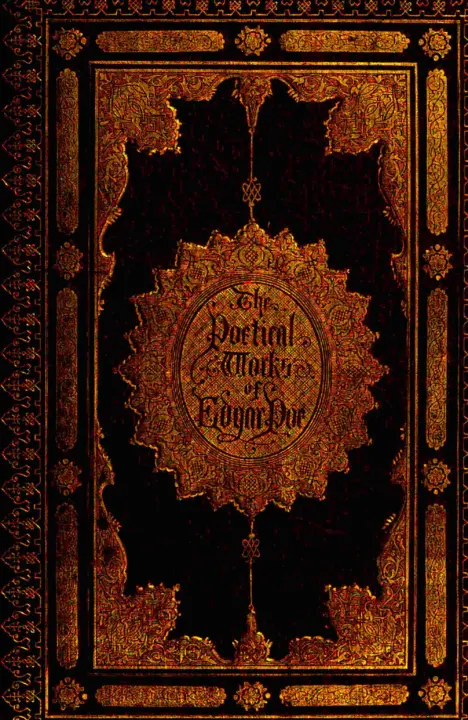
The poetical works of Edgar Allan Poe
Edgar Allan Poe
THE CLASSIC COLLECTION · 1848
"Eureka: A Prose Poem" by Edgar Allan Poe is a non-fiction work published in 1848. Adapted from a lecture, this ambitious essay presents Poe's intuitive vision of the universe's nature, exploring the physical and spiritual cosmos, man's relationship with God, and the soul's destiny beyond death. Poe considered it his greatest achievement—more important than Newton's discovery of gravity. Though contemporaries found it absurd, some ideas surprisingly anticipate modern cosmology. The work blends science, metaphysics, and Poe's trademark ratiocination in an unprecedented philosophical meditation.
Introduction adapted from the source catalogue; source summaries may be automatically generated.
Free to read · English · 44,247 words · No account needed
MAKE TIME FOR A GOOD BOOK
On by default. Untick to stop anonymous reading totals. Each page counts after 10 seconds in view. How this works.
Anonymous counting is on unless you have switched it off.
Oneness, then, is all that I predicate of the originally created Matter; but I propose to show that this Oneness is a principle abundantly sufficient to account for the constitution, the existing phænomena and the plainly inevitable annihilation of at least the material Universe.
The willing into being the primordial particle, has completed the act, or more properly the conception, of Creation. We now proceed to the ultimate purpose for which we are to suppose the Particle created—that is to say, the ultimate purpose so far as our considerations yet enable us to see it—the constitution of the Universe from it, the Particle.
This constitution has been effected by forcing the originally and therefore normally One into the abnormal condition of Many. An action of this character implies rëaction. A diffusion from Unity, under the conditions, involves a tendency to return into Unity—a tendency ineradicable until satisfied. But on these points I will speak more fully hereafter.
The assumption of absolute Unity in the primordial Particle includes that of infinite divisibility. Let us conceive the Particle, then, to be only not totally exhausted by diffusion into Space. From the one Particle, as a centre, let us suppose to be irradiated spherically—in all directions—to immeasurable but still to definite distances in the previously vacant space—a certain inexpressibly great yet limited number of unimaginably yet not infinitely minute atoms.
Now, of these atoms, thus diffused, or upon diffusion, what conditions are we permitted—not to assume, but to infer, from consideration as well of their source as of the character of the design apparent in their diffusion? Unity being their source, and difference from Unity the character of the design manifested in their diffusion, we are warranted in supposing this character to be at least generally preserved throughout the design, and to form a portion of the design itself:—that is to say, we shall be warranted in conceiving continual differences at all points from the uniquity and simplicity of the origin. But, for these reasons, shall we be justified in imagining the atoms heterogeneous, dissimilar, unequal, and inequidistant? More explicitly—are we to consider no two atoms as, at their diffusion, of the same nature, or of the same form, or of the same size?—and, after fulfilment of their diffusion into Space, is absolute inequidistance, each from each, to be understood of all of them? In such arrangement, under such conditions, we most easily and immediately comprehend the subsequent most feasible carrying out to completion of any such design as that which I have suggested—the design of variety out of unity—diversity out of sameness—heterogeneity out of homogeneity—complexity out of simplicity—in a word, the utmost possible multiplicity of relation out of the emphatically irrelative One. Undoubtedly, therefore, we should be warranted in assuming all that has been mentioned, but for the reflection, first, that supererogation is not presumable of any Divine Act; and, secondly, that the object supposed in view, appears as feasible when some of the conditions in question are dispensed with, in the beginning, as when all are understood immediately to exist. I mean to say that some are involved in the rest, or so instantaneous a consequence of them as to make the distinction inappreciable. Difference of size, for example, will at once be brought about through the tendency of one atom to a second, in preference to a third, on account of particular inequidistance; which is to be comprehended as particular inequidistances between centres of quantity, in neighboring atoms of different form—a matter not at all interfering with the generally-equable distribution of the atoms. Difference of kind, too, is easily conceived to be merely a result of differences in size and form, taken more or less conjointly:—in fact, since the Unity of the Particle Proper implies absolute homogeneity, we cannot imagine the atoms, at their diffusion, differing in kind, without imagining, at the same time, a special exercise of the Divine Will, at the emission of each atom, for the purpose of effecting, in each, a change of its essential nature:—so fantastic an idea is the less to be indulged, as the object proposed is seen to be thoroughly attainable without such minute and elaborate interposition. We perceive, therefore, upon the whole, that it would be supererogatory, and consequently unphilosophical, to predicate of the atoms, in view of their purposes, any thing more than difference of form at their dispersion, with particular inequidistance after it—all other differences arising at once out of these, in the very first processes of mass-constitution:—We thus establish the Universe on a purely geometrical basis. Of course, it is by no means necessary to assume absolute difference, even of form, among all the atoms irradiated—any more than absolute particular inequidistance of each from each. We are required to conceive merely that no neighboring atoms are of similar form—no atoms which can ever approximate, until their inevitable rëunition at the end.
Your reading position is saved on this browser. Take it to another device with a library code. Reading pages adapt to text, rather than matching a printed edition.
Edgar Allan Poe

Rebecca Harding Davis & Thomas De Quincey & Charles Dickens & Nathaniel Hawthorne & Edward Bulwer Lytton, Baron Lytton & Edgar Allan Poe & Harriet Elizabeth Prescott Spofford

Edgar Allan Poe
Edgar Allan Poe
BEHIND THE BOOK
This eBook is for the use of anyone anywhere in the United States and most other parts of the world at no cost and with almost no restrictions whatsoever. You may copy it, give it away or re-use it under the terms of the Project Gutenberg License included with this eBook or online at www.gutenberg.org. If you are not located in the United States, you will have to check the laws of the country where you are located before using this eBook. Read the source licence.
The original source file, including credits and licence, is retained by this library. Request an original-format copy at no charge. Please include the book title and Project Gutenberg identifier #32037.
KEEP YOUR CURIOSITY GOING

David Patterson (Spirit) Hatch

David Patterson (Spirit) Hatch

David Patterson (Spirit) Hatch
Coulson Kernahan

Ralph Waldo Emerson

Maurice Baring