THE CLASSIC COLLECTION✦The school and societyCLASSIC FREE BOOKS
The school and society
John Dewey
THE CLASSIC COLLECTION · 1908
"Ethics" by John Dewey and James Hayden Tufts is a philosophical treatise on moral theory written in the early 20th century. The text seeks to explore moral problems through a historical lens, emphasizing the relationship between individual conduct and the broader social environment. The authors aim to illuminate how our moral judgments evolve, encouraging a reflective and scientific approach to ethical questions. The opening of the work introduces key concepts and outlines the overall structure of the text. It emphasizes the complexity of ethical conduct, which is influenced by both internal motivations and external societal standards. Dewey and Tufts stress the importance of tracing the historical roots of morality to understand its current manifestations, arguing that ethical principles must evolve alongside social developments. This foundation sets the stage for a detailed examination of moral judgment, the growth of ethical concepts, and the role of various societal influences in shaping individual conduct.
Introduction adapted from the source catalogue; source summaries may be automatically generated.
Free to read · English · 202,829 words · No account needed
MAKE TIME FOR A GOOD BOOK
On by default. Untick to stop anonymous reading totals. Each page counts after 10 seconds in view. How this works.
Anonymous counting is on unless you have switched it off.
Although customs or mores have in them an element of social approval which makes them vehicles of moral judgment, they tend in many cases to sink to the level of mere habits. The reason--such as it was--for their original force--is forgotten. They become, like many of our forms of etiquette, mere conventions. There are, however, certain conditions which center attention upon their importance and lift them to the level of conscious agencies. These conditions may be grouped under three heads. (1) The education of the younger, immature members of the group and their preparation for full membership. (2) The constraint and restraint of refractory members and the adjustment of conflicting interests. (3) Occasions which involve some notable danger or crisis and therefore call for the greatest attention to secure the favor of the gods and avert disaster.
=1. Educational Customs.=--Among the most striking and significant of these are the initiation ceremonies which are so widely observed among primitive peoples. They are held with the purpose of inducting boys into the privileges of manhood and into the full life of the group. They are calculated at every step to impress upon the initiate his own ignorance and helplessness in contrast with the wisdom and power of the group; and as the mystery with which they are conducted imposes reverence for the elders and the authorities of the group, so the recital of the traditions and performances of the tribe, the long series of ritual acts, common participation in the mystic dance and song and decorations, serve to reenforce the ties that bind the tribe.
Initiation into the full privileges of manhood among the tribes of Central Australia, for instance, includes three sets of ceremonies which occupy weeks, and even months, for their completion. The first set, called "throwing up in the air," is performed for the boy when he has reached the age of from ten to twelve. In connection with being thrown up in the air by certain prescribed members of his tribe, he is decorated with various totem emblems and afterward the septum of his nose is bored for the insertion of the nose-bone. At a period some three or four years later a larger and more formidable series of ceremonies is undertaken, lasting for ten days. A screen of bushes is built, behind which the boy is kept during the whole period, unless he is brought out on the ceremonial ground to witness some performance. During this whole period of ten days, he is forbidden to speak except in answer to questions. He is decorated with various totem emblems, for which every detail is prescribed by the council of the tribal fathers and tribal elder brothers. He is charged to obey every command and never to tell any woman or boy what he may see. The sense that something out of the ordinary is to happen to him helps to impress him strongly with a feeling of the deep importance of compliance with the tribal rules, and further still, with a strong sense of the superiority of the older men who know and are familiar with the mysterious rites of which he is about to learn the meaning for the first time. At intervals he watches symbolic performances of men decorated like various totem animals, who represent the doings of the animal ancestors of the clan; he hears mysterious sounds of the so-called bull-roarers, which are supposed by the women and uninitiated to be due to unseen spirits; and the whole ends with the operation which symbolizes his induction into young manhood. But even this is not all; when the young man has reached the age of discretion, when it is felt that he can fully comprehend the traditions of the tribe, at the age of from twenty to twenty-five, a still more impressive series of ceremonies is conducted, which in the instance reported lasted from September to January. This period was filled up with dances, "corroborees," and inspection of the churinga or sacred emblems--stones or sticks which were supposed to be the dwellings of ancestral spirits and which are carefully preserved in the tribe, guarded from the sight of women and boys, but known individually to the elders as the sacred dwelling-place of father or grandfather. As these were shown and passed around, great solemnity was manifest and the relatives sometimes wept at the sight of the sacred object. Ceremonies imitating various totem animals, frequently of the most elaborate sort, were also performed. The young men were told the traditions of the past history of the tribe, and at the close of the recital they felt added reverence for the old men who had been their instructors, a sense of pride in the possession of this mysterious knowledge, and a deeper unity because of what they now have in common. One is at a loss whether to wonder most at the possibility of the whole tribe devoting itself for three months to these elaborate functions of initiation, or at the marvelous adaptability of such ceremonies to train the young into an attitude of docility and reverence. A tribe that can enforce such a process is not likely to be wanting in one side, at least, of the moral consciousness, namely, reverence for authority and regard for the social welfare.[30]
Your reading position is saved on this browser. Take it to another device with a library code. Reading pages adapt to text, rather than matching a printed edition.
John Dewey
John Dewey

John Dewey
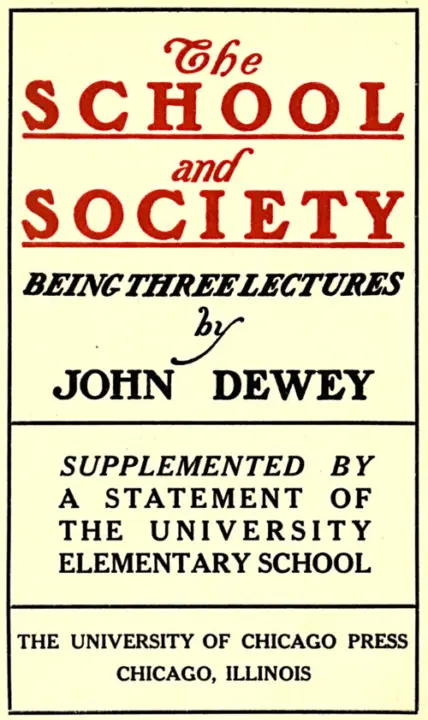
John Dewey
BEHIND THE BOOK
This eBook is for the use of anyone anywhere in the United States and most other parts of the world at no cost and with almost no restrictions whatsoever. You may copy it, give it away or re-use it under the terms of the Project Gutenberg License included with this eBook or online at www.gutenberg.org. If you are not located in the United States, you will have to check the laws of the country where you are located before using this eBook. Read the source licence.
The original source file, including credits and licence, is retained by this library. Request an original-format copy at no charge. Please include the book title and Project Gutenberg identifier #39551.
KEEP YOUR CURIOSITY GOING

David Patterson (Spirit) Hatch
Coulson Kernahan

Ralph Waldo Emerson
Frances Wright
Edwin Abbott Abbott
Joseph Droz