THE CLASSIC COLLECTION✦The school and societyCLASSIC FREE BOOKS
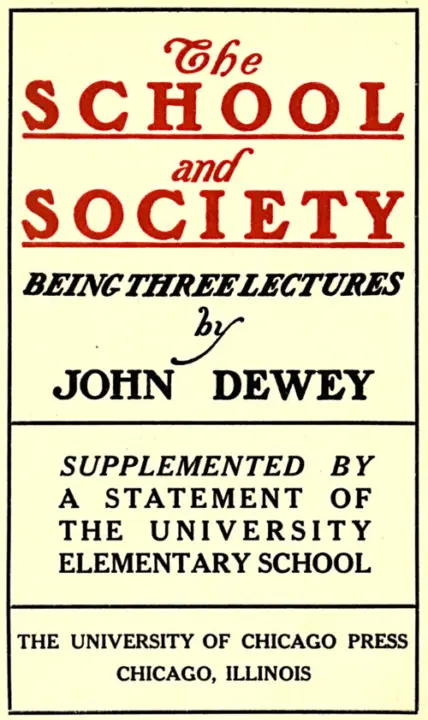
The school and society
John Dewey
THE CLASSIC COLLECTION · 1908
"Ethics" by John Dewey and James Hayden Tufts is a philosophical treatise on moral theory written in the early 20th century. The text seeks to explore moral problems through a historical lens, emphasizing the relationship between individual conduct and the broader social environment. The authors aim to illuminate how our moral judgments evolve, encouraging a reflective and scientific approach to ethical questions. The opening of the work introduces key concepts and outlines the overall structure of the text. It emphasizes the complexity of ethical conduct, which is influenced by both internal motivations and external societal standards. Dewey and Tufts stress the importance of tracing the historical roots of morality to understand its current manifestations, arguing that ethical principles must evolve alongside social developments. This foundation sets the stage for a detailed examination of moral judgment, the growth of ethical concepts, and the role of various societal influences in shaping individual conduct.
Introduction adapted from the source catalogue; source summaries may be automatically generated.
Free to read · English · 202,829 words · No account needed
MAKE TIME FOR A GOOD BOOK
On by default. Untick to stop anonymous reading totals. Each page counts after 10 seconds in view. How this works.
Anonymous counting is on unless you have switched it off.
Besides the writings of Plato (especially, the Apology, Crito, Protagoras, Gorgias, and Republic), Xenophon (Memorabilia), Aristotle (Ethics, Politics), Cicero (On Ends, Laws, Duties; On the Nature of the Gods), Epictetus, Seneca, M. Aurelius, Plutarch, and the fragments of various Stoics, Epicureans, and Sceptics, the tragedies of Aeschylus, Sophocles, and Euripides, and the comedies of Aristophanes (especially the Clouds) afford valuable material.
All the histories of philosophy treat the theoretical side; among them may be mentioned Gomperz (Greek Thinkers, 1900-05), Zeller (Socrates; Plato; Aristotle; Stoics, Epicureans, and Sceptics), Windelband, Benn (Philosophy of Greece, 1898, chs. i., v.).
On the Moral Consciousness: Schmidt, Ethik der alten Griechen, 1882. On the social conditions and theories: Poehlmann, Geschichte des antiken Kommunismus und Sozialismus, 1893-1901; Doering, Die Lehre des Sokrates als sociales Reformsystem, 1895. On the religion: Farnell, Cults of the Greek States, 3 vols., 1896; Rohde, Psyche, 1894.
On Political Conditions and Theory: Newman, Introd. to Politics of Aristotle, 1887; Bradley, Aristotle's Theory of the State in Hellenica; Wilamovitz-Moellendorf, Aristotle und Athen, 1900.
On Nature and Law of Nature: Ritchie, Natural Rights, 1895; Burnet, Int. Journal of Ethics, vii., 1897, pp. 328-33; Hardy, Begriff der Physis, 1884; Voigt, Die Lehre vom jus naturale, 1856-75.
General: Denis, Histoire des Theories et des Idees Morales dans l'Antiquite, 1879; Taylor, Ancient Ideals, 1900; Caird, Evolution of Theology in the Greek Philosophers, 1904; Janet, Histoire de la Science Politique dans ses Rapports avec la Morale, 1887; Grote, History of Greece, 4th ed., 1872; Plato and the Other Companions of Socrates, 1888.
[64] Cf. Xenophon's account of the impressive appeal of Clearchus: "For, first and greatest, the oaths which we have sworn by the gods forbid us to be enemies to each other. Whoever is conscious of having transgressed these,--him I could never deem happy. For if one were at war with the gods, I know not with what swiftness he might flee so as to escape, or into what darkness he might run, or into what stronghold he might retreat and find refuge. For all things are everywhere subject to the gods, and the gods rule all everywhere with equity."--Anabasis, II., v.
[65] Republic, I., 343.
[66] Republic, II., 365.
[67] Republic, II., 365.
[68] Republic, I., 343 f.
[69] Windelband, History of Philosophy, p. 86.
[70] Politics, I., ii. Welldon's translation.
[71] Politics, I., ii. Welldon's translation.
[72] Ethics, VIII., i.; IX., vi.
[73] Republic, V., 473.
[74] Ibid., IX., 592.
[75] Gorgias, 491 ff.
[76] Republic, IX., 589 f.
[77] Republic, IX., 581 f.
[78] Ethics, X., ii.-iv.
Your reading position is saved on this browser. Take it to another device with a library code. Reading pages adapt to text, rather than matching a printed edition.
John Dewey
John Dewey

John Dewey
John Dewey
BEHIND THE BOOK
This eBook is for the use of anyone anywhere in the United States and most other parts of the world at no cost and with almost no restrictions whatsoever. You may copy it, give it away or re-use it under the terms of the Project Gutenberg License included with this eBook or online at www.gutenberg.org. If you are not located in the United States, you will have to check the laws of the country where you are located before using this eBook. Read the source licence.
The original source file, including credits and licence, is retained by this library. Request an original-format copy at no charge. Please include the book title and Project Gutenberg identifier #39551.
KEEP YOUR CURIOSITY GOING

David Patterson (Spirit) Hatch
Coulson Kernahan

Ralph Waldo Emerson
Frances Wright

Edwin Abbott Abbott

Joseph Droz