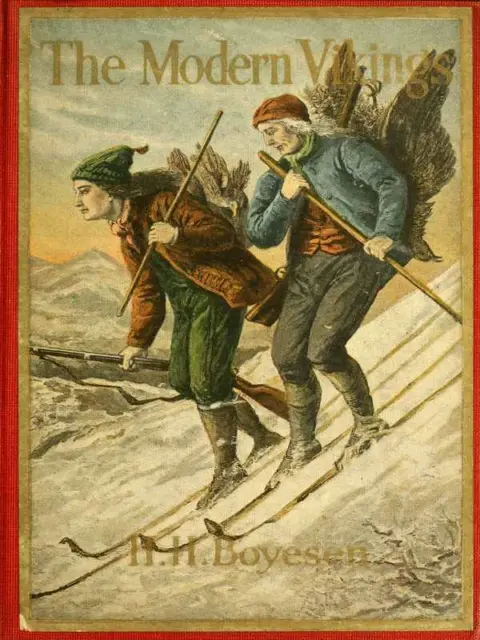
The Modern Vikings: Stories of Life and Sport in the Norseland
Hjalmar Hjorth Boyesen
THE CLASSIC COLLECTION · 1895
"Essays on Scandinavian Literature" by Hjalmar Hjorth Boyesen is a scholarly collection written in the late 19th century. The book examines the literary traditions and influential personalities from Norway, Sweden, and Denmark, showcasing key authors like Henrik Ibsen and Björnstjerne Björnson, among others. Through these essays, the author provides insights into the cultural and historical context that shaped Scandinavian literature, aiming to highlight its significance and evolution. The opening portion introduces Boyesen's ambition to write a comprehensive history of Scandinavian literature, driven by his explorations into prominent literary figures. He reflects on the extensive research required and the rich literary heritage he encountered, noting how his studies led to an in-depth look at Ibsen's works. The preface sets the stage for the following essays, where Boyesen promises to analyze pivotal authors while hinting at his own critical engagement with their contributions to the literary canon. Overall, this introductory section establishes the book's academic purpose and Boyesen's expertise in Scandinavian literary traditions.
Introduction adapted from the source catalogue; source summaries may be automatically generated.
Free to read · English · 66,732 words · No account needed
MAKE TIME FOR A GOOD BOOK
On by default. Untick to stop anonymous reading totals. Each page counts after 10 seconds in view. How this works.
Anonymous counting is on unless you have switched it off.
The unpretentious little story "Dust" (Stoev, 1882) undertakes to demonstrate the unwholesomeness of the religious ideas regarding the life to come usually impressed upon children by parents and teachers. By dust Bjoernson means all obsolete, lifeless matter in the world of thought which settles upon, and often impairs, the vitality of the living growth, or even chokes it outright. "When children are taught that the life here is nothing compared to the life to come--that to be visible is nothing compared to being invisible--that to be a man is nothing compared to being an angel--that to be alive is nothing compared to being dead--then that is not the way to give them the right view of life; not the way to teach them to love life; not the way to inspire them with courage, energy, and patriotism."
In his novel "Flags in City and Harbor" (1884), the English translation of which is entitled "The Heritage of the Kurts," Bjoernson has attacked a tremendous problem. He has attempted to illustrate the force of heredity, and the exact extent to which it may be modified by environment--to what extent an unfavorable heredity may be counteracted by a favorable environment. The family of Kurt, whose history is here traced through five generations, inherits a temperament which would have secured its survival and raised it to distinction in barbaric ages, but which will as surely, unless powerfully modified, necessitate its extinction in the present age. For the Kurts are incapable of assimilating civilization. An excess of physical vigor in the first Kurt who settled in Norway takes the form of lawlessness and an entire absence of moral restraint.
Violence of the most atrocious kind goes unpunished because Kurt is powerful and has friends at court. In his two legitimate sons, Adler and Max (he has a host of illegitimate ones), the family temperament is modified, though in Max, who perpetuates the race, the modification is not radical. Adler is a weakling of enormous vanity, silent and moody, and addicted to the pleasures of the table. Max, on the other hand, is a man of inexhaustible vitality, violent like his father, but possessed of a gift of speech and a tremendous voice which serve to establish his authority over the simple inhabitants of the little coast town. Moreover, he is endowed with great shrewdness and practical sense, and is an expert in ship-building, agriculture, and other pursuits. But he is the terror of women, and his sensual excesses so undermine his strength that he becomes insane, and believes that he is continually pursued by the spirit of his brother, whose death he had caused. Konrad Kurt, the son of Max, runs away from home because he cannot endure to see his mother maltreated by his father. He inherits a shattered constitution and poor nerves; outwardly he is quite a respectable man, but he has a strong physical need of drink, and every night he goes to bed intoxicated. It is the author's purpose to show how the sins of his fathers, by a physiological necessity, predisposed Konrad Kurt to drink. His son, John Kurt, who is the result of a criminal relation, is the complete incarnation of the genius of the family. The fresh blood which he has derived from his English mother has postponed the doom of the race and enabled him to repeat, in a modified form, the excesses of his ancestors. He first distinguishes himself as a virtuoso in swearing. The magnificent redundance and originality of his oaths make him famous in the army, which he chooses as the first field of his exploits. Later he roams aimlessly about the world, merely to satisfy a wild need of adventure. On his return to his native town he signalizes himself by his vices as a genuine Kurt. The little town, however, cannot find it in its heart to condemn a man of so distinguished a race, and society, though it is fully cognizant of his mode of life, not only tolerates but even pets him. He is entertaining, has been everywhere and seen everything. He meets a young girl, named Thomasine Rendalen, the daughter of an educated peasant, who occupies a position as a teacher. She is large, ruddy, full of health and uncorrupted vigor. John Kurt takes a violent fancy to her, and moves heaven and earth to induce her to marry him. He goes even to the length of bribing all her female friends, and they by degrees begin to sing his praises. At last she yields; a net of subtle influences surrounds her, and unconsciously she comes to reflect the view of society. Her moral prudery begins to appear ridiculous to her, and the so-called common-sense view predominates. The author here, with great earnestness, emphasizes the responsibility of society in weakening the moral resistance of the individual rather than strengthening it. Thomasine Rendalen would not have married John Kurt if society had not condoned his offences; and society in condoning such offences undermines its own foundations.
Your reading position is saved on this browser. Take it to another device with a library code. Reading pages adapt to text, rather than matching a printed edition.
Hjalmar Hjorth Boyesen
Hjalmar Hjorth Boyesen
Hjalmar Hjorth Boyesen
Hjalmar Hjorth Boyesen
BEHIND THE BOOK
This eBook is for the use of anyone anywhere in the United States and most other parts of the world at no cost and with almost no restrictions whatsoever. You may copy it, give it away or re-use it under the terms of the Project Gutenberg License included with this eBook or online at www.gutenberg.org. If you are not located in the United States, you will have to check the laws of the country where you are located before using this eBook. Read the source licence.
The original source file, including credits and licence, is retained by this library. Request an original-format copy at no charge. Please include the book title and Project Gutenberg identifier #19908.
KEEP YOUR CURIOSITY GOING

David Patterson (Spirit) Hatch

David Patterson (Spirit) Hatch

David Patterson (Spirit) Hatch
Cécile Tormay

Moritz Busch
John L. Ransom