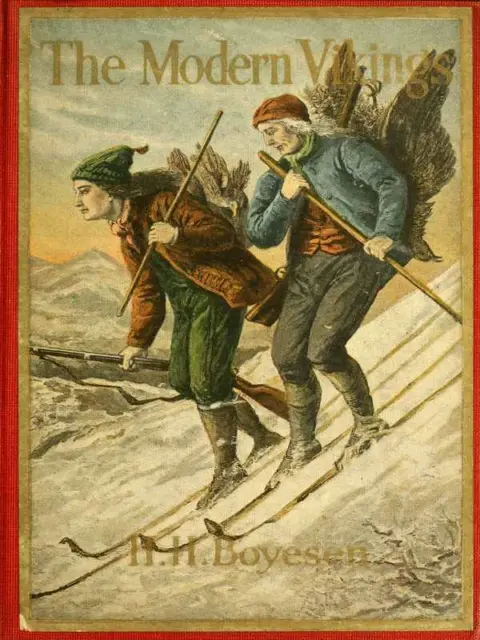
The Modern Vikings: Stories of Life and Sport in the Norseland
Hjalmar Hjorth Boyesen
THE CLASSIC COLLECTION · 1895
"Essays on Scandinavian Literature" by Hjalmar Hjorth Boyesen is a scholarly collection written in the late 19th century. The book examines the literary traditions and influential personalities from Norway, Sweden, and Denmark, showcasing key authors like Henrik Ibsen and Björnstjerne Björnson, among others. Through these essays, the author provides insights into the cultural and historical context that shaped Scandinavian literature, aiming to highlight its significance and evolution. The opening portion introduces Boyesen's ambition to write a comprehensive history of Scandinavian literature, driven by his explorations into prominent literary figures. He reflects on the extensive research required and the rich literary heritage he encountered, noting how his studies led to an in-depth look at Ibsen's works. The preface sets the stage for the following essays, where Boyesen promises to analyze pivotal authors while hinting at his own critical engagement with their contributions to the literary canon. Overall, this introductory section establishes the book's academic purpose and Boyesen's expertise in Scandinavian literary traditions.
Introduction adapted from the source catalogue; source summaries may be automatically generated.
Free to read · English · 66,732 words · No account needed
MAKE TIME FOR A GOOD BOOK
On by default. Untick to stop anonymous reading totals. Each page counts after 10 seconds in view. How this works.
Anonymous counting is on unless you have switched it off.
Strange as it may seem, Bjoernson did not intend "The King" as an argument in favor of the republic. In his preface to the third edition he distinctly repudiates the idea. The recent development of the Norwegian people, has, he says, made the republic a remoter possibility than it was ten years before (1875). But he qualifies this statement with the significant condition, "If we are not checked by fraud." And I fancy that he would have a perfect right to justify his present position by demonstrating the fraud, trickery, if not treason, by which Norway has during the last decade been thwarted in her aspirations and checked in her development. That preface, by the way, dated Paris, October, 1885, is one of the most forceful and luminous of his political pronunciamientos. It rings from beginning to end with conviction and a manly indignation. His chief purpose, he says, in writing this drama was, "to extend the boundaries of free discussion." His polemics against the clergy are not attacks upon Christianity, though he contends that religion is subject to growth as well as other things. The ultimate form of government he believes to be the republic, on the journey toward which all European states are proceeding fast, or slow, and in various stages of progress. There is something abrupt, gnarled, Carlylese, in his urgent admonitions and appeals for fair-play. The personal note is so distinct that I cannot read the play without unconsciously supplying the very cadence of Bjoernson's voice.
A further attempt to extend the boundaries of free discussion is made in the two dramas, "Leonarda" (1879) and "A Glove" (1883), which both deal with interesting phases of the woman question, and both wage war against conventional notions of right and wrong. The former elucidates the attitude of society toward the woman who has been compromised (whether justly or not), and the latter its attitude toward the man. I confess there is something a trifle hazy in his exposition of the problem in "Leonarda;" and I am unable to determine whether Leonarda really has anything to reproach herself with or not. In her conversation with the bishop in the second act, she appears to admit that she has much to regret. She begs him "help her atone for her past." She practically throws herself upon his mercy, reminding him that his Master, Christ, was the friend of sinners. But in the last act she appears suddenly with the halo of martyrdom. General Rosen, who has been the cause of her social ostracism, turns out to be her husband, whom she has divorced on account of his dissipated habits, and now keeps, in the hope of saving him, on a sort of probation. She believes that without her he would go straight to perdition, and from a sense of duty she tolerates him, not daring to shirk her responsibility for the old reprobate's soul. Truth to tell, she treats him like a naughty boy, punishing him, when he has been drunk, with a denial of favors; and when he has been good, rewarding him with her company. I suppose there are men who might be saved by such treatment, but I venture to doubt whether they are worth saving. As for Leonarda, she has apparently no cause for encouragement. But she perseveres, heedless of obloquy, as long as her own affections are disengaged. She presently falls in love, however, with a young man named Hagbart Tallhaug, who has insulted her and is now engaged to her niece, Agot. Hagbart is the nephew of the bishop of the diocese, who, after much persuasion is induced to receive Agot, on condition that her aunt will remove from the district and demand no recognition from the family. Having been informed of these conditions, Leonarda calls upon the bishop, uninvited, and vainly remonstrates with him. The young people are, however, unwilling to accept happiness on the terms offered by his reverence. At this point a new complication arises. Hagbart who had loved in Agot a kind of reflection of her aunt's character and manner, being now thrown into the company of the latter, discovers his mistake and transfers his affection to Leonarda. Exactly wherein the newness of Leonarda's type consists we are not fully informed, but we are led to infer that she represents a purer and truer humanity than the women bred in the traditions of feudalism, with their hypocritical arts and conventions. She is not meant to be seductive, but radiant, ravishing.
Your reading position is saved on this browser. Take it to another device with a library code. Reading pages adapt to text, rather than matching a printed edition.
Hjalmar Hjorth Boyesen
Hjalmar Hjorth Boyesen
Hjalmar Hjorth Boyesen
Hjalmar Hjorth Boyesen
BEHIND THE BOOK
This eBook is for the use of anyone anywhere in the United States and most other parts of the world at no cost and with almost no restrictions whatsoever. You may copy it, give it away or re-use it under the terms of the Project Gutenberg License included with this eBook or online at www.gutenberg.org. If you are not located in the United States, you will have to check the laws of the country where you are located before using this eBook. Read the source licence.
The original source file, including credits and licence, is retained by this library. Request an original-format copy at no charge. Please include the book title and Project Gutenberg identifier #19908.
KEEP YOUR CURIOSITY GOING

David Patterson (Spirit) Hatch

David Patterson (Spirit) Hatch

David Patterson (Spirit) Hatch
Cécile Tormay

Moritz Busch
John L. Ransom