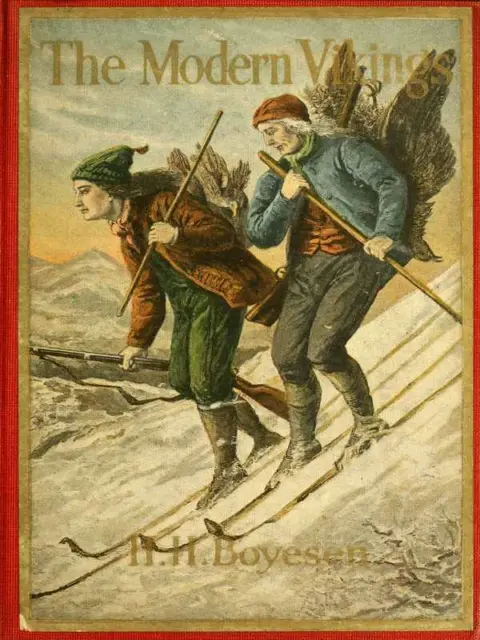
The Modern Vikings: Stories of Life and Sport in the Norseland
Hjalmar Hjorth Boyesen
THE CLASSIC COLLECTION · 1895
"Essays on Scandinavian Literature" by Hjalmar Hjorth Boyesen is a scholarly collection written in the late 19th century. The book examines the literary traditions and influential personalities from Norway, Sweden, and Denmark, showcasing key authors like Henrik Ibsen and Björnstjerne Björnson, among others. Through these essays, the author provides insights into the cultural and historical context that shaped Scandinavian literature, aiming to highlight its significance and evolution. The opening portion introduces Boyesen's ambition to write a comprehensive history of Scandinavian literature, driven by his explorations into prominent literary figures. He reflects on the extensive research required and the rich literary heritage he encountered, noting how his studies led to an in-depth look at Ibsen's works. The preface sets the stage for the following essays, where Boyesen promises to analyze pivotal authors while hinting at his own critical engagement with their contributions to the literary canon. Overall, this introductory section establishes the book's academic purpose and Boyesen's expertise in Scandinavian literary traditions.
Introduction adapted from the source catalogue; source summaries may be automatically generated.
Free to read · English · 66,732 words · No account needed
MAKE TIME FOR A GOOD BOOK
On by default. Untick to stop anonymous reading totals. Each page counts after 10 seconds in view. How this works.
Anonymous counting is on unless you have switched it off.
As a school-boy I witnessed the first performance of "The Newly Married," at the Christiania Theatre (1865), (as, indeed, of all the Bjoernsonian dramas up to 1869); and I yet remember my surprise when, instead of mail-clad Norse warriors, carousing in a sooty, log-built hall, the curtain rose upon a modern interior, in which a fashionably attired young lady kissed a frock-coated old gentleman. It was a dire disappointment to me and my comrade, who had come thirsting for gore. But how completely the poet conquered us! Each phrase seemed to woo our reluctant ears, and the pulse of life that beat in the characters and carried along the action awakened in us a delighted recognition. Truth to tell, we had but the very vaguest idea of what was the prima causa malorum; but for all that, with the rest of the audience, we were immensely gratified that the upshot of it all was so satisfactory.
During the years 1865-67 Bjoernson occupied the position of artistic director of the Christiania Theatre, and edited the illustrated weekly paper, Norsk Folkeblad ("The Norwegian People's Journal"). As the champion of Norwegian nationality in literature, and on the stage, he unfolded an amazing activity. In 1870 he published "Arnljot Gelline," a lyrical epic, relating, in a series of poems of irregular metres, the story of the pagan marauder of that name, and his conversion to Christianity by King Olaf the Saint. Never has he found a more daring and tremendous expression for the spirit of old Norse paganism than in this powerful but somewhat chaotic poem. Never has anyone gazed more deeply into the ferocious heart of the primitive, predatory man, whose free, wild soul had not yet been tamed by social obligations and the scourge of the law. In the same year (1870) was published the now classical collection of "Poems and Songs" (Digte og Sange), which, it is no exaggeration to say, marks a new era in the Norwegian lyric. Among Bjoernson's predecessors there are but two lyrists of the first order, viz., Wergeland and Welhaven. The former was magnificently profuse and chaotic, abounding in verve and daring imagery, but withal high-sounding, declamatory, and, at his worst, bombastic. There is a reminiscence in him of Klopstock's inflated rhetoric; and a certain dithyrambic ecstasy--a strained, high-keyed aria-style which sometimes breaks into falsetto. His great rival, Welhaven, was soberer, clearer, more gravely melodious. He sang in beautiful, tempered strains, along the middle octaves, never ranging high into the treble or deep into the base. There is a certain Tennysonian sweetness, artistic self-restraint, and plastic simplicity in his lyrics; just as there is in Wergeland's reformatory ardor, his noble rage, and his piling up of worlds, aeons, and eternities a striking kinship to Shelley. But both these poets, though their patriotism was strong, were intellectually Europeans, rather than Norwegians. The roots of their culture were in the general soil of the century, whose ideas they had absorbed. Their personalities were not sufficiently tinged with the color of nationality to give a distinctly Norse cadence to their voices. Wergeland seems to me like a man who was desperately anxious to acquire a national accent; but somehow never could catch the trick of it. As regards Welhaven, he was less aware of his deficiency (if deficiency it was); but was content to sing of Norse themes in a key of grave, universal beauty. Of the new note that came into the Norwegian lyric with Bjoernson, I can discover no hint in his predecessors. Such a poem as, for instance, "Nils Finn," with its inimitably droll refrain--how utterly inconceivable it would be in the mouth of Wergeland or Welhaven! The new quality in it is as unexplainable as the poem itself is untranslatable. It has that inexpressible cadence and inflection of the Norse dialect which you feel (if you have the conditions for recognizing it) in the first word a Norseman addresses to you. It has that wonderful twang of the Hardanger fiddle, and the color and sentiment of the ballads sung and the legendary tales recited around the hearth in a Norwegian homestead during the long winter nights. With Bjoernson it was in the blood. It was his soul's accent, the dialect of his thought, the cadence of his emotion. And so, also, is the touching minor undertone in the poem, the tragic strain in the half burlesque, which is again so deeply Norwegian. Who that has ever been present at a Norse peasant wedding has failed to be struck with the strangely melancholy strain in the merriest dances? And in Landstad's collection of "Norwegian Ballads" there is the same blending of humor and pathos in such genuine folk-songs as Truls med bogin, Mindre Alf, and scores of others. To this day I cannot read "Nils Finn," humorous though it is, without an almost painful emotion. All Norway, with a host of precious memories, rises out of the mist of the past at the very first verse:
Your reading position is saved on this browser. Take it to another device with a library code. Reading pages adapt to text, rather than matching a printed edition.
Hjalmar Hjorth Boyesen
Hjalmar Hjorth Boyesen
Hjalmar Hjorth Boyesen
Hjalmar Hjorth Boyesen
BEHIND THE BOOK
This eBook is for the use of anyone anywhere in the United States and most other parts of the world at no cost and with almost no restrictions whatsoever. You may copy it, give it away or re-use it under the terms of the Project Gutenberg License included with this eBook or online at www.gutenberg.org. If you are not located in the United States, you will have to check the laws of the country where you are located before using this eBook. Read the source licence.
The original source file, including credits and licence, is retained by this library. Request an original-format copy at no charge. Please include the book title and Project Gutenberg identifier #19908.
KEEP YOUR CURIOSITY GOING

David Patterson (Spirit) Hatch

David Patterson (Spirit) Hatch

David Patterson (Spirit) Hatch
Cécile Tormay

Moritz Busch
John L. Ransom