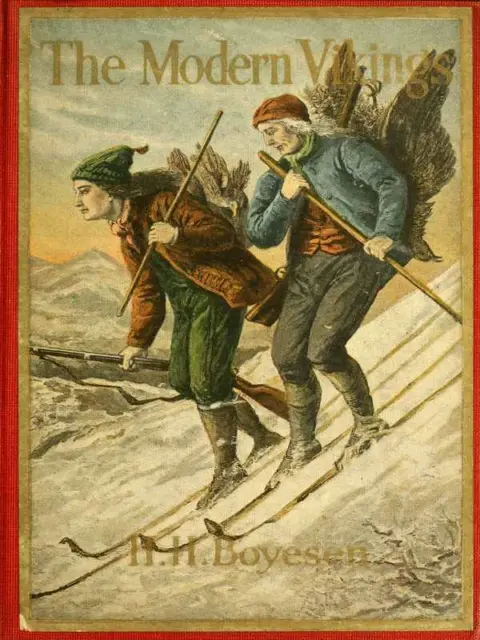
The Modern Vikings: Stories of Life and Sport in the Norseland
Hjalmar Hjorth Boyesen
THE CLASSIC COLLECTION · 1895
"Essays on Scandinavian Literature" by Hjalmar Hjorth Boyesen is a scholarly collection written in the late 19th century. The book examines the literary traditions and influential personalities from Norway, Sweden, and Denmark, showcasing key authors like Henrik Ibsen and Björnstjerne Björnson, among others. Through these essays, the author provides insights into the cultural and historical context that shaped Scandinavian literature, aiming to highlight its significance and evolution. The opening portion introduces Boyesen's ambition to write a comprehensive history of Scandinavian literature, driven by his explorations into prominent literary figures. He reflects on the extensive research required and the rich literary heritage he encountered, noting how his studies led to an in-depth look at Ibsen's works. The preface sets the stage for the following essays, where Boyesen promises to analyze pivotal authors while hinting at his own critical engagement with their contributions to the literary canon. Overall, this introductory section establishes the book's academic purpose and Boyesen's expertise in Scandinavian literary traditions.
Introduction adapted from the source catalogue; source summaries may be automatically generated.
Free to read · English · 66,732 words · No account needed
MAKE TIME FOR A GOOD BOOK
On by default. Untick to stop anonymous reading totals. Each page counts after 10 seconds in view. How this works.
Anonymous counting is on unless you have switched it off.
The significance of Dr. Brandes's literary activity, which has now extended over a quarter of a century, can hardly be estimated from our side of the Atlantic. The Danish horizon was, twenty years ago, hedged in on all sides by a patriotic prejudice which allowed few foreign ideas to enter. As previously stated, the people had, before the two Sleswick-Holstein wars, been in lively communication with Germany, and the intellectual currents of the Fatherland had found their way up to the Belts, and had pulsated there, though with some loss of vigor. But the disastrous defeat in the last war aroused such hostility to Germany that the intellectual intercourse almost ceased. German ideas became scarcely less obnoxious than German bayonets. Spiritual stagnation was the result. For no nation can with impunity cut itself off from the great life of the world. New connections might, perhaps, have been formed with France or England; but the obstacles in the way of such connections appeared too great to be readily overcome. Racial differences and consequent alienism in habits of thought made a rapprochement seem hopeless. It seemed, for awhile, as if the war had cut down the intellectual territory of the Danes even more than it had curtailed their material area. They cultivated their little domestic virtues, talked enthusiastic nonsense on festive occasions, indulged in vain hopes of recovering their lost provinces, but rarely allowed their political reverses to interfere with their amusements. They let the world roar on past their gates, without troubling themselves much as to what interested or agitated it. A feeble, moonshiny late-romanticism was predominant in their literature; and in art, philosophy, and politics that sluggish conservatism which betokens a low vitality, incident upon intellectual isolation.
What was needed at such a time was a man who could re-attach the broken connection--a mediator and interpreter of foreign thought in such a form as to appeal to the Danish temperament and be capable of assimilation by the Danish intellect. Such a man was Georg Brandes. He undertook to put his people en rapport with the nineteenth century, to open new avenues for the influx of modern thought, to take the place of those which had been closed. We have seen that he interpreted to his countrymen the significance of the literary and social movements both in England and in France. But a self-satisfied and virtuous little nation which regards its remoteness from the great world as a matter of congratulation is not apt to receive with favor such a champion of alien ideas. The more the Danes became absorbed in their national hallucinations, the more provincial, nay parochial, they became in their interests, the less did they feel the need of any intellectual stimulus from abroad; and when Dr. Brandes introduced them to modern realism, agnosticism, and positivism they thanked God that none of these dreadful isms were indigenous with them; and were disposed to take Dr. Brandes to task for disturbing their idyllic, orthodox peace by the promulgation of such dangerous heresies. When the time came to fill the professorship for which he was a candidate, he was passed by, and a safer but inferior man was appointed. A formal crusade was opened against him, and he was made the object of savage and bitter attacks. I am not positive, but am disposed to believe, that it was this crusade, not against his opinions only, but against the man himself, which drove Dr. Brandes from Copenhagen, and induced him, in October, 1877, to settle in Berlin. Here he continued his literary activity with unabated zeal, became a valued contributor to the most authoritative German periodicals, and gained a conspicuous position among German men of letters. But while he was sojourning abroad, the seed of ideas which he had left at home began to sprout, and in 1882 his friends in Copenhagen felt themselves strong enough to brave the antagonism which his aesthetical and religious heresies had aroused. At their invitation he returned to Denmark, having been guaranteed an income of four thousand crowns ($1,000) for ten years, with the single stipulation that he should deliver an annual course of public lectures in Copenhagen. Since then his reputation has spread rapidly throughout the civilized world; his books have been translated into many languages, and he would have won his way to a recognition, as the foremost of contemporary critics, if he had not in his later publications discredited himself by his open sympathy with anarchism.
Your reading position is saved on this browser. Take it to another device with a library code. Reading pages adapt to text, rather than matching a printed edition.
Hjalmar Hjorth Boyesen
Hjalmar Hjorth Boyesen
Hjalmar Hjorth Boyesen
Hjalmar Hjorth Boyesen
BEHIND THE BOOK
This eBook is for the use of anyone anywhere in the United States and most other parts of the world at no cost and with almost no restrictions whatsoever. You may copy it, give it away or re-use it under the terms of the Project Gutenberg License included with this eBook or online at www.gutenberg.org. If you are not located in the United States, you will have to check the laws of the country where you are located before using this eBook. Read the source licence.
The original source file, including credits and licence, is retained by this library. Request an original-format copy at no charge. Please include the book title and Project Gutenberg identifier #19908.
KEEP YOUR CURIOSITY GOING

David Patterson (Spirit) Hatch

David Patterson (Spirit) Hatch

David Patterson (Spirit) Hatch
Cécile Tormay

Moritz Busch
John L. Ransom