THE CLASSIC COLLECTION✦Essays on thingsCLASSIC FREE BOOKS
Essays on things
William Lyon Phelps
THE CLASSIC COLLECTION · 1910
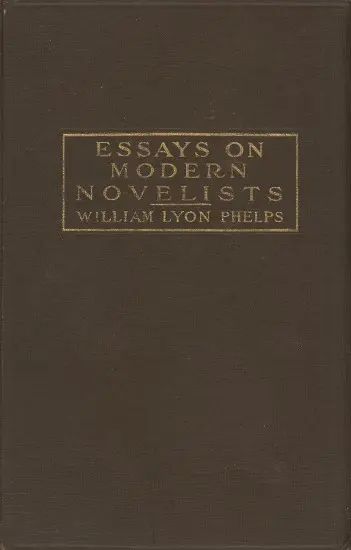
"Essays on Modern Novelists" by William Lyon Phelps is a collection of literary critiques written in the early 20th century. The book offers an in-depth examination of various Modernist authors and their contributions to the genre, aiming to elucidate their themes, styles, and impact on literature. Phelps includes essays on prominent figures such as Thomas Hardy, Mark Twain, and William Dean Howells, illustrating how their works reflect the zeitgeist of their time. At the start of this compilation, Phelps introduces his analysis of William De Morgan, emphasizing the late emergence of De Morgan's literary success. The opening discusses conversations between fictional characters that reveal De Morgan's beliefs about life and creativity, particularly how experience informs his storytelling. Phelps underscores the unique qualities of De Morgan's novels, such as their engaging narratives and character development, while also drawing parallels to the works of other notable authors, laying the groundwork for a detailed exploration of how these novelists collectively shaped modern literature.
Introduction adapted from the source catalogue; source summaries may be automatically generated.
Free to read · English · 66,369 words · No account needed
MAKE TIME FOR A GOOD BOOK
On by default. Untick to stop anonymous reading totals. Each page counts after 10 seconds in view. How this works.
Anonymous counting is on unless you have switched it off.
Our author is fond of presenting events of the most momentous consequence through the lips of humble and indifferent observers. It is only the cabman's chance testimony which shows us that even Rosalind's superb self-control had the limit determined by real womanhood; and in Joseph Vance, the great climax of emotion, when Lossie visits her maligned old lover, is given with unconscious force through the faulty vernacular of the "slut" of a servant-maid, who is utterly unaware of the angels that ministered over that scene; and then by the broken English of the German chess-player, equally blind to the divine presence. Compare these two crude testimonies, which make the ludicrous blunders made by the Hostess in that marvellous account of the death of Falstaff, and you have a veritable harmony of the Gospels. Some novelists use an extraordinary style to describe ordinary events; Mr. De Morgan uses an ordinary style to describe extraordinary events.
Even in his latest book, It Never Can Happen Again,[2] the least cheerful of all his productions, the title is intended to be as comforting as Charles Reade's caption, It Is Never Too Late to Mend. In this story, Mr. De Morgan descends into hell. Delirium tremens has never been pictured with more frightful horror than in the awful night when the mad wretch is bent on murder. No scene in any naturalistic novel surpasses this in vivid detail. Indeed, all of Mr. De Morgan's books might well be circulated as anti-alcohol tracts; the real villain in his tragedies is Drink. Even though drunkenness in a certain aspect supplies comedy in Joseph Vance, drink is, after all, the ruin of old Christopher, and we are left with no shade of doubt that this is so. Mr. De Morgan's unquestionable optimism does not blink the dreadful aspects of life, any more than did Browning's. The scene in the hospital, where the fingers without finger-nails clasp the mighty hand in the rubber glove, is as loathsomely horrible as anything to be found in the annals of disease. And the career of Blind Jim, entirely ignorant of his divine origin and destiny, is a series of appalling calamities. He has lost his sight in a terrible accident; he is run over by a waggon, and loses his leg; he is run over by an automobile, and loses his life. He has also lost, though he does not know it, what is far dearer to him than eyes, or legs, or life,--his little daughter. And yet we do not need the spirit voice of the dead child to assure us that all is well. Indeed, the tragic history of Jim and Lizarann is not nearly so depressing as the humdrum narrative of the melancholy quarrel between Mr. and Mrs. Challis. In previous novels, the author has been pleased to show us domestic happiness; here we have the dreary round of perpetual discord. Of course no one can complain of Mr. De Morgan for his choice in this matter; it is certainly true that not all marriages are happy, even though the majority of them (as I believe) are. The difficulty is that the triangle in this book--husband, wife, and beautiful young lady--has no corner of real interest. It is not entirely the fault of either Mr. or Mrs. Challis that they separate; there is much to be said on both sides. What we object to is the fact that it is impossible to sympathise with either of them; this is not because each is guilty, but because neither is interesting. We do not much care what becomes of them. And as for Judith, the technical virgin who causes all the trouble, she is a very dull person. We do not need this book to learn that female beauty without brains fascinates the ordinary man. The best scenes are those where Blind Jim and Lizarann appear; they are a couple fully worthy of Dickens at his best. Unfortunately they do not appear often enough to suit us, and they both die. We could more easily have spared Mr. and Mrs. Challis, the latter's abominable tea-gossip friend, and that old hypocritical tiger-cat, Mrs. Challis's mother. Why does Mr. De Morgan make elderly women so disgustingly unattractive? Does his sympathy with life desert him here? The entire Challis household, including the satellites of relationship and propinquity, are hardly worth the author's skill or the reader's attention. One would suppose that a brilliant novelist, like Challis, pulled from the domestic orbit by a comet like Judith, would be for a time in an interesting, if not an edifying, position; but he is not. Perhaps Mr. De Morgan wishes to show with the impartiality of a true chronicler of life that a married man, drawn away by his own lust, and enticed, can be just as dull in sin as in virtue. Yet the long dreary family storm ends in sunshine; the discordant pair are redeemed by Love,--the real motive power of this story,--and one feels that it can never happen again. In spite of Mr. De Morgan's continual onslaught on creeds, Athelstan Taylor, who believes the whole Apostles' Creed, compares very favourably with Challis, who believes only the first seven and the last four words of it, apparently the portion accepted by Mr. De Morgan: and by their fruits ye shall know them. It is certainly a proof of the fair-mindedness of our novelist, that he has created orthodox believers like Lossie's husband and Athelstan Taylor, big wholesome fellows, both of them; and has deliberately made both so irresistibly attractive. The professional parson is often ridiculed in modern novels; it is worth noting that in this story the only important character in the whole work who combines intelligence with virtue is the Reverend Athelstan Taylor.
Your reading position is saved on this browser. Take it to another device with a library code. Reading pages adapt to text, rather than matching a printed edition.
William Lyon Phelps
William Lyon Phelps
William Lyon Phelps
William Lyon Phelps
BEHIND THE BOOK
This eBook is for the use of anyone anywhere in the United States and most other parts of the world at no cost and with almost no restrictions whatsoever. You may copy it, give it away or re-use it under the terms of the Project Gutenberg License included with this eBook or online at www.gutenberg.org. If you are not located in the United States, you will have to check the laws of the country where you are located before using this eBook. Read the source licence.
The original source file, including credits and licence, is retained by this library. Request an original-format copy at no charge. Please include the book title and Project Gutenberg identifier #38068.
KEEP YOUR CURIOSITY GOING

David Patterson (Spirit) Hatch

David Patterson (Spirit) Hatch

David Patterson (Spirit) Hatch
Cécile Tormay

Moritz Busch
Coulson Kernahan