THE CLASSIC COLLECTION✦Essays on thingsCLASSIC FREE BOOKS
Essays on things
William Lyon Phelps
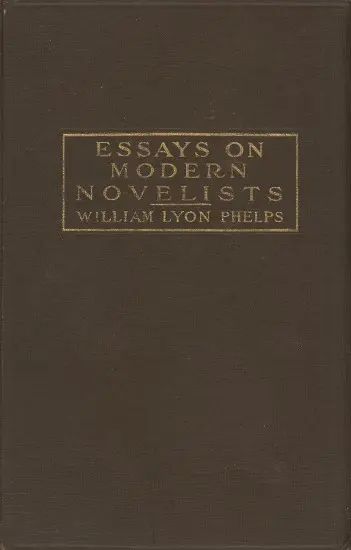
THE CLASSIC COLLECTION · 1910
"Essays on Modern Novelists" by William Lyon Phelps is a collection of literary critiques written in the early 20th century. The book offers an in-depth examination of various Modernist authors and their contributions to the genre, aiming to elucidate their themes, styles, and impact on literature. Phelps includes essays on prominent figures such as Thomas Hardy, Mark Twain, and William Dean Howells, illustrating how their works reflect the zeitgeist of their time. At the start of this compilation, Phelps introduces his analysis of William De Morgan, emphasizing the late emergence of De Morgan's literary success. The opening discusses conversations between fictional characters that reveal De Morgan's beliefs about life and creativity, particularly how experience informs his storytelling. Phelps underscores the unique qualities of De Morgan's novels, such as their engaging narratives and character development, while also drawing parallels to the works of other notable authors, laying the groundwork for a detailed exploration of how these novelists collectively shaped modern literature.
Introduction adapted from the source catalogue; source summaries may be automatically generated.
Free to read · English · 66,369 words · No account needed
MAKE TIME FOR A GOOD BOOK
On by default. Untick to stop anonymous reading totals. Each page counts after 10 seconds in view. How this works.
Anonymous counting is on unless you have switched it off.
But not only should the teacher take an intelligent interest in contemporary authors who have already won a wide reputation, he should be eternally watchful, eternally hopeful--ready to detect signs of promise in the first books of writers whose names are wholly unknown. This does not mean that he should exaggerate the merits of every fresh work, nor beslobber with praise every ambitious quill-driver. On the contrary,--if there be occasion to give an opinion at all,--he should not hesitate to condemn what seems to him shallow, trivial, or counterfeit, no matter how big a "seller" the object in his vision may be. But his sympathies should be warm and keen, and his mind always responsive, when a new planet swims into his ken. One of the most joyful experiences of my life came to me some years ago when I read Bob, Son of Battle with the unknown name Alfred Ollivant on the title-page. It was worth wading through tons of trash to find such a jewel.
And is the literature of our generation really slight and mean? By "Contemporary Literature" we include perhaps authors who have written or who are writing during the lifetime of those who are now, let us say, thirty years old. Contemporary literature would then embrace, in the drama, Ibsen, Bjoernson, Victor Hugo, Henri Becque, Rostand, Maeterlinck, Sudermann, Hauptmann, Pinero, Jones, and others; in the novel, Turgenev, Tolstoi, Dostoievsky, Bjoernson, Hugo, Daudet, Zola, Maupassant, Heyse, Sudermann, Hardy, Meredith, Stevenson, Kipling, Howells, Mark Twain, and many others; in poetry, to speak of English writers alone, Tennyson, Browning, Arnold, Swinburne, Morris, Kipling, Phillips, Watson, Thompson, and others. Those who live one hundred years from now will know more about the permanent value of the works of these men than we do; but are these names really of no importance to teachers whose speciality is literature?
It is interesting to compare the two following poems, written by two distinguished English novelists, both men of fine intelligence, noble character, and absolute sincerity. Mr. Hardy's poem appeared in the Fortnightly Review, for 1 January, 1907.
"I have finished another year," said God,
"In grey, green, white, and brown;
I have strewn the leaf upon the sod,
Sealed up the worm within the clod,
And let the last sun down."
"And what's the good of it?" I said,
"What reasons made You call
From formless void this earth I tread,
When nine-and-ninety can be read
Why nought should be at all?
Your reading position is saved on this browser. Take it to another device with a library code. Reading pages adapt to text, rather than matching a printed edition.
William Lyon Phelps
William Lyon Phelps
William Lyon Phelps
William Lyon Phelps
BEHIND THE BOOK
This eBook is for the use of anyone anywhere in the United States and most other parts of the world at no cost and with almost no restrictions whatsoever. You may copy it, give it away or re-use it under the terms of the Project Gutenberg License included with this eBook or online at www.gutenberg.org. If you are not located in the United States, you will have to check the laws of the country where you are located before using this eBook. Read the source licence.
The original source file, including credits and licence, is retained by this library. Request an original-format copy at no charge. Please include the book title and Project Gutenberg identifier #38068.
KEEP YOUR CURIOSITY GOING

David Patterson (Spirit) Hatch

David Patterson (Spirit) Hatch

David Patterson (Spirit) Hatch
Cécile Tormay

Moritz Busch
Coulson Kernahan