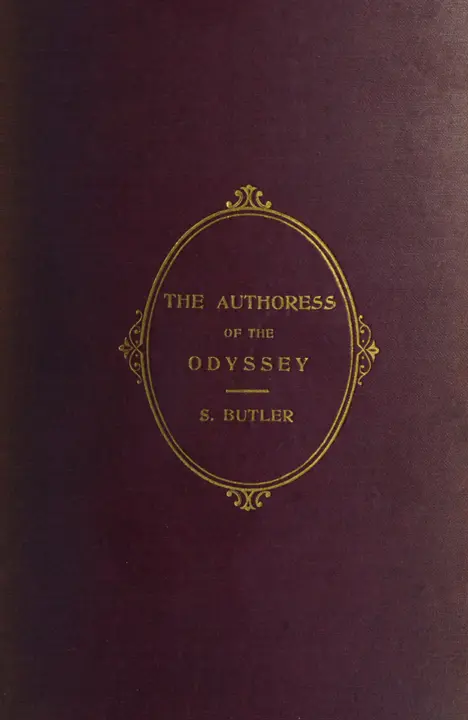
The Authoress of the Odyssey Where and when she wrote, who she was, the use she made of the Iliad, and how the poem grew under her hands
Samuel Butler
THE CLASSIC COLLECTION · 1904
"Essays on Life, Art and Science" by Samuel Butler is a collection of essays written in the late 19th century. This anthology illustrates Butler's remarkable versatility and wit as he explores a variety of subjects, ranging from personal reflections to critiques of societal norms, art, and scientific thought. The collection contains insights into Butler's philosophical musings, personal experiences, and critical observations on human behavior and the nature of existence. The opening of the essays introduces readers to Butler's thoughts on life and literature, highlighting his self-deprecating humor and unique perspective on writing. He begins by sharing a personal anecdote about his search for a suitable writing desk in the British Museum, revealing his introspective nature and the struggle he faces as an author. This opening sets the tone for the essays that follow, as Butler reflects on various literary figures, articulating complex ideas in a relatable manner while drawing connections between himself, his writing, and the legacy of influential writers throughout history. The result is a captivating exploration of art, philosophy, and the intricacies of life that invites readers to contemplate their own existence and the world around them.
Introduction adapted from the source catalogue; source summaries may be automatically generated.
Free to read · English · 65,518 words · No account needed
MAKE TIME FOR A GOOD BOOK
On by default. Untick to stop anonymous reading totals. Each page counts after 10 seconds in view. How this works.
Anonymous counting is on unless you have switched it off.
The contention of those who refuse to admit man unreservedly into the scheme of evolution is comparatively recent. The great propounders of evolution, Buffon, Erasmus Darwin and Lamarck--not to mention a score of others who wrote at the close of the last and early part of this present century--had no qualms about admitting man into their system. They have been followed in this respect by the late Mr. Charles Darwin, and by the greatly more influential part of our modern biologists, who hold that whatever loss of dignity we may incur through being proved to be of humble origin, is compensated by the credit we may claim for having advanced ourselves to such a high pitch of civilisation; this bids us expect still further progress, and glorifies our descendants more than it abases our ancestors. But to whichever view we may incline on sentimental grounds the fact remains that, while Charles Darwin declared language to form no impassable barrier between man and the lower animals, Professor Max Muller calls it the Rubicon which no brute dare cross, and deduces hence the conclusion that man cannot have descended from an unknown but certainly speechless ape.
It may perhaps be expected that I should begin a lecture on the relations between thought and language with some definition of both these things; but thought, as Sir William Grove said of motion, is a phenomenon "so obvious to simple apprehension, that to define it would make it more obscure." {17} Definitions are useful where things are new to us, but they are superfluous about those that are already familiar, and mischievous, so far as they are possible at all, in respect of all those things that enter so profoundly and intimately into our being that in them we must either live or bear no life. To vivisect the more vital processes of thought is to suspend, if not to destroy them; for thought can think about everything more healthily and easily than about itself. It is like its instrument the brain, which knows nothing of any injuries inflicted upon itself. As regards what is new to us, a definition will sometimes dilute a difficulty, and help us to swallow that which might choke us undiluted; but to define when we have once well swallowed is to unsettle, rather than settle, our digestion. Definitions, again, are like steps cut in a steep slope of ice, or shells thrown on to a greasy pavement; they give us foothold, and enable us to advance, but when we are at our journey's end we want them no longer. Again, they are useful as mental fluxes, and as helping us to fuse new ideas with our older ones. They present us with some tags and ends of ideas that we have already mastered, on to which we can hitch our new ones; but to multiply them in respect of such a matter as thought, is like scratching the bite of a gnat; the more we scratch the more we want to scratch; the more we define the more we shall have to go on defining the words we have used in our definitions, and shall end by setting up a serious mental raw in the place of a small uneasiness that was after all quite endurable. We know too well what thought is, to be able to know that we know it, and I am persuaded there is no one in this room but understands what is meant by thought and thinking well enough for all the purposes of this discussion. Whoever does not know this without words will not learn it for all the words and definitions that are laid before him. The more, indeed, he hears, the more confused he will become. I shall, therefore, merely premise that I use the word "thought" in the same sense as that in which it is generally used by people who say that they think this or that. At any rate, it will be enough if I take Professor Max Muller's own definition, and say that its essence consists in a bringing together of mental images and ideas with deductions therefrom, and with a corresponding power of detaching them from one another. Hobbes, the Professor tells us, maintained this long ago, when he said that all our thinking consists of addition and subtraction--that is to say, in bringing ideas together, and in detaching them from one another.
Your reading position is saved on this browser. Take it to another device with a library code. Reading pages adapt to text, rather than matching a printed edition.
Samuel Butler
Samuel Butler
Samuel Butler
Samuel Butler
BEHIND THE BOOK
This eBook is for the use of anyone anywhere in the United States and most other parts of the world at no cost and with almost no restrictions whatsoever. You may copy it, give it away or re-use it under the terms of the Project Gutenberg License included with this eBook or online at www.gutenberg.org. If you are not located in the United States, you will have to check the laws of the country where you are located before using this eBook. Read the source licence.
The original source file, including credits and licence, is retained by this library. Request an original-format copy at no charge. Please include the book title and Project Gutenberg identifier #3461.
KEEP YOUR CURIOSITY GOING

David Patterson (Spirit) Hatch

David Patterson (Spirit) Hatch

David Patterson (Spirit) Hatch
Coulson Kernahan

Ralph Waldo Emerson

Maurice Baring