
Last letters from the living dead man
David Patterson (Spirit) Hatch
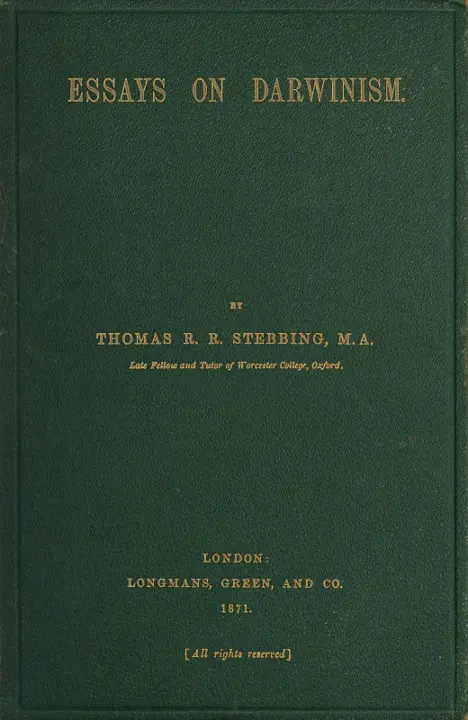
THE CLASSIC COLLECTION · 1871
"Essays on Darwinism" by Thomas Roscoe Rede Stebbing is a collection of essays written in the late 19th century. This work delves into the implications and nuances of Darwin's theories of natural selection and evolution, emphasizing the importance of understanding the science behind these groundbreaking ideas. Stebbing addresses common misconceptions, critiques of Darwinism, and the connections between evolution and broader existential queries about life and humanity. The opening of this scholarly work serves as a preface, laying the foundation for a more in-depth exploration of Darwinian thought. Stebbing praises Darwin's clarity and commitment to truth while critically examining the misunderstandings surrounding his theories. He highlights how many reject Darwinism without engaging with the material and emphasizes the need for a thoughtful and open-minded exploration of these scientific principles. This introduction sets the stage for subsequent essays, which promise to tackle various aspects of Darwinism, the intersection of science and religion, and the implications of evolutionary theory for humanity and morality.
Introduction adapted from the source catalogue; source summaries may be automatically generated.
Free to read · English · 48,503 words · No account needed
MAKE TIME FOR A GOOD BOOK
On by default. Untick to stop anonymous reading totals. Each page counts after 10 seconds in view. How this works.
Anonymous counting is on unless you have switched it off.
It is scarcely fair to ask for space to answer his momentous challenge about the first vertebrate, or to explain the thoroughly sceptical form which the challenge assumes. When the Apostle Thomas said, ‘except I see the print of the nails, I will not believe,’ he had no logical claim to receive the proof of the resurrection which he demanded, because a priori it would have been quite fair to suppose our Lord’s resurrection-body would retain no such signs of previous outrage; and it is a kindred mistake to suppose that the truth of the development-theory in any way hinges upon the possibility of constructing an effigy of the first vertebrate either as it actually was, or to suit an anti-Darwinian’s notions of what it ought to have been. According to the development-theory, it must have been the product of innumerable antecedent factors, itself the heir of many far-descended and often modified characters; and yet, for all that, it will probably have been a far simpler organism than the simplest modern vertebrate. It is well known by what insensible gradations the natural kingdoms and the classes in those great divisions pass, so to speak, into one another; it need, therefore, cause no surprise if the primary vertebrate of all the vertebrates should prove neither to have been fish, flesh, fowl, nor good red herring; but for an actual specimen of a living vertebrate that can neither ‘swim, crawl, fly, nor walk,’ I cannot do better than refer my philosophical opponent to a new-born baby.
Sir,--Against your correspondent’s preference for vernacular terms may be set a remark by Dr. Whewell, that ‘the loose and infantine grasp of common language cannot hold objects steadily enough for scientific examination, or lift them from one stage of generalization to another. They must be secured by the rigid mechanism of a scientific phraseology.’ To say that ‘the first vertebrate must have been the product of innumerable antecedent factors,’ is, perhaps, an expression more puzzling than if one merely said that ‘its immediate progenitors’ were ‘a single pair;’ but then it has the advantage of being considerably more suggestive, and a good deal more to the purpose. Among these ‘factors’ of a living creature parents commonly find a place,--two parents generally; in some cases, only one; in some cases, not even one, if we are to believe the advocates of spontaneous generation, or the still popular view in regard to the Creation. To the parental factors of any particular offspring must be added those which are constituted by food and climate and a multitude of changes and chances in the whole course of its existence. Some characters it may derive from remote ancestors, transmitted through, though not developed in, its ‘immediate progenitors.’ It is now forty years since two French anatomists showed the possibility, or even probability, of a connection between the molluscous cuttle-fish and the vertebrate type; and, considering the propensity of the highest vertebrate for perpetually squirting ink at those who meddle with it, most readers of controversy will think the instance well selected. Those who wish to be told what the first vertebrate was probably like, should first accurately define what they mean by a vertebrate. Is a jointed backbone the only essential? And if so, how many vertebræ are essentially requisite? A creature with two vertebræ would be as much a vertebrate as a creature with three. What shall we say, then, of a creature possessing, if we may use the expression, but a single vertebra? It would not have a jointed backbone. It would not be a vertebrate. Yet, by the simple multiplication of similar parts, in accordance with a thousand analogies, a vertebrate could be developed from it. By the differentiation of these similar parts, which not only might follow, but must follow, a great variety of species could easily be evolved. Those who really take an interest in the problems connected with this subject, and whose ‘convictions’ are not too strong and absolute to be swayed by ascertained facts and logical reasoning will do well to study the ‘Principles of Biology,’ Herbert Spencer. They will there see by what extraordinarily simple gradations the lowliest organisms are connected with higher and the highest forms. They will there find that ‘modification of characters’ is a doctrine less intricate than might be supposed, even if it cannot be wholly explained in words of one syllable.
Your reading position is saved on this browser. Take it to another device with a library code. Reading pages adapt to text, rather than matching a printed edition.
BEHIND THE BOOK
This eBook is for the use of anyone anywhere in the United States and most other parts of the world at no cost and with almost no restrictions whatsoever. You may copy it, give it away or re-use it under the terms of the Project Gutenberg License included with this eBook or online at www.gutenberg.org. If you are not located in the United States, you will have to check the laws of the country where you are located before using this eBook. Read the source licence.
The original source file, including credits and licence, is retained by this library. Request an original-format copy at no charge. Please include the book title and Project Gutenberg identifier #48987.
KEEP YOUR CURIOSITY GOING
David Patterson (Spirit) Hatch

David Patterson (Spirit) Hatch

David Patterson (Spirit) Hatch
Coulson Kernahan

Ralph Waldo Emerson

Maurice Baring