
Last letters from the living dead man
David Patterson (Spirit) Hatch
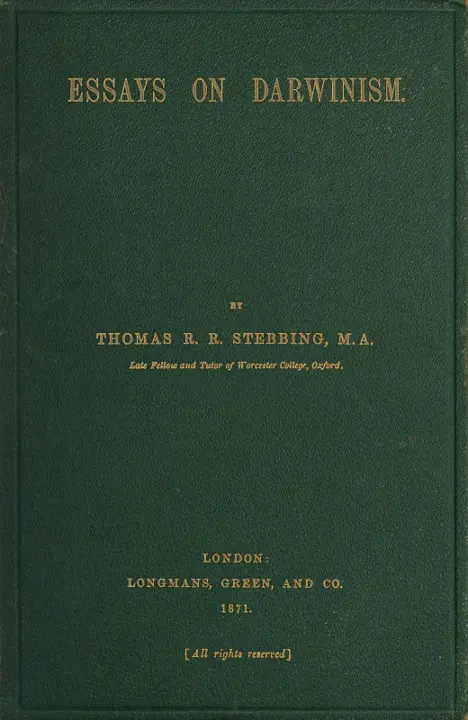
THE CLASSIC COLLECTION · 1871
"Essays on Darwinism" by Thomas Roscoe Rede Stebbing is a collection of essays written in the late 19th century. This work delves into the implications and nuances of Darwin's theories of natural selection and evolution, emphasizing the importance of understanding the science behind these groundbreaking ideas. Stebbing addresses common misconceptions, critiques of Darwinism, and the connections between evolution and broader existential queries about life and humanity. The opening of this scholarly work serves as a preface, laying the foundation for a more in-depth exploration of Darwinian thought. Stebbing praises Darwin's clarity and commitment to truth while critically examining the misunderstandings surrounding his theories. He highlights how many reject Darwinism without engaging with the material and emphasizes the need for a thoughtful and open-minded exploration of these scientific principles. This introduction sets the stage for subsequent essays, which promise to tackle various aspects of Darwinism, the intersection of science and religion, and the implications of evolutionary theory for humanity and morality.
Introduction adapted from the source catalogue; source summaries may be automatically generated.
Free to read · English · 48,503 words · No account needed
MAKE TIME FOR A GOOD BOOK
On by default. Untick to stop anonymous reading totals. Each page counts after 10 seconds in view. How this works.
Anonymous counting is on unless you have switched it off.
Palæontology is defined as ‘the science which treats of fossil remains both animal and vegetable.’ This principle of the continuity of life from age to age may be considered as one of its definite acquisitions. There is no single point of geological time at which it can be said, ‘at this epoch clearly all old species had passed away, all kinds of life had become new.’ Not only is there no indication of such a break, but there is the strongest evidence against any such having ever occurred. In spite, however, of the completeness of the evidence required for proving this single conclusion, the general incompleteness and enormous deficiencies in some parts of the palæontological record can be established beyond dispute. We are in the position of a man who has kept the title-deeds to a large estate, while almost all the estate itself has been buried under the encroachments of the sea. Here and there some old landmarks may be discernible far out in the waters, showing the extent of what had once been meadow and woodland, farm and garden, but unable to show how these were distributed, or to exhibit any of their details.
Mr. Parfitt, in his paper on ‘Fossil Sponge Spicules,’ told the Devonshire Association last year (1870) that we have evidence more or less exact of sponges in a fossil state as far back in time as the Silurian system, mentioning specimens of Acanthospongia Siluriensis, Cliona antiqua, and Cliona prisca, and stating in regard to the two latter that the genus is still in our own seas. He then referred to large masses of a fossil in the Devonian rocks of Cornwall, believed by some to be sponges, and by others to be the remains of fish. That these are in reality fish-remains has, in fact, been shown pretty conclusively[59]. From this point, however, up to the Great Oolite, Mr. Parfitt tells us that scarcely a vestige of the sponges is to be found, although since that time they have been very abundant. Between the Silurian and the Great Oolite the interval of time must have been enormous. It is occupied by a vast series of sedimentary rocks, embracing very varied mineral characteristics. From this series our museums have been, and are still being, supplied with vast heaps of fossil organic structures, including among numerous others, plants and corals and fish and reptiles. Through all that protracted period there is no reason to suppose, in regard to the outer rind of the globe, that the general conditions of earth, air, and water were other than they are now. All England may have been under water; delicate creatures may have wintered at the North Pole for the sake of its genial climate; and an infinity of other local and temporary differences may have prevailed, without making the habitable globe of those days essentially different from our own. The laws of chemistry and mechanics, the laws of heat and motion, must have been just the same as they are now. Then, as now, there must have been oceans and continents, winds and currents, forests growing, decaying, and being buried, sand and chalk being deposited in layers, molten minerals thrown up by volcanoes, ice forming at a definite temperature, glaciers scoring the rocks, icebergs transporting boulders, rains and rivers slowly washing down the hills, and waves corroding the cliffs on the sea-shore. We have evidence also that life in many forms abounded. Those forms, though seldom transmitted to creatures of the present day with anything approaching an exact likeness, can yet be classified under the same general names with the most modern forms of life. Now sponges are forms of an extremely simple organization. The silicious spicules are well adapted for the wear and tear of a fossil existence. In the greensand and the chalk they are actually found in extraordinary abundance. It would be inconvenient upon any theory to have to suppose these very simple structures introduced into the world for the first time quite late in the series of living organisms, and after beings much more complicated and higher in the scale of existence, unless, indeed, we suppose that about the time of the Great Oolite the evolution of man was first thought of, and the sponge accordingly prepared for him to wash his face with. But even if the bath and the basin be admitted as the final causes of sponge-existence, the conception of it must be carried back, as we have seen, to the Silurian period; while, according to Mr. Parfitt, the immense interval of Lias and Trias, Permian, Carboniferous, and Devonian remains black and spongeless, as though it were the appropriate era of the great unwashed. But if the Darwinian theory be a true one, sponge-life having begun in the Silurian period, and being in existence now, must have been continuous through the whole interval; every single deposit in the entire series since the Silurian must have been contemporary with some of the sponges; and, as a matter of fact, Mr. Parfitt’s statement, however true of the condition of our knowledge a few years back, must now be qualified by the addition of several species spread over the interval in Britain alone, even if we exclude some indefinite structures, of which no opinion can be at present pronounced with safety. Mr. Parfitt himself, in a paper read at Honiton in 1868, remarks that ‘the Devonian formation has furnished a great number of specimens of what appear to be species of sponges.’ From Permian and Triassic beds on the continent of Europe, a very large number of forms are said to be more or less distinctly made out. Mr. Salter, in 1864, reported the discovery of Protospongia Fenestrata in the Lingula flags of St. David’s, thus carrying back this form of life beyond the Silurian to the Cambrian era. It is an interesting illustration of the great ambiguity of these ancient fossils, that two such authorities as Mr. Salter and Dr. Bowerbank differed about the Protospongia, the one supposing it to exhibit the spicules, the other the fibre of the sponge. The simple facts that species have to be moved backwards and forwards between the amorphozoic and zoophytic groups, that relics may pass for fish in one year and sponges in another, and by-and-by be recognised again as fish, show the often imperfect condition of the record, even where it is not a complete blank.
Your reading position is saved on this browser. Take it to another device with a library code. Reading pages adapt to text, rather than matching a printed edition.
BEHIND THE BOOK
This eBook is for the use of anyone anywhere in the United States and most other parts of the world at no cost and with almost no restrictions whatsoever. You may copy it, give it away or re-use it under the terms of the Project Gutenberg License included with this eBook or online at www.gutenberg.org. If you are not located in the United States, you will have to check the laws of the country where you are located before using this eBook. Read the source licence.
The original source file, including credits and licence, is retained by this library. Request an original-format copy at no charge. Please include the book title and Project Gutenberg identifier #48987.
KEEP YOUR CURIOSITY GOING
David Patterson (Spirit) Hatch

David Patterson (Spirit) Hatch

David Patterson (Spirit) Hatch
Coulson Kernahan

Ralph Waldo Emerson

Maurice Baring