
Last letters from the living dead man
David Patterson (Spirit) Hatch
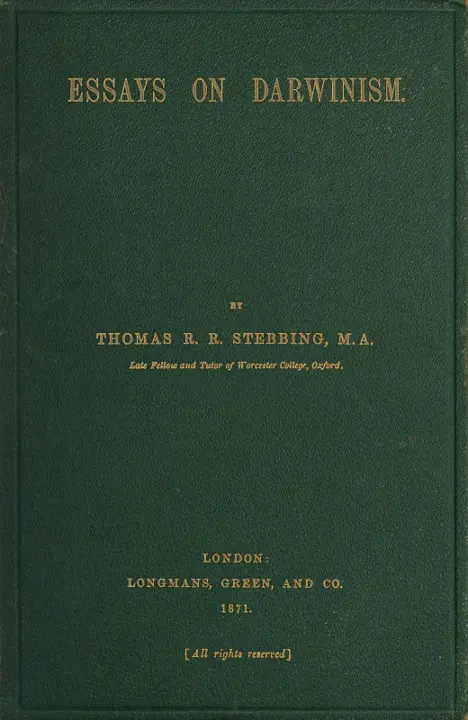
THE CLASSIC COLLECTION · 1871
"Essays on Darwinism" by Thomas Roscoe Rede Stebbing is a collection of essays written in the late 19th century. This work delves into the implications and nuances of Darwin's theories of natural selection and evolution, emphasizing the importance of understanding the science behind these groundbreaking ideas. Stebbing addresses common misconceptions, critiques of Darwinism, and the connections between evolution and broader existential queries about life and humanity. The opening of this scholarly work serves as a preface, laying the foundation for a more in-depth exploration of Darwinian thought. Stebbing praises Darwin's clarity and commitment to truth while critically examining the misunderstandings surrounding his theories. He highlights how many reject Darwinism without engaging with the material and emphasizes the need for a thoughtful and open-minded exploration of these scientific principles. This introduction sets the stage for subsequent essays, which promise to tackle various aspects of Darwinism, the intersection of science and religion, and the implications of evolutionary theory for humanity and morality.
Introduction adapted from the source catalogue; source summaries may be automatically generated.
Free to read · English · 48,503 words · No account needed
MAKE TIME FOR A GOOD BOOK
On by default. Untick to stop anonymous reading totals. Each page counts after 10 seconds in view. How this works.
Anonymous counting is on unless you have switched it off.
It is not uncommon to find fossils in the pebbles of a conglomerate rock showing lines of a dislocating fracture filled with spar. The fossil shell or coral once had an inhabitant. We must allow time for its life and death. Its vacant tabernacle must then have become filled with extraneous matter. This must have required time to harden into rock. While that rock was still in the mass, some cause must have operated to fracture it, and such causes are not of every-day operation. After this, more time was needed to fill up the divisional line with spar; more time to break off the fragment containing the shell from the general mass of the rock; more time to roll it into a pebble; more time to imbed it hard and fast in a conglomerate rock; more time to raise the rock high out of the waters; and, lastly, one more vast addition of time for the crumbling away of the conglomerate formation, so as to expose the tall sea-cliff from which human hands might gather this memorial relic of untold ages.
The same tale is told by the coal-measures. Dr. Dawson, of Montreal, has drawn out the argument from the carboniferous formation[57] with extraordinary force and a convincing plainness that leaves nothing to be desired, for the benefit of any one who will read his great work on Acadian geology. The formation of coal depends on sub-aërial growths, affected by sub-aqueous action. The trees and plants, out of which coal is formed, for the most part could not possibly have grown under water. The mud, the sand, the stone which cover seams of coal, could not have been laid over them without the agency of water to bring them down, and spread them out in regular layers of stratification. When the hollow bark of a tall tree is found erect upon its roots, with those roots still permeating the clay from which they once drew nourishment, it is evident that time must be allowed for the growth of the tree, for the almost complete decay which left nothing of it but its bark and roots, and for the slow accumulation of sediment which has encased without overthrowing it. A complete alteration must have taken place in the conditions of the ground in the interval between the time when the tree began to grow, and the time when a length of seven or eight feet of its upright stem was buried in mud. Layers, indeed, of sand and mud may be spread out over small areas by storms and inundations with comparative speed; but if above the sands we come to thicknesses of limestone composed almost entirely of animal remains, such as those of shells and fish, not only are we forced to admit a long period for the successive generations of those creatures, but we are forced to observe the products of the ocean lying actually above the products of the dry land, as though, according to the old poetical extravagance, the stag and doe had taken to the waters and the fishes been building in the tree-tops. The conclusion is inevitable, that what was once dry land, fruitful in vegetation, in process of time became a swamp, and from the swamp became a sea. It will be a fresh surprise, but a fresh evidence of time’s duration, if above the limestone we find more clay with more plants buried in more mud, and over-topped by more limestone. Bearing in mind the old supposition, that order and beauty and life upon the globe are only six thousand years’ old, astonishment should reach its climax when we find, as we do, that within the thickness of only a few feet of the earth’s crust, the record that we have been describing is repeated again and again and again; but beyond the climax, a fresh and overpowering marvel awaits us, when, as at one spot in British America, the record expands itself from a few feet into sixteen thousand, showing conclusively by eighty successive bands of coal that fourscore times at least, and perhaps many more, while that thickness of the earth’s crust was forming, the waters gave place to dry land, and in turn the dry land to the waters,--showing conclusively that during all the period of these changes tall forests of graceful trees abounded on the globe, along with exquisite ferns and curious reptiles, and beetles and winged insects of great size and beauty; while fish replenished the waters, along with an infinity of shells and corals, and other inhabitants of the deep. Yet these sixteen thousand feet, these eighty successive forests, these hundred and sixty changes, comprise but a small fraction of the whole known succession of strata.
Your reading position is saved on this browser. Take it to another device with a library code. Reading pages adapt to text, rather than matching a printed edition.
BEHIND THE BOOK
This eBook is for the use of anyone anywhere in the United States and most other parts of the world at no cost and with almost no restrictions whatsoever. You may copy it, give it away or re-use it under the terms of the Project Gutenberg License included with this eBook or online at www.gutenberg.org. If you are not located in the United States, you will have to check the laws of the country where you are located before using this eBook. Read the source licence.
The original source file, including credits and licence, is retained by this library. Request an original-format copy at no charge. Please include the book title and Project Gutenberg identifier #48987.
KEEP YOUR CURIOSITY GOING
David Patterson (Spirit) Hatch

David Patterson (Spirit) Hatch

David Patterson (Spirit) Hatch
Coulson Kernahan

Ralph Waldo Emerson

Maurice Baring