
Last letters from the living dead man
David Patterson (Spirit) Hatch
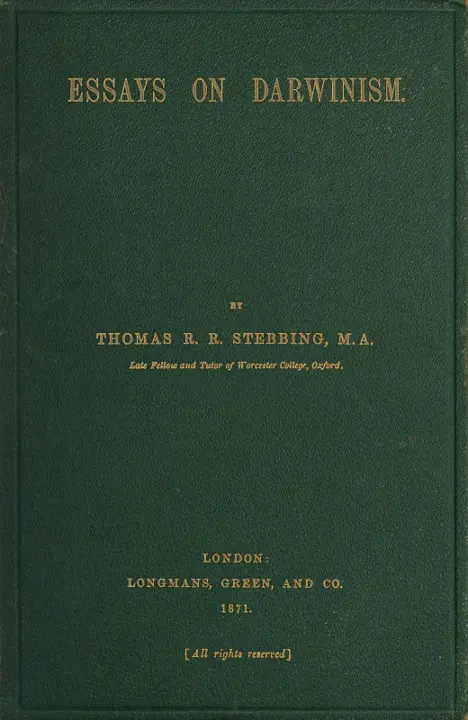
THE CLASSIC COLLECTION · 1871
"Essays on Darwinism" by Thomas Roscoe Rede Stebbing is a collection of essays written in the late 19th century. This work delves into the implications and nuances of Darwin's theories of natural selection and evolution, emphasizing the importance of understanding the science behind these groundbreaking ideas. Stebbing addresses common misconceptions, critiques of Darwinism, and the connections between evolution and broader existential queries about life and humanity. The opening of this scholarly work serves as a preface, laying the foundation for a more in-depth exploration of Darwinian thought. Stebbing praises Darwin's clarity and commitment to truth while critically examining the misunderstandings surrounding his theories. He highlights how many reject Darwinism without engaging with the material and emphasizes the need for a thoughtful and open-minded exploration of these scientific principles. This introduction sets the stage for subsequent essays, which promise to tackle various aspects of Darwinism, the intersection of science and religion, and the implications of evolutionary theory for humanity and morality.
Introduction adapted from the source catalogue; source summaries may be automatically generated.
Free to read · English · 48,503 words · No account needed
MAKE TIME FOR A GOOD BOOK
On by default. Untick to stop anonymous reading totals. Each page counts after 10 seconds in view. How this works.
Anonymous counting is on unless you have switched it off.
But Egypt and Switzerland are a long way off; geologizing in a railway-cutting has been before now a fatal employment; and digging pits forty feet deep into the mud of the Nile is an operation attended with difficulties peculiar to itself. Here, however, in Torquay, close at hand, we possess a register of time as compact, as accessible, as genuine, as the Library of the British Museum. Limestone, it is well known, is formed beneath the waters of the sea. When it appears above the sea-level, it must have been upheaved from its ocean-bed. How long a period must be allowed for the hill which contains Kent’s cavern to have been formed by this double process, may be left for the present to the imagination. How long a time elapsed before the cavern was burst open or eaten out from the solid limestone, we will not enquire. Thanks to the diligent exploration of it; thanks to the unwearied courtesy of its scientific curators[51], the contents of the cavern, or at least a portion of them, are now well known. Not only do they embrace the remains of animals not now existing in England, but they embrace the remains of animals long since lost to the globe. With these are mingled the products of human intelligence, the weapons of the savage. The cave-earth which, as well as the stalagmite, contains these relics of a most remote antiquity, is itself permeated with films of stalagmite, a conclusive proof of its gradual introduction. Over the lower portions have been formed in succession three solid stalagmitic floors, remnants of which have quite lately been discovered still imbedded in the cavern[52]. Let us for a moment consider what this implies. If we transport ourselves to Matlock Bath in Derbyshire, for the small fee of a penny, any one of its ‘petrifying wells’[53] will be open to our inspection. In these curious grottoes whatever object you please, natural or artificial, be it skull or the cap that once covered it, be it basket or bird, or shell or leaf, may be encrusted with a coating of stalagmite. The inexperienced visitor would like to place an object in the well, and to wait while the ‘petrifying’ waters do their work. He is surprised to find that in that case he must wait and watch for months and years, while the slow persevering stream falls upon his treasure with its ceaseless drip, drip, drip, and that the work so slowly accomplished would not be accomplished at all if the flowing of the stream were hastened. Imagine, then, in this famous cavern of ours what an interminable song, though an intermittent one, must have been sung with this drip, drip, drip, through ages and ages, to produce, as in one place it has done, a solid stalagmitic mass full twelve feet in thickness. Now, according to Usher’s chronology, we have seventeen centuries from Adam to the Flood, and twenty-three centuries from the Flood to the age of Julius Cæsar. If this chronology is to be accepted, Kent’s cavern must have been filled either in the first period or in the second. As the same arguments will apply to each, let us assume that the second or longer period sufficed for this purpose, and see what further admissions this assumption will involve. We have three and twenty centuries at our disposal. At the end of that time we know historically that Britain was occupied by tribes more or less savage, some of them going about almost naked, destitute of almost all the arts of civilization. We are to imagine the ancestors of this wild race migrating from Asia and slowly pioneering their way to the western limits of Europe. Necessity is the mother of invention; but these men in their difficult adventurous travel through unknown seas and pathless jungles tenanted by dangerous beasts, learn only how to forget. They forget the use of brass and iron, and take to weapons and tools of flint; they give up tillage; they give up building strong towers, and shelter themselves in wooden huts or caves and dens of the earth. The climate of Western Asia is warm and sunny, that of England often, and in many parts, bleak and foggy and cold; therefore these intelligent children of Noah, in order perhaps to harden themselves in the process of acclimatization, as they force their way into the fog and mist, instead of keeping or assuming the flowing robes of the Asiatic, exchange their garments, at any rate in battle, for a wash of paint. How interesting it would be to have the family portraits of a Highland clan from the earliest times, showing how they gradually made it fashionable to do without the various articles of clothing which one by one they have been induced to resume[54]! During the same epoch, within the same limits of time, migrating also from the warm regions of Asia, came elephants and lions, hyenas and bears, the rhinoceros and the elk. Little recked they then of change of climate, which now they so ill endure. They prowled all over Europe; they swam across the English Channel. Yet before the historical period begins in Gaul and Britain, most of these species had had time not only to make their way thither, not only to nourish and abound in these habitations, but to die out and to be forgotten. We know for certain that elephants once roamed over Devon. Did they succumb to the flint weapons of the savage? Was the same savage able to extirpate the hyena and the lion, though the representatives of those fierce beasts still partially set us at defiance in India, notwithstanding the rifles and gunpowder of modern civilization? Let us imagine that within the specified time all that has been mentioned could have happened, and that some of the animals, such as the woolly rhinoceros, had time to assume the characters of northern species, or that the climate had time for vast changes and alterations, or that the winds perhaps in those days blew hot and cold with the same breath so as to suit arctic and tropical species indifferently;--we must imagine further that within the same limits the three floors of stalagmite could have been formed in succession, and two of them successively broken up. They must have been formed, not during the whole of the period, but only during that part of it which followed the introduction into Britain of wild beasts, and of men who used flint weapons; for one unmistakeable weapon of human manufacture, and innumerable bones of the great old cave bear have been found within the rock-like breccia of stone and stalagmite and cave-earth, some feet below both the floors of more recent formation[55]. The longer the period, therefore, we allow for the migration from the East and the dying out of civilized life, the shorter is the period left for the stalagmitic formation. Yet probably the whole twenty-three centuries would not suffice for the formation of one of the floors; how much less could a fraction of the period suffice to form all three, and to supply the intervals during which, through some change of circumstances, the cave-earth was accumulating, and consequently no solid floor being formed.
Your reading position is saved on this browser. Take it to another device with a library code. Reading pages adapt to text, rather than matching a printed edition.
BEHIND THE BOOK
This eBook is for the use of anyone anywhere in the United States and most other parts of the world at no cost and with almost no restrictions whatsoever. You may copy it, give it away or re-use it under the terms of the Project Gutenberg License included with this eBook or online at www.gutenberg.org. If you are not located in the United States, you will have to check the laws of the country where you are located before using this eBook. Read the source licence.
The original source file, including credits and licence, is retained by this library. Request an original-format copy at no charge. Please include the book title and Project Gutenberg identifier #48987.
KEEP YOUR CURIOSITY GOING
David Patterson (Spirit) Hatch

David Patterson (Spirit) Hatch

David Patterson (Spirit) Hatch
Coulson Kernahan

Ralph Waldo Emerson

Maurice Baring