
Last letters from the living dead man
David Patterson (Spirit) Hatch
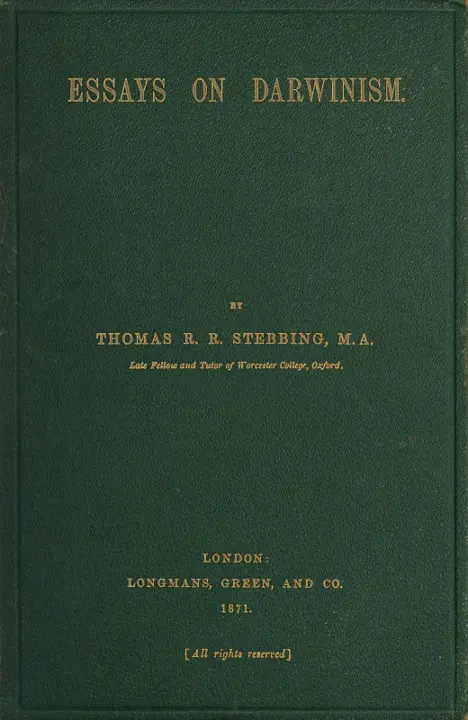
THE CLASSIC COLLECTION · 1871
"Essays on Darwinism" by Thomas Roscoe Rede Stebbing is a collection of essays written in the late 19th century. This work delves into the implications and nuances of Darwin's theories of natural selection and evolution, emphasizing the importance of understanding the science behind these groundbreaking ideas. Stebbing addresses common misconceptions, critiques of Darwinism, and the connections between evolution and broader existential queries about life and humanity. The opening of this scholarly work serves as a preface, laying the foundation for a more in-depth exploration of Darwinian thought. Stebbing praises Darwin's clarity and commitment to truth while critically examining the misunderstandings surrounding his theories. He highlights how many reject Darwinism without engaging with the material and emphasizes the need for a thoughtful and open-minded exploration of these scientific principles. This introduction sets the stage for subsequent essays, which promise to tackle various aspects of Darwinism, the intersection of science and religion, and the implications of evolutionary theory for humanity and morality.
Introduction adapted from the source catalogue; source summaries may be automatically generated.
Free to read · English · 48,503 words · No account needed
MAKE TIME FOR A GOOD BOOK
On by default. Untick to stop anonymous reading totals. Each page counts after 10 seconds in view. How this works.
Anonymous counting is on unless you have switched it off.
All around us in England, in Devonshire, in Torquay, and all over the globe, lie the memorials of human beings, of whose day and generation the oldest historical records we possess know absolutely nothing. Here and there the tale is told by a heap of shells. From such heaps we know what dishes were served at the Dane’s dinner-table, at a time when cereal crops were unknown in Denmark, and sea-weed was used instead of salt[46]. Oysters and cockles, mussels and periwinkles, seem to have been ad libitum; the stag, the roe-deer, and the wild boar were at the service of that ancient Dane as often as he could catch them with his weapons of wood, stone, horn, or bone[47]; when pork and venison were scarce, his palate could content itself with dog or fox. From the waters of the mountain-lake, from the centre of the high-piled barrow, in the circles of giant stones upon broad-stretching plain or wild moorland, from peat-moss and railway-cutting and limestone cavern, we obtain, as Sir John Lubbock and Mr. Pengelly and others have so well shown, the unwritten records of prehistoric man, of human beings unnoticed in any credible history, and preceding all well-established definite historical dates whether of sacred or profane literature. Who reared the Titanic monuments of Stonehenge and Abury we know not. We know not who constructed the extraordinary animal-mounds of Wisconsin in North America--mounds hundreds of feet long, reared a few feet above the level plains, in the figures of men and beasts and birds and reptiles. These monuments, if such they were intended to be, must have demanded prodigious industry for their construction. They imply a considerable population, and some advance in artistic skill. But why they were designed, and who designed them, are circumstances alike unknown. It is necessary to press home this argument founded upon our ignorance, and to dwell upon it with some emphasis, because numbers of persons are pleased to imagine and assert that, within two or three thousand years before the Christian era, the whole human population of the globe was as it were still in the bud, and that from a single family, not mustering a dozen members to start with, all its tribes have since then been derived, with their endless diversities of features, hair, complexion, customs, tastes, and other qualities both of mind and body. According to the old chronology we are to suppose that within this limited space of time, from under a single roof, the children went forth, spreading over all lands, not only miraculously forgetting the common ancestral language, but forgetting the arts, the traditions, the sentiments, which they had in common, retrograding in some cases into a savage ferocity or an almost imbecile simplicity, in others retaining or developing forms of an advanced civilization. Esquimaux and Hottentots, Japanese and Red Indians, the Negro and the Greek, are thus united in ties of cousinship by no means remote. Arts, monuments, and modes of life essentially different in spirit and character are supposed, within these narrow bounds of time, to have sprung up; nor only to have sprung up, but to have passed away, leaving only a few faint vestiges to recall the artists, the heroes, the lawgivers, the national temper, the genius of the time, whereunto they owed their existence. It must surely be allowed that marriage customs change with slow reluctance; an alteration of the sentiment with which women are regarded is not easily or quickly produced. Yet on no subject are the practices and opinions of mankind more widely diversified. One wife to one husband is in some places the rule; but in others, one husband to many wives, one wife to many husbands, or husbands and wives without any special appropriation, which some societies consider a selfish infringement of the general right. According to the customs of different nations, wives must be fought for, or stolen, or purchased, or caught in a race, or wooed and won with pin-money and other endearments. According to the feeling of different races, the wife is a chattel, a beast of burden, a slave, a stewardess, a domestic ornament, an equal, or a master[48]. Let it be granted that many of these customs and sentiments may have been contemporaneous in their growth or development, the same thing cannot be admitted of the different centres of colonization in which they grew and developed. Men do not without cause quit their ancestral homes to found colonies in remote parts of the world; and the causes only arise at intervals. When the cause has arisen, and the new settlement been occupied, the exiles retain for the most part, and long retain in affectionate remembrance the manners and customs, the religion and laws, of the mother-country; or when the remembrance is other than affectionate, they retain them from the want of an alternative, from the conservatism in which all men to a greater or less degree participate, from the incapacity of the human mind to strike out new customs, or revolutionize ideas, except by a gradual and half-unconscious progression.
Your reading position is saved on this browser. Take it to another device with a library code. Reading pages adapt to text, rather than matching a printed edition.
BEHIND THE BOOK
This eBook is for the use of anyone anywhere in the United States and most other parts of the world at no cost and with almost no restrictions whatsoever. You may copy it, give it away or re-use it under the terms of the Project Gutenberg License included with this eBook or online at www.gutenberg.org. If you are not located in the United States, you will have to check the laws of the country where you are located before using this eBook. Read the source licence.
The original source file, including credits and licence, is retained by this library. Request an original-format copy at no charge. Please include the book title and Project Gutenberg identifier #48987.
KEEP YOUR CURIOSITY GOING
David Patterson (Spirit) Hatch

David Patterson (Spirit) Hatch

David Patterson (Spirit) Hatch
Coulson Kernahan

Ralph Waldo Emerson

Maurice Baring