
Last letters from the living dead man
David Patterson (Spirit) Hatch
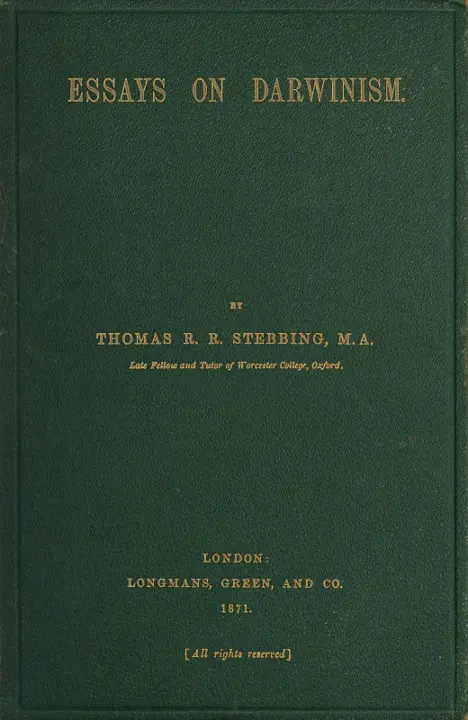
THE CLASSIC COLLECTION · 1871
"Essays on Darwinism" by Thomas Roscoe Rede Stebbing is a collection of essays written in the late 19th century. This work delves into the implications and nuances of Darwin's theories of natural selection and evolution, emphasizing the importance of understanding the science behind these groundbreaking ideas. Stebbing addresses common misconceptions, critiques of Darwinism, and the connections between evolution and broader existential queries about life and humanity. The opening of this scholarly work serves as a preface, laying the foundation for a more in-depth exploration of Darwinian thought. Stebbing praises Darwin's clarity and commitment to truth while critically examining the misunderstandings surrounding his theories. He highlights how many reject Darwinism without engaging with the material and emphasizes the need for a thoughtful and open-minded exploration of these scientific principles. This introduction sets the stage for subsequent essays, which promise to tackle various aspects of Darwinism, the intersection of science and religion, and the implications of evolutionary theory for humanity and morality.
Introduction adapted from the source catalogue; source summaries may be automatically generated.
Free to read · English · 48,503 words · No account needed
MAKE TIME FOR A GOOD BOOK
On by default. Untick to stop anonymous reading totals. Each page counts after 10 seconds in view. How this works.
Anonymous counting is on unless you have switched it off.
The sentiment in question amounts to this, that certain powers or faculties of the human mind are so wonderful and so unique, that they could not have originated in the ordinary processes of nature without some special intervention. Antecedents conforming to the usual observed order in other living productions are not sufficiently magnificent for the soul of man. Something sudden, something mysterious, is demanded in the agency of its creation. It must be like Pallas Athene, springing from the brain of Zeus, a goddess fully armed from her birth in the panoply of wisdom and virtue. Yet the whole feeling thus to be described of what is fit and worthy must be accredited, as we desire to show, simply to prejudice. Nothing can really depend for its intrinsic grandeur upon our knowledge or ignorance of its origin. A single cause instantaneously producing its effect does not make the result in any way more admirable or magnificent than the like result coming at the close of an indefinitely extended chain of causation. Feelings of surprise and wonder are excited when we find that ten thousand copies of the Times newspaper can be printed within a single hour; but the same feelings move us in the granite-yards of Scotland, when we learn that many months are required for cutting through a single block. At the first proposal of railways, a pace of twenty or five-and-twenty miles an hour was thought too wonderful for belief; while now, from familiarity with far higher rates of speed, we think it miserably slow. A child is surprised to learn that the light of the sun requires time to reach the eye; but a new and even greater surprise is aroused by the information that the time so required is only a few minutes for ninety millions of miles. The swiftness of thought is proverbial. A single act of thought is commonly supposed to be absolutely instantaneous; and yet presence of mind, which depends on rapidity of thought, is fully recognized as an uncommon quality, while it has now been ascertained by experiment that every thought requires a definite, and in many cases measurable, length of time for its production and exercise. Following the analogy of these illustrations, we may expect that the popular opinion or prejudice as to the instantaneous creation of the human mind will vanish and subside when men become familiar with the idea of its slow development. It will at least be seen that there is no special dignity and grandeur in the supposed suddenness of its introduction into the universe. The general scheme of nature, so far as we can penetrate its working, seems to show that there is some proportion observed between the time spent in producing and the perfection of the thing produced. Religion itself is an unquestionable witness to this method of procedure. There is no great religion of which the adherents claim to have had it revealed to them from the first in its full perfection. What is true of religion, is true of all arts and sciences. Their progress has been gradual. The greatness of nations, even when it seems to blaze forth in history most suddenly, ever finds its true origin in numerous steps of slow preparation. A hardy, frugal tribe of warriors is nursed in some obscure mountain cradle. The struggle for existence fosters their preservative virtues. A line of rulers is evoked, forced by the circumstances of their tenure to acquire, as their leading qualities, cunning, prudence, self-control, fertility of resource, promptitude of action, till at length the hour and the man coincide, and a handful of barbarians give their name to a great empire. The same rule prevails with languages, and the literatures that adorn them. So fully is this established in regard to literature, that men who examine the subject deeply are almost led to disbelieve in originality of genius altogether, from the invariable indebtedness of the noblest authors to the thoughts and imaginings of earlier minds. There is, therefore, no antecedent improbability that can fairly be pleaded against the gradual development of the human mind. On the contrary, every possible analogy is in its favour. A supposition so favoured becomes at least a lawful and reasonable subject of enquiry. If it be true that the theory of evolution applies to the mind of man, we should expect to find in that mind itself traces of the earlier steps, or grades of development, through which it has passed, and also in the world around creatures lower than humanity in some sort representing those earlier stages of slowly unfolding reason. In other words, we should expect to find in human nature itself those very inequalities, that very conflict of the higher and the lower elements on which moralists so urgently insist, and we should expect to find affinities and resemblances, more or less close, pervading the whole animal creation, and exhibiting human reason and brute intelligence as, upon a broad view, one in kind, however different in degree.
Your reading position is saved on this browser. Take it to another device with a library code. Reading pages adapt to text, rather than matching a printed edition.
BEHIND THE BOOK
This eBook is for the use of anyone anywhere in the United States and most other parts of the world at no cost and with almost no restrictions whatsoever. You may copy it, give it away or re-use it under the terms of the Project Gutenberg License included with this eBook or online at www.gutenberg.org. If you are not located in the United States, you will have to check the laws of the country where you are located before using this eBook. Read the source licence.
The original source file, including credits and licence, is retained by this library. Request an original-format copy at no charge. Please include the book title and Project Gutenberg identifier #48987.
KEEP YOUR CURIOSITY GOING
David Patterson (Spirit) Hatch

David Patterson (Spirit) Hatch

David Patterson (Spirit) Hatch
Coulson Kernahan

Ralph Waldo Emerson

Maurice Baring