THE CLASSIC COLLECTION✦Songs of Heroic DaysCLASSIC FREE BOOKS
Songs of Heroic Days
Thomas O'Hagan
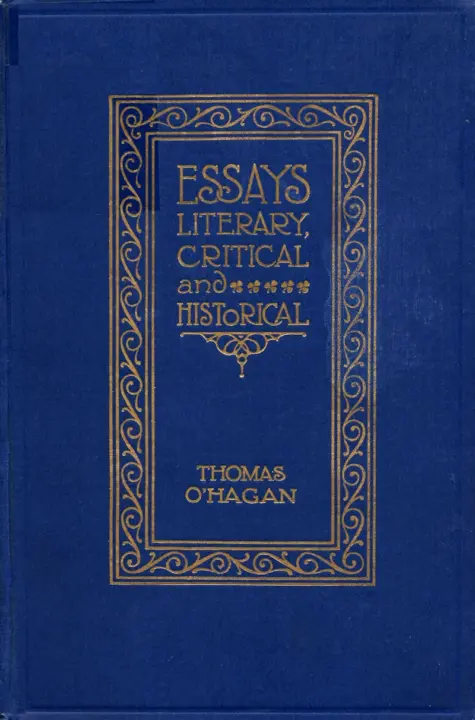
THE CLASSIC COLLECTION · 1909
"Essays Literary, Critical and Historical" by Thomas O'Hagan is a collection of essays written in the early 20th century. The work explores various literary, critical, and historical topics, showcasing the author's keen insights on literature, education, and the role of women in society. Through these essays, O'Hagan engages deeply with literary analysis and critiques of contemporary thought, particularly in the context of Catholicism and its influence on scholarship. The opening portion of the book introduces the author and outlines the dedication of the essays to French Canadians and Acadians, highlighting O'Hagan's appreciation for their contributions to Canadian culture. He notes the origins of the essays, some of which have been published previously in reputable journals, and discusses his influences and inspirations for writing. The preface also sets the stage for a discussion of significant literary figures and themes, particularly emphasizing the value and impact of Tennyson’s work, along with a critical examination of historical narratives and their representation in poetry and literature.
Introduction adapted from the source catalogue; source summaries may be automatically generated.
Free to read · English · 20,681 words · No account needed
MAKE TIME FOR A GOOD BOOK
On by default. Untick to stop anonymous reading totals. Each page counts after 10 seconds in view. How this works.
Anonymous counting is on unless you have switched it off.
“Sleep and rest, sleep and rest,
Father will come to thee soon;
Rest, rest, on mother’s breast,
Father will come to thee soon;
Father will come to his babe in the nest,
Silver sails all out of the west
Under the silver moon:
Sleep, my little one, sleep, my pretty one, sleep.”
Sweet influence, indeed, this of the babe which reaches across the ocean and unites loving hearts.
The next song, “The Bugle,” is regarded by many as the finest lyric that has been written since the days of Shakespeare. Its real meaning is frequently not grasped by the casual reader. It is based upon the contrast between the echoes of a bugle on a mountain lake, which grow fainter and fainter in proportion to the receding distance, and the influence of soul upon soul through growing distances of time:
“The splendor falls on castle walls
And snowy summits old in story:
The long light shakes across the lakes,
And the wild cataract leaps in glory.
Blow, bugle, blow, set the wild echoes flying,
Blow, bugle; answer, echoes, dying, dying, dying.
“O hark, O hear! how thin and clear,
And thinner, clearer, farther going!
O sweet and far from cliff and scar
The horns of Elfland faintly blowing!
Blow, let us hear the purple glens replying:
Blow, bugle; answer, echoes, dying, dying, dying.
“O love, they die in yon rich sky,
They faint on hill or field or river:
Our echoes roll from soul to soul
And grow forever and forever.
Blow, bugle, blow, set the wild echoes flying,
And answer, echoes, answer, dying, dying, dying.”
The stress of meaning is in the words our and grow. Our echoes roll from soul to soul—from generation to generation—from grandparent to parent and grandchild. This poem represents unity through the family in its relation to the future, just as the first two songs represent that unity through the past and present.
The fourth is intended to show the influences of home and wedded love in nerving a man for the shocks and conflicts of life:
“Thy voice is heard thro’ rolling drums,
That beat to battle where he stands;
Thy face across his fancy comes,
And gives the battle to his hands:
A moment while the trumpets blow,
He sees his brood about thy knee;
The next, like fire he meets the foe,
And strikes him dead—for thine and thee.”
We see by this lyric that patriotism and heroic effort have their root and origin in home affection.
The next song represents the influence of the family, of which the child is the bond, upon the mother:
Your reading position is saved on this browser. Take it to another device with a library code. Reading pages adapt to text, rather than matching a printed edition.
BEHIND THE BOOK
This eBook is for the use of anyone anywhere in the United States and most other parts of the world at no cost and with almost no restrictions whatsoever. You may copy it, give it away or re-use it under the terms of the Project Gutenberg License included with this eBook or online at www.gutenberg.org. If you are not located in the United States, you will have to check the laws of the country where you are located before using this eBook. Read the source licence.
The original source file, including credits and licence, is retained by this library. Request an original-format copy at no charge. Please include the book title and Project Gutenberg identifier #51593.
KEEP YOUR CURIOSITY GOING

David Patterson (Spirit) Hatch

David Patterson (Spirit) Hatch

David Patterson (Spirit) Hatch
Cécile Tormay

Moritz Busch
John L. Ransom