THE CLASSIC COLLECTION✦Early memories; some chapters of autobiographyCLASSIC FREE BOOKS
Early memories; some chapters of autobiography
John Butler Yeats
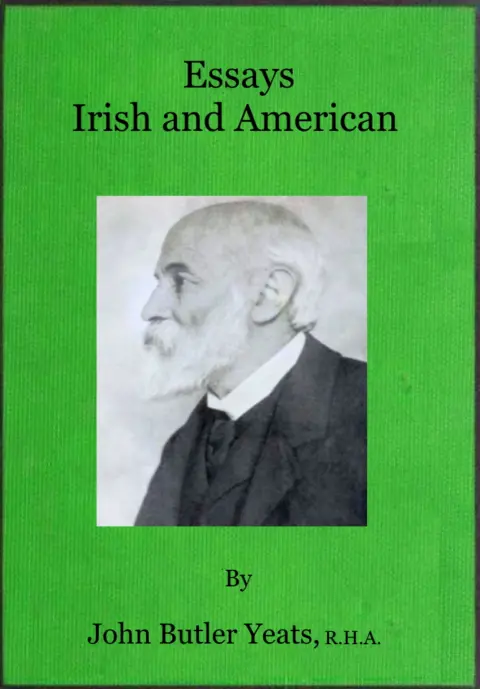
THE CLASSIC COLLECTION · 1918
"Essays Irish and American" by John Butler Yeats is a collection of essays written in the early 20th century. The work reflects on various cultural aspects, blending observations from both Irish and American perspectives, while addressing themes such as art, society, and individual character. Yeats's essays aim to explore the complexities of humanity, delving into the lives and philosophies of notable figures and the cultural landscapes they inhabit. The opening of the collection features an appreciation written by Æ (George William Russell) that provides insight into the author's character and artistic perspective. It highlights Yeats's appreciation for the humanity and natural qualities he sees in others, particularly through his artistic endeavors. Following this introduction, the first essay, "Recollections of Samuel Butler," recounts Yeats's experiences with the English writer and painter Samuel Butler, detailing Butler's struggles as a painter, his observations of English society, and Yeats's reflections on character and individual nature. This opening portion sets the stage for a thoughtful examination of the interplay between art and life, revealing Yeats's deep engagement with the cultural identities he explores.
Introduction adapted from the source catalogue; source summaries may be automatically generated.
Free to read · English · 21,167 words · No account needed
MAKE TIME FOR A GOOD BOOK
On by default. Untick to stop anonymous reading totals. Each page counts after 10 seconds in view. How this works.
Anonymous counting is on unless you have switched it off.
Besides his exemption from military organization and a central government, there is yet another fact to be noted in the Englishman’s history. A peaceful immigration into his country has been as difficult as a warlike invasion. In other countries, when the population was reduced by plague and pestilence, the void was quickly filled up by an inrush of hungry foreigners; in England this was impossible. There a sudden fall in population meant a sudden rise in the abundance of food, because there was no one to come from outside to take the food out of men’s mouths. The population of mediæval England remained always small. The Englishman’s native joviality and ease of heart were his song of triumph over a condition in which, if he managed to survive, he lived easily and fed well and clothed himself warmly. If other people died, so much the worse for them and the better for him. To this day the Englishman takes extraordinary care of his health. The French and Irish contempt for death is to him a continual and a shocking surprise. He never needed to work hard; he faced no great struggles; he merely took care of his health.
In those far-off days of ease, little work, and much mortality the Englishman acquired all his habits, all his positive and negative qualities, together with that fear of death which we know oppressed Dr. Johnson; and though the last hundred years have much blunted his characteristics, the pattern still remains. He is still given to much self-contemplation in its various forms of self-complacency, self-examination, self-condemnation, and self-exultation. He talks continually of himself; deprived of that subject and of what is akin to it, he is a silent man. Not to be the subject of conversation, neither to be praised nor abused, is to him a disconcerting experience. He is not vain; it is merely that his occupation is gone. The Americans are too busy with their own growing fortunes to remember his existence, and for that reason he is, here in New York, either so gentle and sad or so peppery and quarrelsome as to be quite unrecognizable. He is no longer himself. In his own country he is an unwearied egotist. When pleased it is with himself, when displeased it is still with himself. With his neighbours he is often sulky; yet his worst quarrels are with himself, and therefore the hardest to reconcile. His variations are variations not of idea, but of mood. The French live in a ferment of opinion; it is their atmosphere--man contending against man with noise, vociferation, oratory, and much action and movement. Among the English there is always the silence of inward communing, the stillness of a people overweighted with meditation. In France new schools of art and movements in literature are the triumphs or--it may be--the eccentricities and freaks of the logical process. In England such movements mean the welcome or unwelcome emergence into light of a new species. French impressionism was ushered into the world with loud argument. Turner’s art was something inscrutable and mysterious, the expression of a temperament that did not argue and looked for no converts. Under any strong excitement the Englishman withdraws into himself as into the security of his own home. The Frenchman, on the contrary, gets away from himself into the world of friends and ideas and starts a propaganda to embrace the world. He seeks to impress; his literature and art are full of dramatic surprises, while English art and literature have always avoided startling effects; and, if they impress, do so accidentally, as a tall mountain might the people who lived in the valley. They continually spring forth from the mysterious depths of personality, and, concerning themselves only with moods of feeling, rely for expression on rhythm and music. A personality cannot explain itself or account for itself; it can only cure its ache and soothe its irritability by the music--the long-drawn-out or fantastic music of artistic creation. French art and literature concern themselves with ideas, and their effort is to make these brilliant, orderly and specious, using the emphasis and animation and sonorousness of art rather that its deeper music. So that in France they watch for a distinguished intellect, while in England we look for an individuality that is at once powerful, strange, and intimate, its expression intelligible only to those who have explored the farthest recesses of consciousness. In France we find a garden, in England a wilderness. Yet, do not forget, the gardener will often visit the wilderness in search for new plants and shrubs. The inductive mind sows that which the deductive mind plants out and waters.
Your reading position is saved on this browser. Take it to another device with a library code. Reading pages adapt to text, rather than matching a printed edition.
BEHIND THE BOOK
This eBook is for the use of anyone anywhere in the United States and most other parts of the world at no cost and with almost no restrictions whatsoever. You may copy it, give it away or re-use it under the terms of the Project Gutenberg License included with this eBook or online at www.gutenberg.org. If you are not located in the United States, you will have to check the laws of the country where you are located before using this eBook. Read the source licence.
The original source file, including credits and licence, is retained by this library. Request an original-format copy at no charge. Please include the book title and Project Gutenberg identifier #62939.
KEEP YOUR CURIOSITY GOING

David Patterson (Spirit) Hatch

David Patterson (Spirit) Hatch

David Patterson (Spirit) Hatch

Ralph Waldo Emerson

Maurice Baring

Oscar Wilde & James McNeill Whistler