READ · DISCOVER · ENJOYClassic literature · Always free
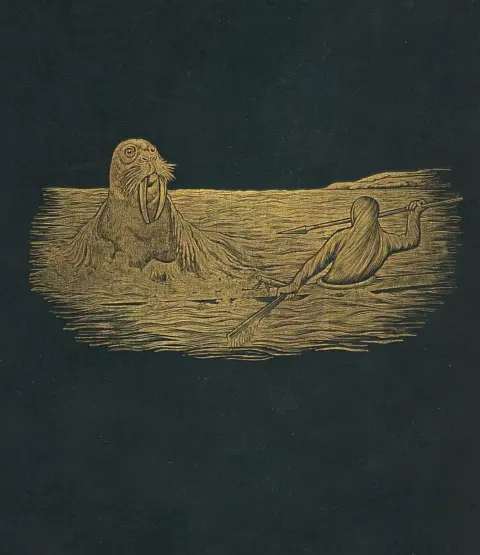
Eskimo Life — digital edition cover

THE CLASSIC COLLECTION · 1893

Eskimo Life

"Eskimo Life" by Fridtjof Nansen is an ethnographic account written in the late 19th century. The work delves into the lives, customs, and environment of the Greenlandic Eskimos, highlighting their relationship with nature and their survival strategies in a harsh Arctic landscape. Nansen, having spent a winter among the Eskimos, aims to document his observations while expressing compassion for their declining culture due to European influence. At the start of the narrative, Nansen sets the scene by describing the stark beauty of Greenland and the unique lifestyle of the Eskimos who inhabit it. He reflects on their intimate connection to the sea and their resources, underscoring contrasts between their past and present. The opening introduces key themes such as the resilience of the Eskimo people in the face of environmental challenges and the impact of European colonization. Nansen also shares personal anecdotes from his winter experience, crafting an evocative image of the Eskimo community and their way of life, enriched by their cultural practices and deep appreciation for their surroundings.

Introduction adapted from the source catalogue; source summaries may be automatically generated.

Start reading ↓

Free to read · English · 95,433 words · No account needed

MAKE TIME FOR A GOOD BOOK

Eskimo Life

On by default. Untick to stop anonymous reading totals. Each page counts after 10 seconds in view. How this works.

Anonymous counting is on unless you have switched it off.

Eskimo Life

That the reader may form some conception of a primitive Eskimo's habits of thought on moral questions, I quote the following letter from a converted Greenlander to Paul Egede.[41] I reproduce it here, because it in many respects bears out the views above expressed, and Egede's book 'Accounts of Greenland,'[42] in which this translation is printed (pp. 230-236) is now not easily obtainable. The writer was a heathen who had been baptised by Paul Egede's father, Hans Egede. The letter, which was of course written in Eskimo, gives evidence not only of a peculiar moral point of view, but also of a keen understanding, and of feelings which, as Paul Egede says, one would scarcely expect 'in so stupid a people as we have hitherto taken them to be.' It is, as will be seen, an answer to an epistle of Egede's, and runs as follows:--

Amiable Pauia![43]

You know how precious and agreeable your letter is to me; but how appalled I was when I read of the destruction of such multitudes of people in the great earthquake,[44] inconceivable to us, which you say devoured in one moment more people than there are in all our country. I cannot tell you how this moved me, or how frightened we were, so that many fled from the place where they lived to another, which was quite as unsafe, though it was on a rock; for we see even here that rocks have been split open from the top to the very depths, though when it happened none of us know. Granite rocks, such as our land consists of, and sand-hills like your land, are equally easy for God to overthrow, in whose power the whole world stands, and we poor little animals are easily buried in the ruins. You give me to understand that with you there have been neither snow nor great cold this winter, and conclude that it must have been all the severer with us; but we, too, have had an unusually mild winter. I hear that your learned men are of opinion that this mild weather has been caused by the warm vapours emanating from the earth at the time of the earthquake, which have warmed the air and melted the snow-material. But if I had not heard that this was the opinion of the learned, I should have thought that the warmth of the earth would avail little to heat the height and breadth of the air--as little as a man's breath avails to warm a large house in which he simply breathes for a moment and then goes out again. The south winds, which are always warm, and have blown all the year through with us, are the cause of the moderate cold we have had; but why the south wind blew I cannot tell, nor the learned either, perhaps. Were these wretched people killed by the heat, or did the earth swallow them up, or were they shaken to death? Skipper B. thought that their own houses must have fallen upon them and killed them. Your people do not seem to care very much about it; for they are not only cheerful and merry, but they relate that the two nations[45] who come here whale-fishing, not your countrymen, but of the same faith as you, are fighting with and shooting each other both by land and sea, hunting each other as we hunt seals and reindeer, and stealing and taking away ships and goods from each other, from people they have never seen or known, simply because their lord and master will have it so. When I asked the skipper, through an interpreter, what could be the cause of such inhumanity, he answered that it was all about a piece of land right opposite ours,[46] so far away that it could only be reached after three months' sailing. Then I thought that there must be great scarcity of land where these people dwell; but he said no, that it was only because of the great lords' greediness for more riches and more people to rule over. I was so astounded by this greediness, and so terrified lest it should fall upon us too, that I was almost out of my mind; but I presently took heart again, you will scarcely guess why. I thought of our snow-clad country and its poor inhabitants, and said to myself: 'Thank God! we are poor and possess nothing which these greedy Kablunaks [so they call all foreigners] can desire. What we have upon the earth they do not care to possess, what we require for food and clothing swims in the great sea; of that they may take as much as they can, there will always be enough for us.' If only we have as much food as we can eat, and skins enough to keep us from the cold, we are quite contented; and you know very well that we let to-morrow take care of itself. Therefore we will not fight with anyone, even if we were strong enough; although we can as justly say that the sea belongs to us as the believers in the East can say of the unbelievers in the West that they and their possessions belong to them. We can say it is our sea which surrounds our land, and that the whales, cachalots, grampuses, porpoises, unicorns [that is, narwhals], white whales, seals, halibuts, salmon, cod, and sea-scorpions which swim in it belong to us too; but we willingly allow others to take of this great store as much as they please. We are happy in that we have not so great a natural covetousness as they. I have often wondered at the Christians, and have not known what to think about them--they leave their own beautiful land, and suffer much hardship in this country, which is to them so rough and disagreeable, simply for the sake of making us good people; but have you seen so much evil in our nation, have you ever heard such strange and utterly senseless talk among us? Their teachers instruct us how we are to escape the devil, whom we never knew; and yet the roystering sailors pray with the greatest earnestness that the devil may take them, or may split them. I daresay you remember how I, in my youth, learned such phrases from them to please them, without knowing what they meant, until you forbade me to use them. Since I have come to understand them myself, I have heard more than I wanted of them. This year in particular I have heard so much of the Christians, that if I had not, in the course of long familiarity with them, known many good and worthy men among them, and if Hans Pungiok and Arnarsak, who have been to your country, had not told me that there were many pious and virtuous people there, I could have wished that we had never set eyes upon them lest they should corrupt our people. I daresay you have often heard how my countrymen think of you and yours that you have learned good behaviour among us; and when they see a pious person among you, they will often say, 'He is like a human being,' or 'a Greenlander.' You no doubt remember that funny fellow Okako's idea of sending angekoks [that is, medicine-men] to your country to teach the people to be good, as your king has sent preachers hither to teach us that there is a God, which we did not know before. But I know that your people do not lack instruction, and therefore that proposal is of no use. It is strange enough, my dear Pauia!--your people know that there is a God, the creator and upholder of all things, that after this life they will either be happy or miserable, according as they shall have conducted themselves here, and yet they live as if they were under orders to be wicked, and it was to their honour and advantage to sin. My countrymen, on the other hand, know nothing either of a God or a devil, believe neither in punishment nor in reward after this life; and yet they live decently, treat each other kindly, and share with each other peaceably when they have food to share. There are, of course, bad people among us too, which proves that we must be of one stock; and perhaps we must thank our barren land for the fact that most of us are above reproach. (You do not think, I hope, that I am talking hypocritically about my countrymen, for you know by experience that what I say is true.) When I have heard accounts of your pleasant country I have often envied its inhabitants; for they have great abundance of the delicious fruits of the earth, and of animals, birds, and fishes of innumerable sorts, fine large comfortable houses, fine clothes, a long summer, no snow or cold, no midges, but everything pleasant and desirable; and this happiness, I thought, belonged to you alone because you were believers, and, as it were, God's own children, while we, as unbelievers, were placed in this country as a punishment. But, oh, we happy Greenlanders! Oh, dear native land! How well it is that you are covered with ice and snow; how well it is that if in your rocks there are gold and silver, for which the Christians are so greedy, it is covered with so much snow that they cannot get at it! Your unfruitfulness makes us happy and saves us from molestation! Pauia! we are indeed contented with our lot. Fish and flesh are our sole food; dainties seldom come in our way, but are all the pleasanter when they do. Our drink is ice-cold water; it quenches thirst and does not steal away the understanding or the natural strength like that maddening drink of which your people are so fond. Our clothing is of unsightly thick-haired skins, but it is well suited to this country, both for the animals, while the skins are still theirs, and for us when we take them from them. Here then, thank God, there is nothing to tempt anyone to come and kill us for its sake. We live without fear. It is true that here in the North we have the fierce white bears; but to deal with them we have our dogs, which fight for us, so that we do not run the slightest risk. Murder is very seldom heard of among us. It does not happen unless someone is suspected or accused of being a magician and of having killed someone by his witchcraft, in which case he is killed without remorse by those whose duty it is, who think they have just as good right as the executioner in your country to take the lives of malefactors; but they make no boast of it, and do not give thanks to God for it like the great lords in your country, when they have killed all the people of another land, as D. has told me. It surely cannot be to the good God of whom you teach us, who has forbidden us to shed blood, that they give thanks and praises; it must be to another who loves slaughter and destruction. I wonder if it is not to the Tornarsuk [the devil]? Yet that cannot be either; for it would be flying in the face of the good God to give any honour to Satan. I hope you will explain this to me at your convenience. I promise not to tell my countrymen about it. It might lead them to think like Kaua, who dared not become a Christian for fear he should come to be like the wicked sailors. I will not tell you anything about the conversion of my countrymen, for I know that our teacher has given you all information. The thing you desired me to look into I will, as far as I am able, attend to. I have not been able to make the experiment with the compass, since the cold this year has been only moderate. The cause of the two conflicting currents is no doubt what you say. Since you value so much the two fishes almost turned to stone, I shall try to procure more for you; they are found in clay beds, as you suppose. Now I seem to have been speaking to you and you to me--now I must close my letter. The skipper is ready and the wind is fair. The mighty Protector of all of us guide them over the great and perilous sea, and preserve them, especially from the wicked men-hunters, of whom I see they are most in dread, so that they may come scatheless to their fatherland and find you, my beloved, with gladness.

Your reading position is saved on this browser. Take it to another device with a library code. Reading pages adapt to text, rather than matching a printed edition.

More from this author

BEHIND THE WORDS

About Fridtjof Nansen

Fridtjof Nansen (1861–1930). Explore Eskimo Life, Farthest North, Vol. II Being the Record of a Voyage of Exploration of the Ship ‘Fram’ 1893-1896, Farthest North, Vol. I Being the Record of a Voyage of Exploration of the Ship ‘Fram’ 1893-1896 in this collection. These books span travel & exploration, adventure, history.

Explore this author’s books →

THE READERS’ VERDICT

How did this story stay with you?

Not rated yet
Your rating for Eskimo Life

Be the first to share your verdict.

One rating per browser, which you can change or remove. A necessary browser identifier remembers your vote. How ratings work

A GOOD STORY DESERVES COMPANY

Pass this book along.

A great read is even better when it’s shared.

SEND A LITTLE INSPIRATION

Share this book

BEHIND THE BOOK

Edition & source details.

Title
Eskimo Life
Author
Fridtjof Nansen
First publication (Open Library catalogue match)
1893
Digital edition publisher
Project Gutenberg
Gutenberg release date
2014-09-26
Language
English
Source edition imprint
Not stated in source catalogue
Source identifier
Project Gutenberg #46972
Contributors
Otto Ludvig Sinding (ill); William Archer (trl)

Public-domain source & licence

This eBook is for the use of anyone anywhere in the United States and most other parts of the world at no cost and with almost no restrictions whatsoever. You may copy it, give it away or re-use it under the terms of the Project Gutenberg License included with this eBook or online at www.gutenberg.org. If you are not located in the United States, you will have to check the laws of the country where you are located before using this eBook. Read the source licence.

Full source licence and obtaining an original copy

The original source file, including credits and licence, is retained by this library. Request an original-format copy at no charge. Please include the book title and Project Gutenberg identifier #46972.

the full Project Gutenberg License must appear
prominently whenever any copy of a Project Gutenberg work (any work
on which the phrase “Project Gutenberg” appears, or with which the
phrase “Project Gutenberg” is associated) is accessed, displayed,
performed, viewed, copied or distributed:

This eBook is for the use of anyone anywhere in the United States and most
other parts of the world at no cost and with almost no restrictions
whatsoever. You may copy it, give it away or re-use it under the terms
of the Project Gutenberg™ License included with this eBook or online
at www.gutenberg.org. If you
are not located in the United States, you will have to check the laws
of the country where you are located before using this eBook.

1.E.2. If an individual Project Gutenberg electronic work is
derived from texts not protected by U.S. copyright law (does not
contain a notice indicating that it is posted with permission of the
copyright holder), the work can be copied and distributed to anyone in
the United States without paying any fees or charges. If you are
redistributing or providing access to a work with the phrase “Project
Gutenberg” associated with or appearing on the work, you must comply
either with the requirements of paragraphs 1.E.1 through 1.E.7 or
obtain permission for the use of the work and the Project Gutenberg
trademark as set forth in paragraphs 1.E.8 or 1.E.9.

1.E.3. If an individual Project Gutenberg electronic work is posted
with the permission of the copyright holder, your use and distribution
must comply with both paragraphs 1.E.1 through 1.E.7 and any
additional terms imposed by the copyright holder. Additional terms
will be linked to the Project Gutenberg License for all works
posted with the permission of the copyright holder found at the
beginning of this work.

1.E.4. Do not unlink or detach or remove the full Project Gutenberg
License terms from this work, or any files containing a part of this
work or any other work associated with Project Gutenberg.

1.E.5. Do not copy, display, perform, distribute or redistribute this
electronic work, or any part of this electronic work, without
prominently displaying the sentence set forth in paragraph 1.E.1 with
active links or immediate access to the full terms of the Project
Gutenberg License.

1.E.6. You may convert to and distribute this work in any binary,
compressed, marked up, nonproprietary or proprietary form, including
any word processing or hypertext form. However, if you provide access
to or distribute copies of a Project Gutenberg work in a format
other than “Plain Vanilla ASCII” or other format used in the official
version posted on the official Project Gutenberg website
(www.gutenberg.org), you must, at no additional cost, fee or expense
to the user, provide a copy, a means of exporting a copy, or a means
of obtaining a copy upon request, of the work in its original “Plain
Vanilla ASCII” or other form. Any alternate format must include the
full Project Gutenberg License as specified in paragraph 1.E.1.

1.E.7. Do not charge a fee for access to, viewing, displaying,
performing, copying or distributing any Project Gutenberg works
unless you comply with paragraph 1.E.8 or 1.E.9.

1.E.8. You may charge a reasonable fee for copies of or providing
access to or distributing Project Gutenberg electronic works
provided that:

• You pay a royalty fee of 20% of the gross profits you derive from
the use of Project Gutenberg works calculated using the method
you already use to calculate your applicable taxes. The fee is owed
to the owner of the Project Gutenberg trademark, but he has
agreed to donate royalties under this paragraph to the Project
Gutenberg Literary Archive Foundation. Royalty payments must be paid
within 60 days following each date on which you prepare (or are
legally required to prepare) your periodic tax returns. Royalty
payments should be clearly marked as such and sent to the Project
Gutenberg Literary Archive Foundation at the address specified in
Section 4, “Information about donations to the Project Gutenberg
Literary Archive Foundation.”

• You provide a full refund of any money paid by a user who notifies
you in writing (or by e-mail) within 30 days of receipt that s/he
does not agree to the terms of the full Project Gutenberg™
License. You must require such a user to return or destroy all
copies of the works possessed in a physical medium and discontinue
all use of and all access to other copies of Project Gutenberg™
works.

• You provide, in accordance with paragraph 1.F.3, a full refund of
any money paid for a work or a replacement copy, if a defect in the
electronic work is discovered and reported to you within 90 days of
receipt of the work.

• You comply with all other terms of this agreement for free
distribution of Project Gutenberg™ works.


1.E.9. If you wish to charge a fee or distribute a Project
Gutenberg™ electronic work or group of works on different terms than
are set forth in this agreement, you must obtain permission in writing
from the Project Gutenberg Literary Archive Foundation, the manager of
the Project Gutenberg™ trademark. Contact the Foundation as set
forth in Section 3 below.

1.F.

1.F.1. Project Gutenberg volunteers and employees expend considerable
effort to identify, do copyright research on, transcribe and proofread
works not protected by U.S. copyright law in creating the Project
Gutenberg™ collection. Despite these efforts, Project Gutenberg™
electronic works, and the medium on which they may be stored, may
contain “Defects,” such as, but not limited to, incomplete, inaccurate
or corrupt data, transcription errors, a copyright or other
intellectual property infringement, a defective or damaged disk or
other medium, a computer virus, or computer codes that damage or
cannot be read by your equipment.

1.F.2. LIMITED WARRANTY, DISCLAIMER OF DAMAGES - Except for the “Right
of Replacement or Refund” described in paragraph 1.F.3, the Project
Gutenberg Literary Archive Foundation, the owner of the Project
Gutenberg™ trademark, and any other party distributing a Project
Gutenberg™ electronic work under this agreement, disclaim all
liability to you for damages, costs and expenses, including legal
fees. YOU AGREE THAT YOU HAVE NO REMEDIES FOR NEGLIGENCE, STRICT
LIABILITY, BREACH OF WARRANTY OR BREACH OF CONTRACT EXCEPT THOSE
PROVIDED IN PARAGRAPH 1.F.3. YOU AGREE THAT THE FOUNDATION, THE
TRADEMARK OWNER, AND ANY DISTRIBUTOR UNDER THIS AGREEMENT WILL NOT BE
LIABLE TO YOU FOR ACTUAL, DIRECT, INDIRECT, CONSEQUENTIAL, PUNITIVE OR
INCIDENTAL DAMAGES EVEN IF YOU GIVE NOTICE OF THE POSSIBILITY OF SUCH
DAMAGE.

1.F.3. LIMITED RIGHT OF REPLACEMENT OR REFUND - If you discover a
defect in this electronic work within 90 days of receiving it, you can
receive a refund of the money (if any) you paid for it by sending a
written explanation to the person you received the work from. If you
received the work on a physical medium, you must return the medium
with your written explanation. The person or entity that provided you
with the defective work may elect to provide a replacement copy in
lieu of a refund. If you received the work electronically, the person
or entity providing it to you may choose to give you a second
opportunity to receive the work electronically in lieu of a refund. If
the second copy is also defective, you may demand a refund in writing
without further opportunities to fix the problem.

1.F.4. Except for the limited right of replacement or refund set forth
in paragraph 1.F.3, this work is provided to you ‘AS-IS’, WITH NO
OTHER WARRANTIES OF ANY KIND, EXPRESS OR IMPLIED, INCLUDING BUT NOT
LIMITED TO WARRANTIES OF MERCHANTABILITY OR FITNESS FOR ANY PURPOSE.

1.F.5. Some states do not allow disclaimers of certain implied
warranties or the exclusion or limitation of certain types of
damages. If any disclaimer or limitation set forth in this agreement
violates the law of the state applicable to this agreement, the
agreement shall be interpreted to make the maximum disclaimer or
limitation permitted by the applicable state law. The invalidity or
unenforceability of any provision of this agreement shall not void the
remaining provisions.

1.F.6. INDEMNITY - You agree to indemnify and hold the Foundation, the
trademark owner, any agent or employee of the Foundation, anyone
providing copies of Project Gutenberg™ electronic works in
accordance with this agreement, and any volunteers associated with the
production, promotion and distribution of Project Gutenberg™
electronic works, harmless from all liability, costs and expenses,
including legal fees, that arise directly or indirectly from any of
the following which you do or cause to occur: (a) distribution of this
or any Project Gutenberg work, (b) alteration, modification, or
additions or deletions to any Project Gutenberg work, and (c) any
Defect you cause.

Section 2. Information about the Mission of Project Gutenberg

Project Gutenberg is synonymous with the free distribution of
electronic works in formats readable by the widest variety of
computers including obsolete, old, middle-aged and new computers. It
exists because of the efforts of hundreds of volunteers and donations
from people in all walks of life.

Volunteers and financial support to provide volunteers with the
assistance they need are critical to reaching Project Gutenberg’s
goals and ensuring that the Project Gutenberg collection will
remain freely available for generations to come. In 2001, the Project
Gutenberg Literary Archive Foundation was created to provide a secure
and permanent future for Project Gutenberg and future
generations. To learn more about the Project Gutenberg Literary
Archive Foundation and how your efforts and donations can help, see
Sections 3 and 4 and the Foundation information page at www.gutenberg.org.

Section 3. Information about the Project Gutenberg Literary Archive Foundation

The Project Gutenberg Literary Archive Foundation is a non-profit
501(c)(3) educational corporation organized under the laws of the
state of Mississippi and granted tax exempt status by the Internal
Revenue Service. The Foundation’s EIN or federal tax identification
number is 64-6221541. Contributions to the Project Gutenberg Literary
Archive Foundation are tax deductible to the full extent permitted by
U.S. federal laws and your state’s laws.

The Foundation’s business office is located at 41 Watchung Plaza #516,
Montclair NJ 07042, USA, +1 (862) 621-9288. Email contact links and up
to date contact information can be found at the Foundation’s website
and official page at www.gutenberg.org/contact

Section 4. Information about Donations to the Project Gutenberg
Literary Archive Foundation

Project Gutenberg™ depends upon and cannot survive without widespread
public support and donations to carry out its mission of
increasing the number of public domain and licensed works that can be
freely distributed in machine-readable form accessible by the widest
array of equipment including outdated equipment. Many small donations
($1 to $5,000) are particularly important to maintaining tax exempt
status with the IRS.

The Foundation is committed to complying with the laws regulating
charities and charitable donations in all 50 states of the United
States. Compliance requirements are not uniform and it takes a
considerable effort, much paperwork and many fees to meet and keep up
with these requirements. We do not solicit donations in locations
where we have not received written confirmation of compliance. To SEND
DONATIONS or determine the status of compliance for any particular state
visit www.gutenberg.org/donate.

While we cannot and do not solicit contributions from states where we
have not met the solicitation requirements, we know of no prohibition
against accepting unsolicited donations from donors in such states who
approach us with offers to donate.

International donations are gratefully accepted, but we cannot make
any statements concerning tax treatment of donations received from
outside the United States. U.S. laws alone swamp our small staff.

Please check the Project Gutenberg web pages for current donation
methods and addresses. Donations are accepted in a number of other
ways including checks, online payments and credit card donations. To
donate, please visit: www.gutenberg.org/donate.

Section 5. General Information About Project Gutenberg electronic works

Professor Michael S. Hart was the originator of the Project
Gutenberg concept of a library of electronic works that could be
freely shared with anyone. For forty years, he produced and
distributed Project Gutenberg eBooks with only a loose network of
volunteer support.

Project Gutenberg eBooks are often created from several printed
editions, all of which are confirmed as not protected by copyright in
the U.S. unless a copyright notice is included. Thus, we do not
necessarily keep eBooks in compliance with any particular paper
edition.

Most people start at our website which has the main PG search
facility: www.gutenberg.org.

This website includes information about Project Gutenberg,
including how to make donations to the Project Gutenberg Literary
Archive Foundation, how to help produce our new eBooks, and how to
subscribe to our email newsletter to hear about new eBooks.


KEEP YOUR CURIOSITY GOING

Your next chapter awaits.
