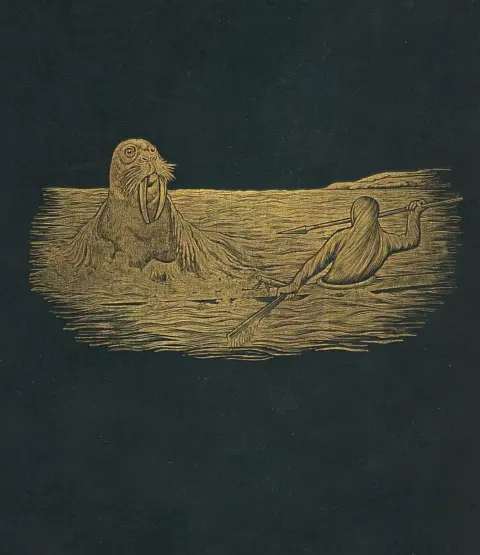
It is calm, the smooth sea heaves in a long swell towards the rocky islets that fringe the shore, a light haze still lies over the sounds between them, and the sea-birds floating on the surface seem double their natural size. The kaiaks cut their way forwards, side by side, making only a silent ripple; the paddles swing in an even rhythm, while the men keep up an unbroken stream of conversation, and now and then burst out into merry laughter. Bird-darts are thrown in sport, now by one, now by another, in order to keep eye and hand in practice. Presently an auk comes within range of one of them; the dart speeds through the air, and the bird, transfixed, attempts, with much flapping of wings, to dive, but is held up next moment upon the point of the dart. The point is pulled out, the hunter seizes the bird's beak between his teeth, and with a strong twitch breaks its neck, then fastens it to the back part of the kaiak.
They soon leave the sounds and islets behind them and put straight out
to the open sea.
After some hours' paddling, they have at last reached the hunting-ground. Great seal-heads are seen peering over the water in many directions, and the hunters scatter in search of their prey.
Boas, one of the best hunters of the village, has seen a large he-seal far off, and has paddled towards it; but it has dived, and he lies and waits for its reappearance. There! a little way before him its round black head pops up. He bends well forward, while with noiseless and wary strokes he urges the kaiak toward the seal, which lies peaceful and undisturbed, stretching its neck and rocking up and down upon the swell. But suddenly it is on the alert; it has caught a glimpse of the flashing paddle-blade, and now looks straight at him with its great round eyes. He instantly stops paddling and sits motionless, while the way on the kaiak carries it noiselessly forward. The seal discovers nothing new to be alarmed at, and resumes its former quietude. It throws its head backwards, holds its snout straight up in the air, and bathes in the morning sun which gleams upon its black, wet skin. In the meantime the kaiak is rapidly nearing; every time the seal looks in that direction, Boas sits still and moves no muscle; but as soon as it turns its head away again, he shoots forward like a flash of lightning. He is coming within range; he gets his harpoon clear, sees that the line is properly coiled upon the stand; one stroke more and it is time to throw--when the seal quietly disappears under the water. It was not frightened, and will consequently come up again at no great distance. He lies still and waits. But the minutes drag on; a seal can remain under water an incredible time, and it seems even longer to one who is waiting for his prey. But the Eskimo is gifted with admirable patience; he lies absolutely motionless except for his head, with which he keeps watch on every side. At last the seal's head once more appears over the water a little way off and to one side. He cautiously turns the kaiak, unobserved by his prey, and once more he shoots towards it over the mirror-like sea. But suddenly it catches sight of him again, looks at him sharply for a moment, and dives. He knows its habits, however, and at full speed he dashes towards the spot where it disappeared. Before many moments have passed it pops up its head again to look around. Now he is within range: the harpoon is seized and carried back over his shoulder, then with a strong movement, as if hurled from a steel spring, it rushes whistling from the throwing-stick, whirling the line behind it. The seal gives a violent plunge, but at the moment it arches its back to dive, the harpoon sinks into its side, and buries itself up to the shaft. A few convulsive strokes of its tail churn the water into foam, and away it goes, dragging the harpoon-line behind it towards the depths. In the meantime Boas has seized the throwing-stick between his teeth, and, quicker than thought, has thrown the bladder out of the kaiak behind him. It dances away over the surface of the sea, now and then seeming on the point of disappearing, as indeed it finally does. Before long, however, it again comes in sight, and he chases after it as quickly as his paddle can take him, snapping up on the way his harpoon-shaft which has floated to the surface. The lance is laid ready for use. Next moment the seal comes up; infuriated at its inability to escape, it turns upon its pursuer, attacks first the bladder, which it tears to pieces, and then goes straight for the kaiak. Again Boas is within range; the animal arches its back and hurls itself forward with gaping maw, so that the water foams around it. A miss may now cost him his life; but he calmly raises his lance and sends it speeding with terrible force through the seal's mouth and out at the back of its neck. A shudder runs through it, and its head sinks; but the next moment it raises itself perpendicularly in the water, the blood pours frothing from its mouth, it gapes wildly and utters a smothered roar, while the hood over its nose is inflated to an astounding size. It shakes its head so that the lance-shaft quivers and waves to and fro; but it does not succeed in breaking it or getting free from it. A moment more and Boas's second lance has pierced through one of its fore-flappers into its lungs; the seal collapses, and the fight is over. He paddles up to its side, and as it still moves a little, he gives it a finishing stab with his long-handled knife. Then he sets quietly about pulling out his lances and replacing them in the kaiak, takes out his towing-line and blows up his towing-bladder, which he fastens to the seal, cuts the harpoon-head out and once more makes it fast to the shaft, coils the line on the stand, and takes out a new bladder and places it behind him. Next, the seal's flappers are lashed close to its body, with the thong designed for that purpose, and the animal is attached by means of the towing-line to one side of the kaiak, so that it can easily be towed along, its head being fastened to the foremost pair of thongs on the deck, and its tail to the hindmost. Now Boas is ready to look about him for more game. He is lucky, and has not paddled far before he catches sight of another seal. In an instant he has cast loose the one already killed, which is kept afloat by the towing-bladder, while he again sets off in pursuit. This one, too, he kills, after some wary stalking and eager waiting; he takes it in tow and returns for his first prey. The two great animals are fastened one on each side of the kaiak. He has now a good cargo, and cannot get very quickly through the water; but that does not prevent him from increasing his bag. As soon as another seal comes in sight those already secured are cast loose, and when the next one is killed it is fastened behind the others. In this way one man will sometimes come towing as many as four seals, or even more at a pinch.