Farthest North, Vol. II Being the Record of a Voyage of Exploration of the Ship ‘Fram’ 1893-1896
Fridtjof Nansen

THE CLASSIC COLLECTION · 1893
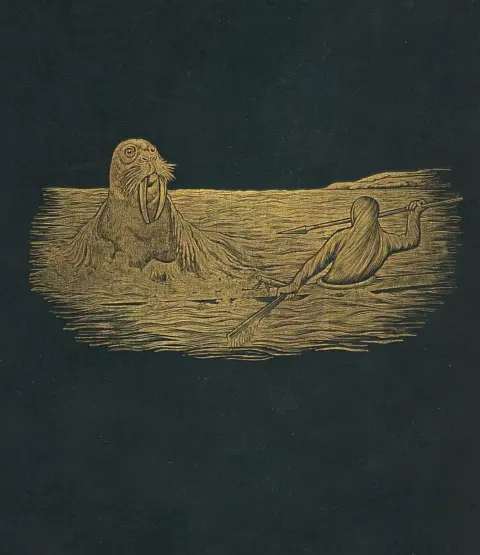
"Eskimo Life" by Fridtjof Nansen is an ethnographic account written in the late 19th century. The work delves into the lives, customs, and environment of the Greenlandic Eskimos, highlighting their relationship with nature and their survival strategies in a harsh Arctic landscape. Nansen, having spent a winter among the Eskimos, aims to document his observations while expressing compassion for their declining culture due to European influence. At the start of the narrative, Nansen sets the scene by describing the stark beauty of Greenland and the unique lifestyle of the Eskimos who inhabit it. He reflects on their intimate connection to the sea and their resources, underscoring contrasts between their past and present. The opening introduces key themes such as the resilience of the Eskimo people in the face of environmental challenges and the impact of European colonization. Nansen also shares personal anecdotes from his winter experience, crafting an evocative image of the Eskimo community and their way of life, enriched by their cultural practices and deep appreciation for their surroundings.
Introduction adapted from the source catalogue; source summaries may be automatically generated.
Free to read · English · 95,433 words · No account needed
MAKE TIME FOR A GOOD BOOK
On by default. Untick to stop anonymous reading totals. Each page counts after 10 seconds in view. How this works.
Anonymous counting is on unless you have switched it off.
[71: The way in which name and thing melt into one appears clearly, to mention one instance, in the Swabian custom of 'throwing the names of three shrewish women' into the wine, in order to turn it into good vinegar.]
[72: Compare Nansen: The First Crossing of Greenland, i., p. 328;
abridged edit., p. 160.]
[73: As to the significance of the name and its mention among the different races, compare Kristoffer Nyrop's comprehensive essay, 'The Power of the Name,' in Mindre Afhandlinger udgivne af det philologisk-historiske Samfund, Copenhagen, 1887, pp. 119-209. See also B. Gröndahl in Annaler for nordisk Oldkyndighed, 1863, p. 127, &c.; Moltke Moe, in Letterstedtske Tidsskrift, 1879, p. 286, &c.; S. Grundtvig, Danmarks gamle Folkeviser, ii. p. 339, &c.; H. Spencer, Principles of Sociology, vi. p. 701.]
[74: Compare Rink, Aarböger for nordisk Oldkyndighed og Historie,
1868, iii. p. 202.]
[75: Compare Paul Egede, Efterretninger om Grönland, p. 149.]
[76: Holm, Meddelelser om Grönland, part 10, p. 113.]
[77: Communicated to me by Moltke Moe.]
[78: See on the same subject Paul Egede, Efterretninger om Grönland, p. 117. According to some accounts, witches and 'wicked people' go to the over-world.]
[79: Communicated by Moltke Moe. Compare also J. Flood, Grönland, Kristiania, 1873, p. 10, note. Similar notions are said to be current in Bavaria and in the Marquesas islands. Compare Liebrecht, in the Academy, iii. (1872), p. 321.]
[80: P. Egede, Efterretninger om Grönland, p. 109. See also H. Egede, Det gamle Grönlands nye Perlustration, p. 84. Cranz, Historie von Grönland, p. 301.]
[81: Meddelelser om Grönland, part 10, p. 106, note.]
[82: Tylor, Primitive Culture (1873), i. p. 472.]
[83: This conception of a second death, or the death of the soul, is found among many races: Hindus, Tartars, Greeks, Kelts, Frenchmen, Scandinavians, Germans, &c.]
[84: Tylor, Primitive Culture, ii. p. 44.]
[85: Knortz, Aus dem Wigwam, Leipzig, 1880, p. 133; compare p. 142.]
[86: It is interesting to note that the Alaska Eskimos seem to believe in a being similar to this tornarssuk of the east coast of Greenland, with long tentacles, &c. See Holm: Meddelelser om Grönland, part 10, p. 115, note 1.]
[87: Tartok means properly 'dark.' Among the Eskimos of Southern Alaska, the same word, taituk, means 'mist.' In East Greenland târtek means 'black.' (Compare Rink: Meddelelser om Grönland, part 11, p. 152.)]
[88: Rink: Tales and Traditions of the Eskimo, p. 44. In Scotland a singing in the ears is called 'the dead-bell,' and portends the death of a friend. Hogg: Mountain Bard, 3rd ed. p. 31.]
[89: Tredie Continuation, &c., p. 74.]
Your reading position is saved on this browser. Take it to another device with a library code. Reading pages adapt to text, rather than matching a printed edition.
Fridtjof Nansen
Fridtjof Nansen
BEHIND THE BOOK
This eBook is for the use of anyone anywhere in the United States and most other parts of the world at no cost and with almost no restrictions whatsoever. You may copy it, give it away or re-use it under the terms of the Project Gutenberg License included with this eBook or online at www.gutenberg.org. If you are not located in the United States, you will have to check the laws of the country where you are located before using this eBook. Read the source licence.
The original source file, including credits and licence, is retained by this library. Request an original-format copy at no charge. Please include the book title and Project Gutenberg identifier #46972.
KEEP YOUR CURIOSITY GOING
Wilfrid Scawen Blunt

E. W. (Edgar Watson) Howe
Francis Greenleaf Allinson & Anne C. E. (Anne Crosby Emery) Allinson
Cyrenus Cole

John Martineau

